


A service invoice is the document that turns finished work into money. When it is clear and complete, customers pay quickly and rarely argue. When it is vague, late or missing details, it sits in a pile, gets questioned, or goes unpaid. This guide covers what a service invoice should contain, how to lay it out, and the habits that get it paid faster.
Estimate, work order and invoice: the difference
| Document | When it is used | What it does |
|---|---|---|
| Estimate or quote | Before the work | States the expected price and scope |
| Work order or service report | During the work | Records what was found and done |
| Invoice | After the work | Requests payment for the completed job |
| Receipt | After payment | Confirms the amount paid |
The invoice should match the estimate the customer approved. If the price changed, the invoice should show why. Our guide on how to write a service estimate covers the first document in the chain.
What every service invoice needs
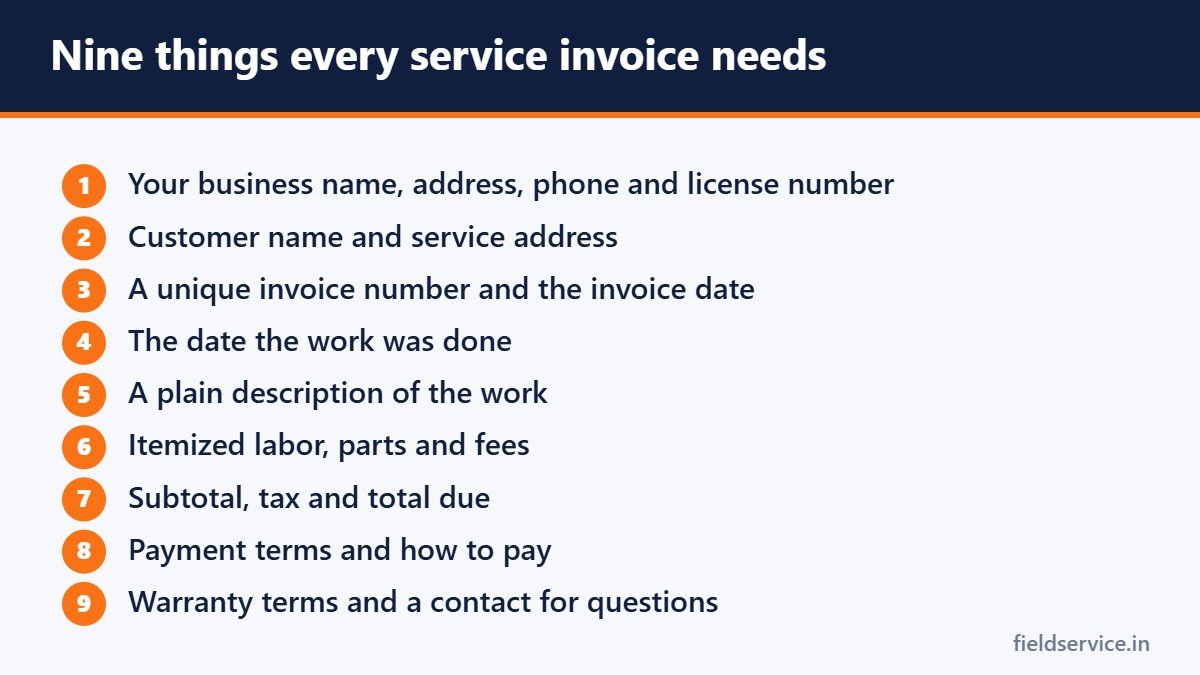
- Your details: business name, address, phone, email and, where your state requires it, your contractor license number.
- Customer details: the name of the person or company paying, and the address where the work was done. These are sometimes different.
- Invoice number: a unique number in sequence. It makes payments easy to match and is expected by your accountant.
- Dates: the invoice date and the date of service.
- Description of work: what the customer reported, what you found and what you did, in plain words.
- Line items: labor, parts, trip or diagnostic fees and any other charges, each on its own line.
- Totals: subtotal, sales tax where it applies, and the total due.
- Terms: the due date, accepted payment methods and any late fee.
- Warranty: what is covered, for how long, and what is excluded.
A worked example
A technician replaces a failed capacitor and contactor on an air conditioner. The company charges a diagnostic fee and bills labor by the hour.
| Item | Quantity | Rate | Amount |
|---|---|---|---|
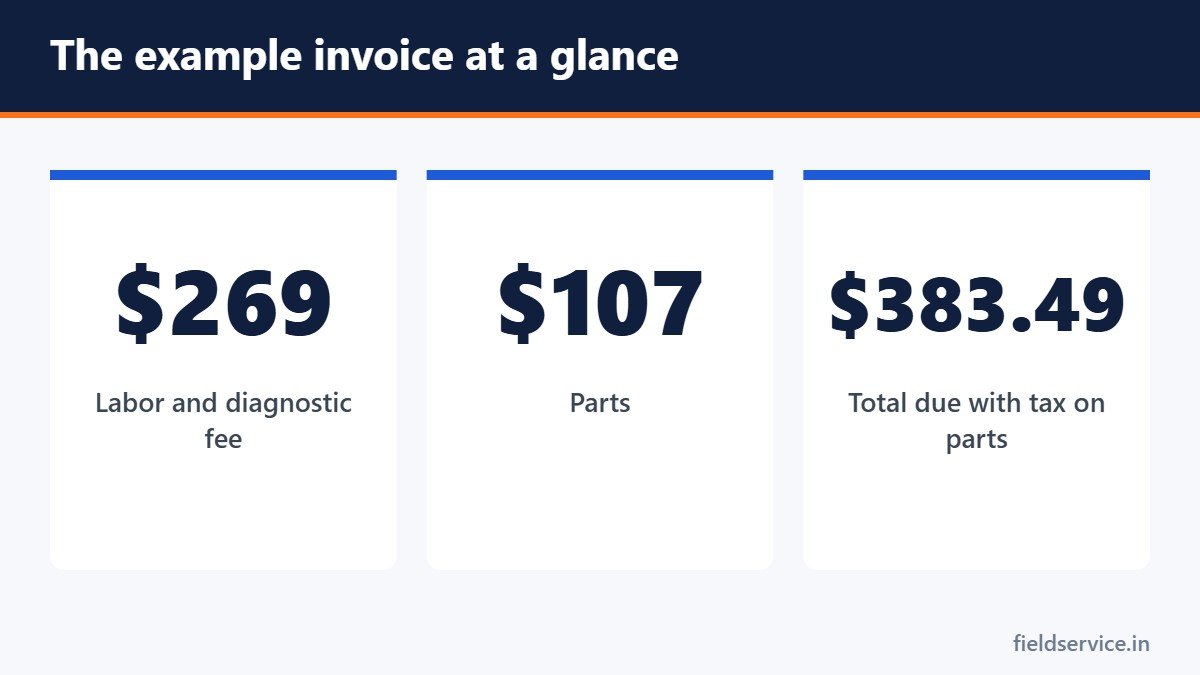
| Diagnostic and trip fee | 1 | $89.00 | $89.00 |
| Labor: replace capacitor and contactor, test system | 1.5 h | $120.00 | $180.00 |
| Dual run capacitor 45/5 MFD | 1 | $45.00 | $45.00 |
| Contactor, 2-pole 30 A | 1 | $62.00 | $62.00 |
| Subtotal | $376.00 | ||
| Sales tax on parts (7% of $107.00) | $7.49 | ||
| Total due | $383.49 |
The tax line is only an example. Sales tax rules for repair labor and parts differ from state to state, and sometimes by city. In some states labor is taxable and in others it is not. Ask your accountant or your state’s tax agency how to charge it.
Flat-rate invoices
If you price by the job, the invoice shows one price per task rather than hours and parts. It should still name each task clearly, for example “Replace dual run capacitor” and “Replace contactor”, so the customer can see what they paid for. See flat rate vs time and materials for how the two methods compare.
Write the description for the customer
“Repaired AC” tells the customer nothing and invites a dispute. A good description follows the same three parts as a service report: complaint, cause and correction.
- Weak: Repaired AC unit.
- Better: Customer reported the outdoor unit humming but not running. Found a failed dual run capacitor and a pitted contactor. Replaced both parts, tested the system through a full cooling cycle and confirmed normal operation.
If you recommended further work that the customer declined, note that too. It protects you if the system fails later. Our guide on how to document a service call explains the format.
Payment terms that reduce late payment
- Residential work: state that payment is due on completion, and collect before you leave. See taking payments in the field.
- Commercial work: agree terms before the job, such as net 15 or net 30, and print the actual due date on the invoice, not only the term.
- Deposits: for larger jobs, show the deposit received and the balance due.
- Late fees: if you charge them, they must be agreed in advance and must comply with your state’s law.
- Ways to pay: list every method you accept. The more ways a customer can pay, the fewer reasons there are to delay.
Send it the same day
The longer an invoice takes to arrive, the longer it takes to be paid, and the more likely details are forgotten. Invoice on site when you can. Field service software and even simple templates make this possible from a phone; see digital service reports.
Common invoice mistakes
- No invoice number, or numbers that repeat.
- A total that does not match the approved estimate, with no explanation.
- Labor and parts lumped into one figure when the customer expected a breakdown.
- No due date.
- Missing license number where the state requires it on invoices or contracts.
- Warranty work invoiced without showing that it was done at no charge. See managing warranty work.
To check that the price on the invoice covers your costs, use the service call minimum price calculator.
Related guides
Sources
Three Excel workbooks that take you from what a technician costs to what to charge, then show whether each job made money.
Not sure yet? Try two forms free or see all packs.
Frequently asked questions
What is the difference between an invoice and a receipt?
An invoice requests payment for work that has been done. A receipt confirms that payment has been received. Many businesses mark a paid invoice as paid and use it as the receipt.
Do I need to number my invoices?
Yes. A unique, sequential invoice number lets you and the customer match payments to jobs and keeps your accounting records in order.
Should a service invoice show labor and parts separately?
For time-and-materials work, yes. Customers expect to see hours, rates and parts. For flat-rate work, list each task and its price instead.
Is sales tax charged on repair labor?
It depends on the state and sometimes the city. Some states tax repair labor, some tax only parts, and some tax neither in certain cases. Check with your state tax agency or accountant.
How long should I keep copies of invoices?
Keep them for as long as your tax and legal advisers recommend. The IRS says to keep records until the period of limitations for the return runs out, which is generally three years and longer in some situations.
This article is general information and is not tax, legal or accounting advice.