

Six months after a repair, a customer calls to say the system has failed again and that it was never right. The only evidence of what happened on the day is whatever the technician wrote down. If the ticket says “fixed unit,” there is nothing to work with. If it lists the fault found, the readings taken and the recommendation the customer declined, the conversation is short.
Documentation is usually the last thing on a technician’s mind at the end of a call. It is also the cheapest protection a service business has.
Why it matters
- It protects you. A record of what you found and what you advised is your defense in a dispute.
- It helps the next technician. That may be you, a year later, with no memory of the job.
- It supports the invoice. Customers question bills less when they can see what was done.
- It backs up warranty claims. Manufacturers and suppliers often ask for model numbers, serial numbers and failure details.
- It reduces callbacks. Recorded readings show the system was working when you left.
Before you start work
- Confirm the customer’s name, address and contact number.
- Write down the complaint in the customer’s own words.
- Record the make, model and serial number of the equipment. A photo of the data plate is quickest.
- Note the condition of the equipment and the area around it. Photograph any existing damage, rust, water stains or earlier repairs.
That last point prevents a great many arguments. If the drain pan was already cracked when you arrived, you want a time-stamped photo that shows it.
During the diagnosis
- What you tested and in what order.
- The readings you took, with units. Depending on the trade that might be voltage, amperage, pressures, temperatures, static pressure or resistance.
- What you found, stated as a fact. “Capacitor measured 28 microfarads, rated 45” is more useful than “bad capacitor.”
- The likely cause of the failure, where you can tell.
The repair
- What you did, step by step.
- Parts used, with part numbers and quantities.
- Any refrigerant recovered or added, with type and amount.
- Readings after the repair, to show the system is operating correctly.
- Photos of the completed work.
Recommendations and anything declined
This is the section technicians skip most often and the one that matters most later. If you recommended additional work and the customer said no, write down what you recommended, why, and that it was declined. If there is a safety issue, record that you explained it and how the customer responded. Ask for a signature where your company’s process allows it.
Before you leave
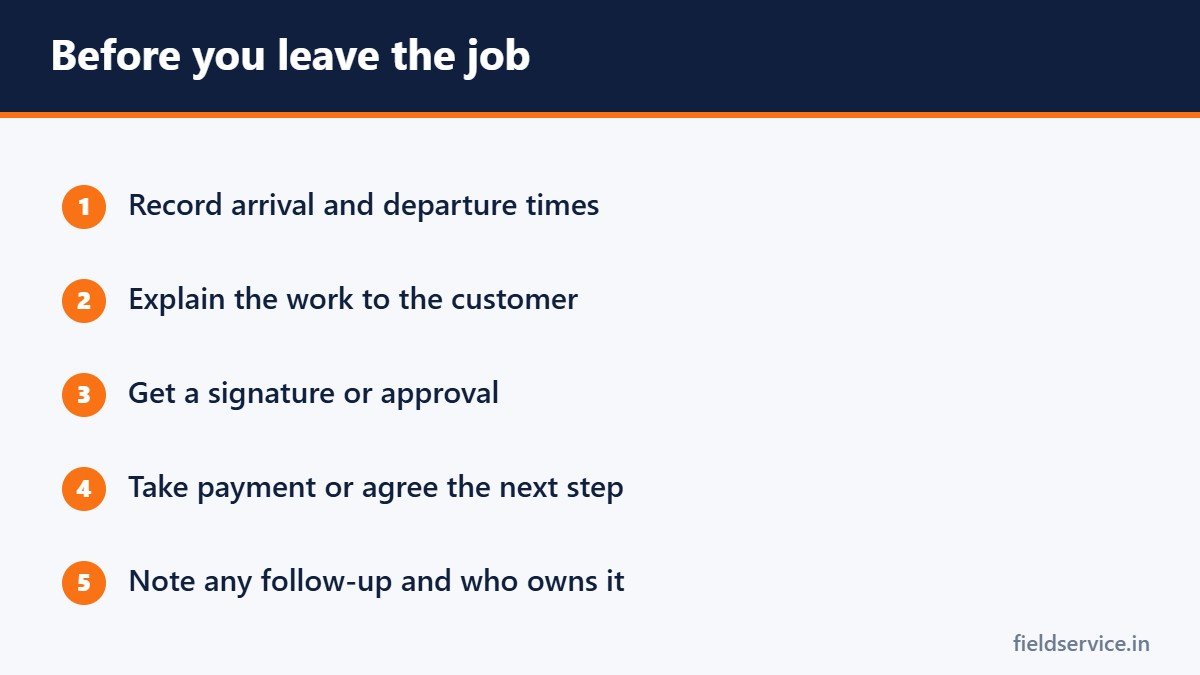
- Time of arrival and departure.
- A short explanation to the customer of what was done.
- The customer’s signature or approval.
- Payment details or the agreed next step.
- Any follow-up needed, with who is responsible for it.
Write notes someone else can use
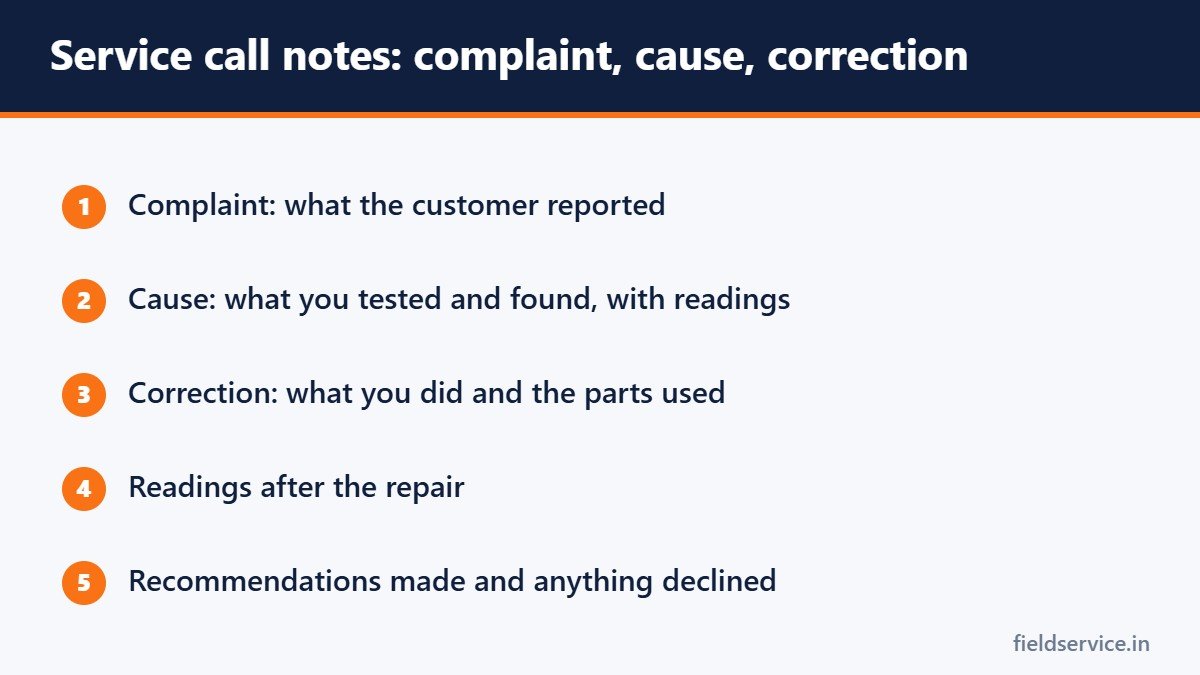
A simple structure helps: complaint, cause, correction.
Weak: “No cool. Replaced part. OK now.”
Better: “Complaint: no cooling, outdoor unit not running. Cause: dual run capacitor failed, compressor side measured 28 µF against 45 µF rated. Contactor contacts pitted. Correction: replaced capacitor and contactor. Compressor amps 11.2, within nameplate rating. Supply air 56°F, return 75°F. Recommended coil cleaning, customer declined.”
The second version takes about a minute longer and answers every question anyone is likely to ask.
Tips that make it easier
- Take photos as you go. It is faster than typing and harder to dispute.
- Use voice-to-text on your phone for the narrative, then read it back once.
- Write the notes before you start the truck. Notes written two jobs later are thinner and less accurate.
- Stick to facts. Leave out opinions about the customer or the last company that worked on the system. Records can be read by the customer, an insurer or a court.
- Use the same order every time so that nothing gets missed.
For owners and managers
Technicians document well when the form makes it easy and when someone reads what they write. Keep the required fields short, review a few tickets each week, and show the team an example where good notes settled a complaint. Good records are also what make numbers such as first-time fix rate and callback rate trustworthy.
A service call is not finished when the equipment runs. It is finished when someone who was not there can read the ticket and understand exactly what happened.
Related guides
- Furnace Tune-Up Checklist: What a Technician Should Check
- Going Out on Your Own: A Checklist for Starting a One-Truck Service Business
- What to Keep in a Service Vehicle: A Practical Stocking Guide
Six everyday forms in Word and PDF, plus Excel workbooks that total mileage reimbursement and overtime pay.
Not sure yet? Try two forms free or see all packs.