


Many service businesses set their call-out fee by looking at what the competitor down the road charges and going a few dollars under. The trouble is that the competitor probably did the same thing. A price copied from someone else tells you nothing about whether your own truck makes money when it leaves the yard.
The better starting point is your cost. Every service call costs you something before a single part is replaced. Once you know that figure, you know the lowest price you can charge without paying to do the work.
The four costs in every call
1. Loaded labor
A technician paid $30 an hour does not cost you $30 an hour. Add payroll taxes, workers’ compensation, health insurance, paid time off and any retirement match. The result is the loaded labor cost, and it is commonly a good deal higher than the wage. Work out yours from last year’s payroll records.
2. Travel time
The drive to the customer is paid time. If the average call involves 45 minutes of driving, that is three quarters of an hour of loaded labor with nothing billed against it. The travel time cost calculator puts a dollar figure on it.
3. The vehicle
Fuel is the cost people remember. Insurance, maintenance, tires, registration and the truck payment or depreciation are the ones they forget. Add up a year of vehicle costs and divide by the number of calls that truck ran.
4. Overhead
Rent, office staff, software, phones, marketing, liability insurance, uniforms and tools all have to be paid by the calls you run. Take your monthly overhead and divide it by your monthly call count to get overhead per call.
Putting it together
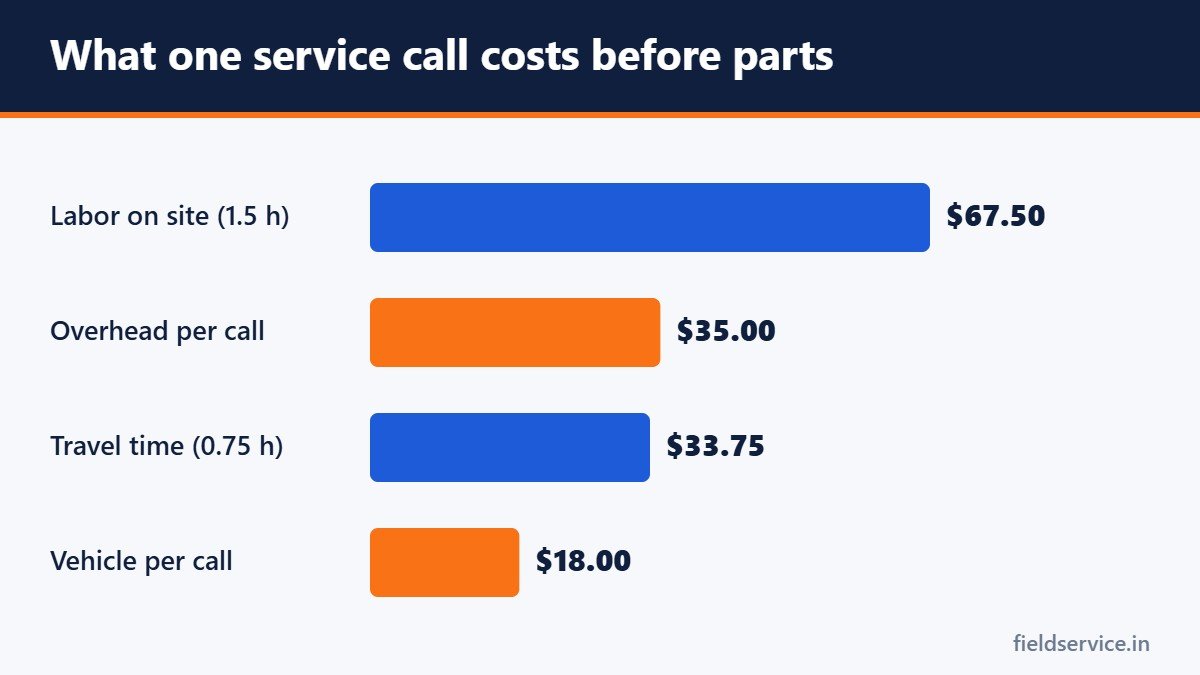
Here is an example with round numbers:
- Loaded labor cost: $45 an hour
- Time on site: 1.5 hours
- Travel time: 0.75 hours
- Vehicle cost per call: $18
- Overhead per call: $35
Cost of the call = $45 × (1.5 + 0.75) + $18 + $35 = $154.25
That is the break-even point. Charge less and the call loses money, no matter how smoothly it went.
Adding profit the right way
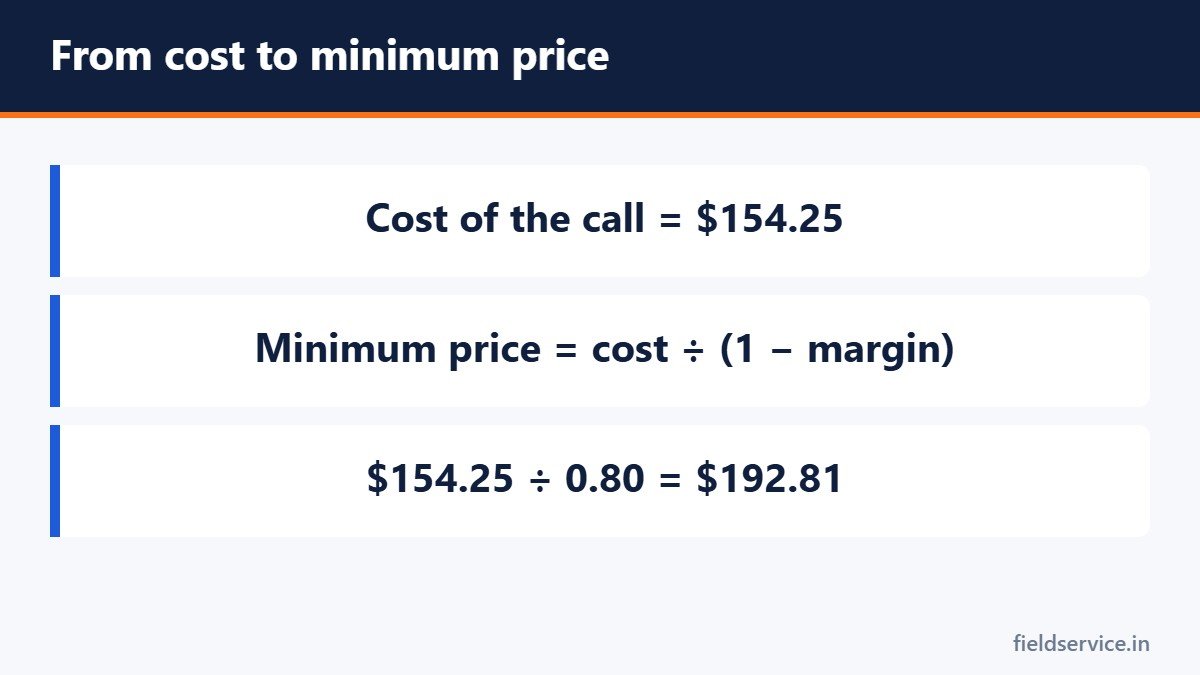
Suppose you want a 20 percent profit margin. The common mistake is to add 20 percent to the cost, which gives $185.10 and a margin of only 16.7 percent. To get a true 20 percent margin, divide by one minus the margin:
Minimum price = $154.25 ÷ (1 − 0.20) = $192.81
The profit is $38.56, which is 20 percent of the price. Our article on markup vs. margin explains why the two methods give different answers. You can enter your own figures in the service call minimum price calculator.
From a minimum price to a pricing structure
The minimum tells you what an average call must bring in. How you present that to the customer is a separate decision. Three approaches are common:
- Diagnostic or trip fee plus repair. A fixed fee covers getting to the door and finding the problem. The repair is quoted on top. This protects you on calls where the customer declines the work.
- Flat-rate pricing. Each repair has a set price that already includes labor, travel and overhead. The customer sees one number before work starts.
- Time and materials. An hourly rate plus parts. It is simple, but the hourly rate has to be high enough to carry the unbilled hours.
Whichever you choose, check it against the minimum. If your diagnostic fee is $89 and half your calls end there, those calls are losing about $65 each on the example above, and the repair calls have to make up the difference.
Recheck the numbers when costs move
Fuel, insurance and wages change every year. A minimum price worked out two years ago is out of date. Put a reminder in the calendar to rework the figure at least once a year, and again whenever you give raises or add a truck.
Common mistakes
- Using the hourly wage as the labor cost and leaving out taxes and benefits.
- Ignoring drive time because it is not on the invoice.
- Dividing overhead by the calls you hope to run, when the honest figure is the calls you ran.
- Adding a percentage to cost and calling it margin.
- Matching a competitor’s price without knowing their costs or yours.
Pricing from cost is not the whole of pricing. What the customer is willing to pay and what the market charges both matter. But cost sets the floor, and a business that does not know where its floor is cannot tell a good job from a bad one.
Related guides
- What Is a Trip Charge and How Should You Set One?
- On-Call Pay for Technicians: How It Works and What to Ask
- Hourly Pay vs. Billable Rate: Why a $30 Technician Bills at Over $100 an Hour
Three Excel workbooks that take you from what a technician costs to what to charge, then show whether each job made money.
Not sure yet? Try two forms free or see all packs.