


A full schedule does not mean a profitable business. Plenty of service companies are busy all year and have little to show for it, because some of the work they do loses money and nobody knows which jobs those are. Working out the profit on individual jobs is how you find out. It takes about ten minutes per job once you have the inputs.
Two levels of profit
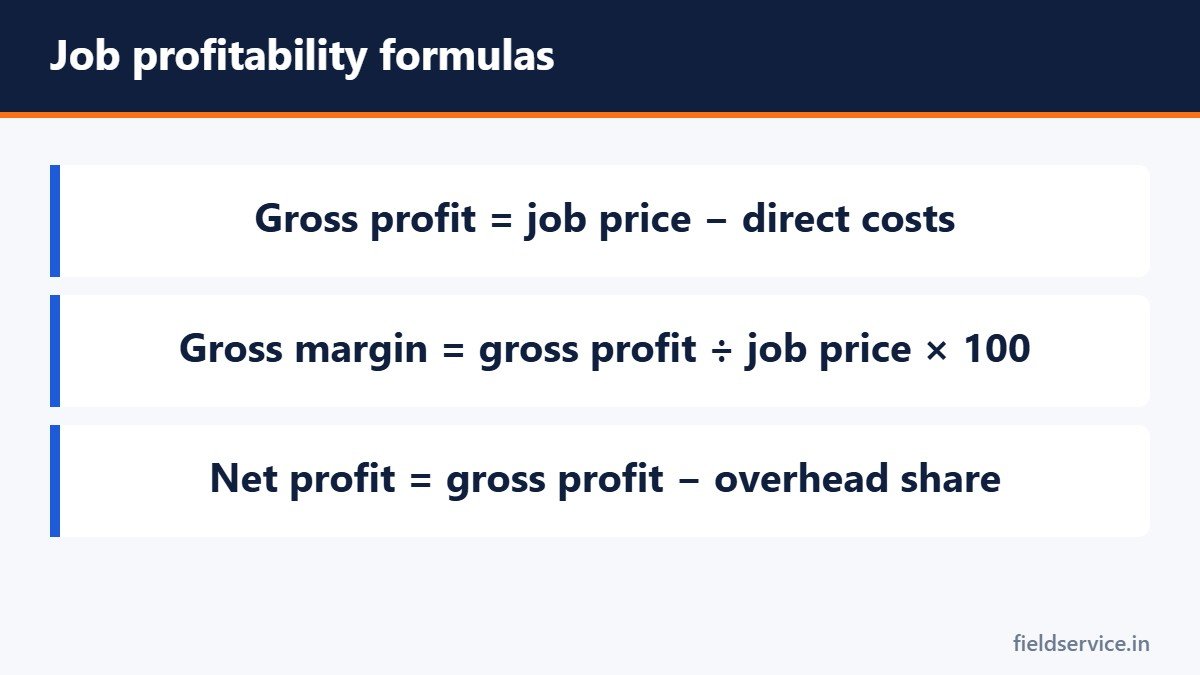
- Gross profit is the job price minus the costs that exist only because of that job.
- Net profit is what remains after the job has also paid its share of overhead.
A job can show a healthy gross profit and still lose money once overhead is counted.
Step 1: add up direct costs
- Labor. All hours on the job, including drive time, at loaded cost. See loaded labor cost.
- Materials and parts at what you paid for them.
- Other direct costs, such as permits, subcontractors, equipment rental and disposal fees.
Step 2: gross profit and margin
Subtract direct costs from the price. Divide the result by the price to get gross margin. The job gross margin calculator does both.
Step 3: allocate overhead
Overhead is everything the business pays for that is not tied to one job: rent, office wages, insurance, software, marketing and vehicles. A simple way to share it out is per labor hour. Divide your monthly overhead by the billable hours in the month. If that comes to $35 an hour, a six-hour job carries $210 of overhead.
A worked example
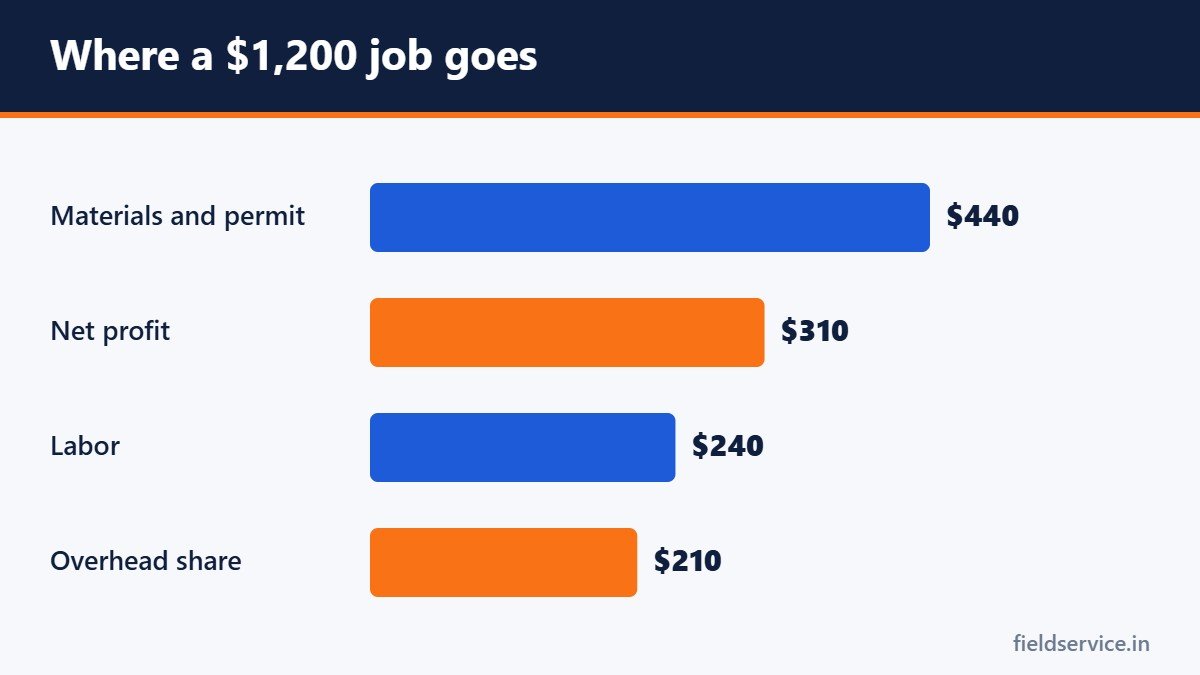
A water heater replacement is sold for $1,200.
| Item | Amount |
|---|---|
| Job price | $1,200 |
| Labor: 6 hours at $40 loaded cost | $240 |
| Materials | $380 |
| Permit | $60 |
| Total direct cost | $680 |
| Gross profit | $520 (43.3%) |
| Overhead: 6 hours at $35 | $210 |
| Net profit | $310 (25.8%) |
What changes the result
Suppose the same job runs two hours over because of a corroded fitting. Labor rises to $320 and overhead to $280. Net profit falls from $310 to $160. Two extra hours removed almost half the profit. That is why accurate time estimates matter as much as accurate material prices.
Costs that go missing
- Drive time and the trip to the supply house
- Time spent on the estimate and the paperwork
- Callbacks and warranty work on the job. See the real cost of a callback.
- Card processing fees
- Small materials such as fittings, sealant and wire
- Discounts given at the door
Use the results
- Compare job types. You may find maintenance visits earn more per hour than installations, or the other way around.
- Compare estimated hours with actual hours. Jobs that always run over need a new estimate or a new price.
- Look at customers and areas. Long drives and difficult sites show up in the numbers.
- Adjust prices where the margin is thin. See how to price a service call.
Keep the record simple
You do not need special software to start. For each job, write down the price, hours, materials and other costs. Review ten jobs a month. Patterns appear quickly, and they are usually not the ones you expected.
When you set prices from these results, work in margin and not markup. Our article on markup vs. margin explains why that matters.
Related guides
- Service Business Overhead: What Counts and How to Calculate It
- Break-Even Point for a Service Business: How to Calculate Yours
- Per Diem for Field Technicians: How It Works
Three Excel workbooks that take you from what a technician costs to what to charge, then show whether each job made money.
Not sure yet? Try two forms free or see all packs.