


A compressor fails eighteen months after installation. The customer expects it to be fixed free of charge, the manufacturer will supply a new compressor, and the contractor is left to provide several hours of skilled labor, refrigerant, a filter drier and two trips. Who pays for that? In many small service businesses the answer is that nobody decided, so the business does, and the cost disappears into the general figures. Warranty work is a normal part of the trade. Managed badly, it is a steady leak.
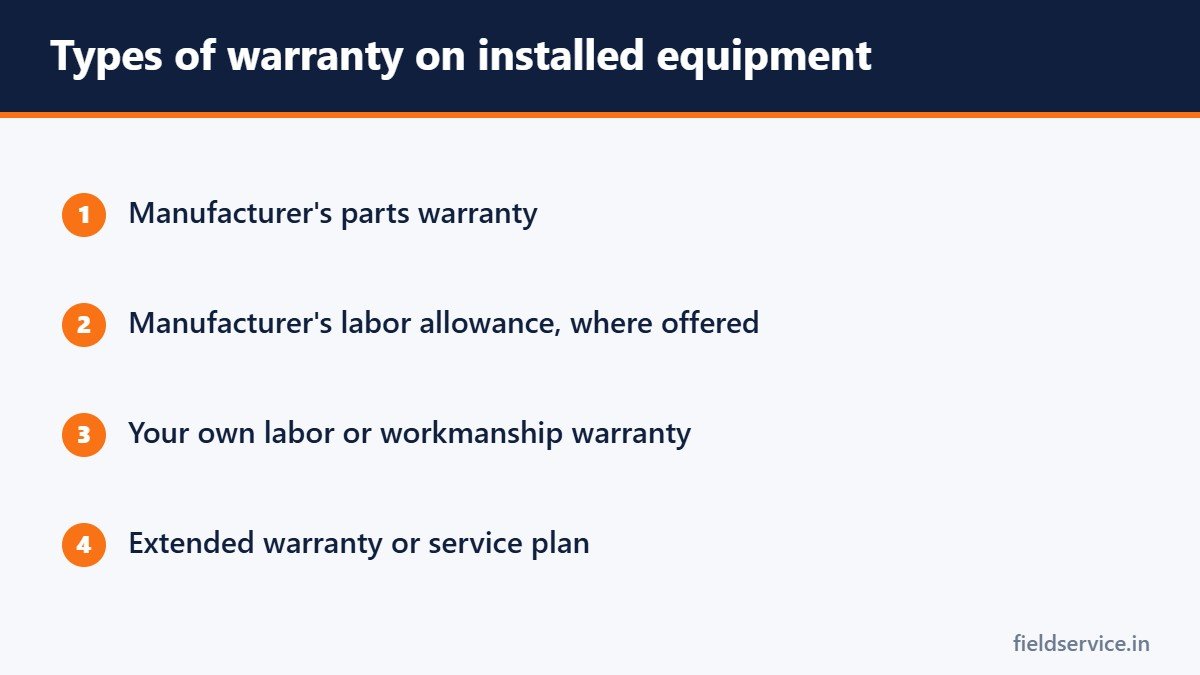
The types of warranty
- Manufacturer’s parts warranty. The manufacturer replaces a failed part within a stated period, often five to ten years on major components for registered residential equipment. It typically covers the part only.
- Manufacturer’s labor allowance. Some manufacturers and programs pay a set amount toward labor for certain repairs. Many do not.
- Contractor’s labor or workmanship warranty. Your own promise to the customer, commonly one year on labor for an installation and a shorter period on repairs.
- Extended warranty or service plan. A separate contract, from the manufacturer or a third party, that covers parts and labor for longer. Claims go to the plan administrator.
Where the cost falls
When a part fails under a parts-only warranty, the manufacturer supplies the part and the contractor carries everything else unless the customer is charged:
- Diagnosis time and travel
- Labor to remove and replace the part
- Refrigerant, driers, brazing materials and other consumables
- The time spent processing the claim and returning the part
- The paying call that could have been run in that slot
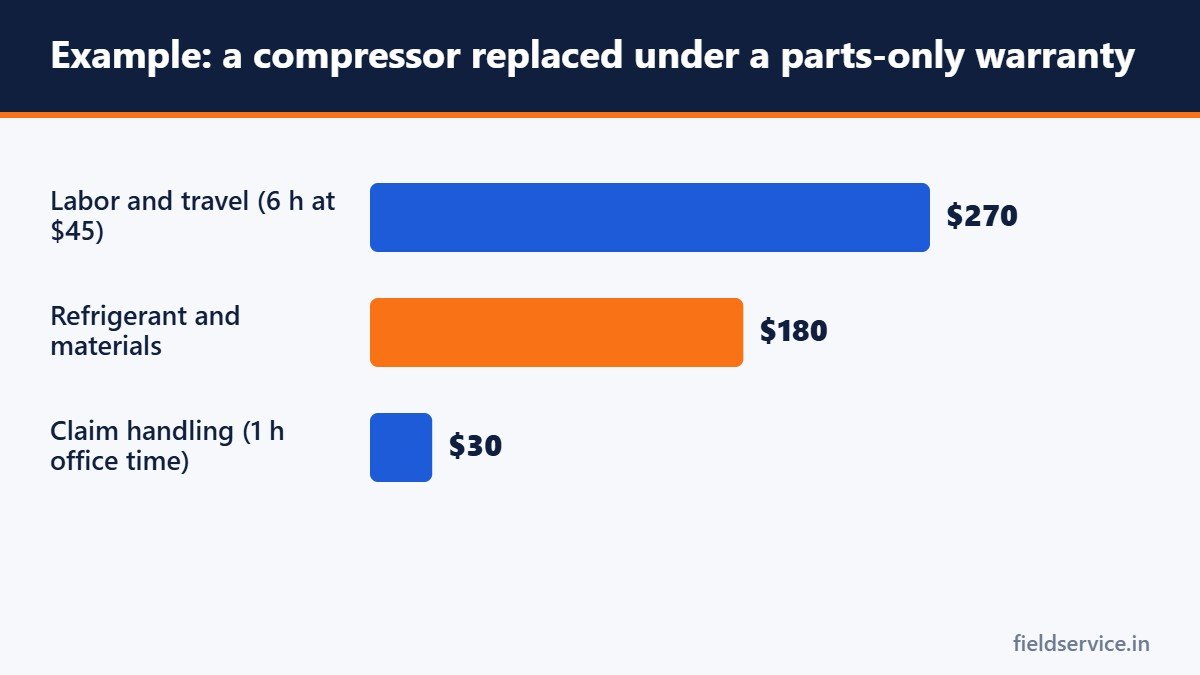
In this example the contractor’s cost is $480, and the manufacturer has supplied a part worth several hundred dollars. If the customer has a labor warranty from you and it is still in force, that $480 is yours. If the labor warranty has expired, the customer pays for labor and materials, and that needs to have been clear to them from the day of installation.
Decide your policy and write it down
- How long is your labor warranty on installations? On repairs?
- What does it cover and what does it exclude, for example damage, lack of maintenance or power problems?
- After it expires, what does the customer pay on a manufacturer’s parts warranty repair?
- Is there a diagnostic fee on warranty calls?
- Does the warranty depend on the customer having maintenance done?
Give the terms to the customer in writing at the time of sale, and put them on the invoice. Most warranty disputes come from customers who assumed “ten-year warranty” meant ten years of free repairs.
Register equipment
Many manufacturers give a longer parts warranty when the equipment is registered within a set time after installation, and a shorter one when it is not. Decide who registers it, you or the customer, and make it a step in closing out every installation. Keep the model and serial numbers and the installation date on file. See using photos and video on service calls.
Processing a claim
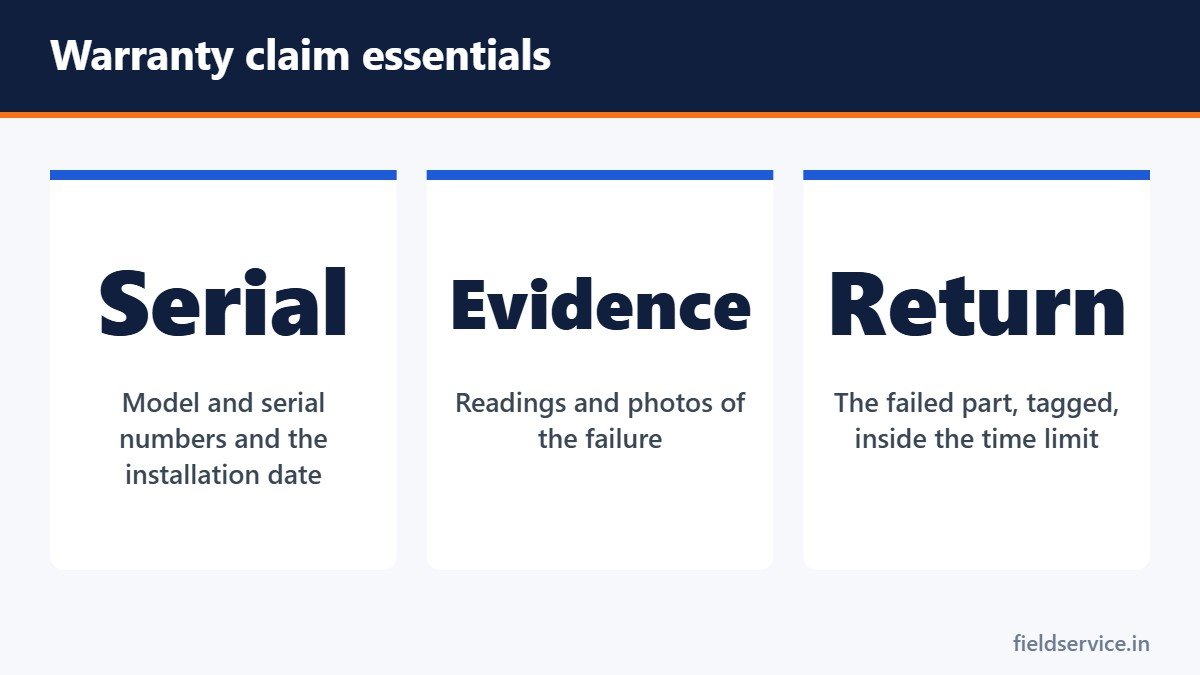
- Confirm the equipment is in warranty, using the serial number and installation date.
- Diagnose and document the failure: readings, photos and the cause where you can identify it.
- Obtain the replacement part through the distributor’s warranty process.
- Complete the claim form fully. Incomplete claims are the main reason for rejection.
- Return the failed part if the manufacturer requires it, within the time allowed, and tagged correctly.
- Follow up until the credit appears on your account.
Unclaimed and rejected warranty credits are a quiet loss. Someone in the office should own the list of open claims and chase it every week.
Track warranty work separately
If warranty jobs are mixed in with everything else, you cannot see what they cost. Give them their own job type and record:
- Labor hours and travel
- Materials used
- Whether the work was under a manufacturer’s warranty, your labor warranty or both
- The equipment brand and model
- The technician who did the original work
- The cause of the failure
Then total it each month. The figure belongs in your overhead and in your installation pricing. See service business overhead.
Warranty work and callbacks are different
A manufacturer’s part that fails is a warranty job. A repair that did not hold because of workmanship or a missed diagnosis is a callback. Both cost you unbilled labor, but the remedy differs. Callbacks call for better procedures and training. See the real cost of a callback. Record them separately so that one does not hide the other.
Use the data
- By brand and model. If one product line produces most of your warranty work, raise it with the distributor and reconsider what you sell.
- By installer. A cluster of failures on one crew’s installations points to installation practice: brazing, evacuation, charging or airflow setup.
- By cause. Compressor failures are often caused by something else, such as poor airflow, incorrect charge or contamination. Replacing the part without finding the cause leads to a second failure.
- By cost. Know the monthly total.
Build it into your prices
Warranty labor is a predictable cost of selling installations. Work out what it has averaged per installation over the past couple of years and include that amount in the installation price, as a warranty reserve. An installation priced with nothing set aside for future warranty labor is underpriced. See how to calculate job profitability.
Prevent warranty failures
- Install to the manufacturer’s instructions: line sizing, evacuation, charge, airflow and electrical supply.
- Record start-up readings on every installation. They are your evidence, and your baseline.
- Sell and schedule maintenance. Many failures trace back to dirty coils and filters. See maintenance agreements.
- Find the cause before replacing a failed major component.
Handling the customer
A customer with failed equipment that is still under warranty is already unhappy. Treat the call as a priority, explain clearly what is covered and what is not before starting, and keep them informed about parts availability. How you handle a warranty repair decides whether that customer buys from you again. See how to handle a customer complaint.
Related guides
- 7 Field Service KPIs Every Small Service Business Should Track
- Truck Inventory Management: Setting Minimums and Maximums That Work
- Seasonal Planning for HVAC and Service Businesses
Three Excel workbooks that take you from what a technician costs to what to charge, then show whether each job made money.
Not sure yet? Try two forms free or see all packs.
Frequently asked questions
Does a manufacturer’s warranty cover labor?
Often not. Many manufacturers’ warranties cover the replacement part only. Labor may be covered by the contractor’s own labor warranty, by a manufacturer’s labor allowance where one exists, or by an extended service plan.
Who pays for labor on a warranty repair?
It depends on the warranties in force. If the contractor’s labor warranty still applies, the contractor does. If it has expired and no extended plan applies, the customer normally pays for labor and materials.
Why do warranty claims get rejected?
Common reasons are incomplete claim forms, missing model and serial numbers, unregistered equipment, failed parts that were not returned in time and failures caused by installation or maintenance issues.
How should a contractor account for warranty labor?
Track warranty jobs as a separate job type, total the cost each month and include an average warranty cost per installation in your installation pricing.
This article is general information. Warranty terms vary by manufacturer and product, so check the specific warranty documents.