


A price said aloud in a driveway is forgotten, misremembered or disputed. A written estimate is the same price with a record attached. It tells the customer exactly what they are buying, protects the business when memories differ, and looks professional next to a competitor’s figure scribbled on the back of a card. Writing a good one takes ten minutes and prevents most of the arguments a service business has about money.
Estimate, quote and bid
The words are used loosely, and that causes trouble.
- An estimate is your best judgment of the likely cost. It can change if the work turns out to be different from what was expected.
- A quote is a fixed price for a defined scope of work. If the scope does not change, the price does not change.
- A bid is a quote submitted in competition, usually for larger or commercial work.
Customers often treat any number as a firm price. Say plainly which one you are giving. If it is an estimate, state what could make it change. Some states have consumer protection rules about written estimates and about how far a final bill may exceed one, so check the rules where you work.
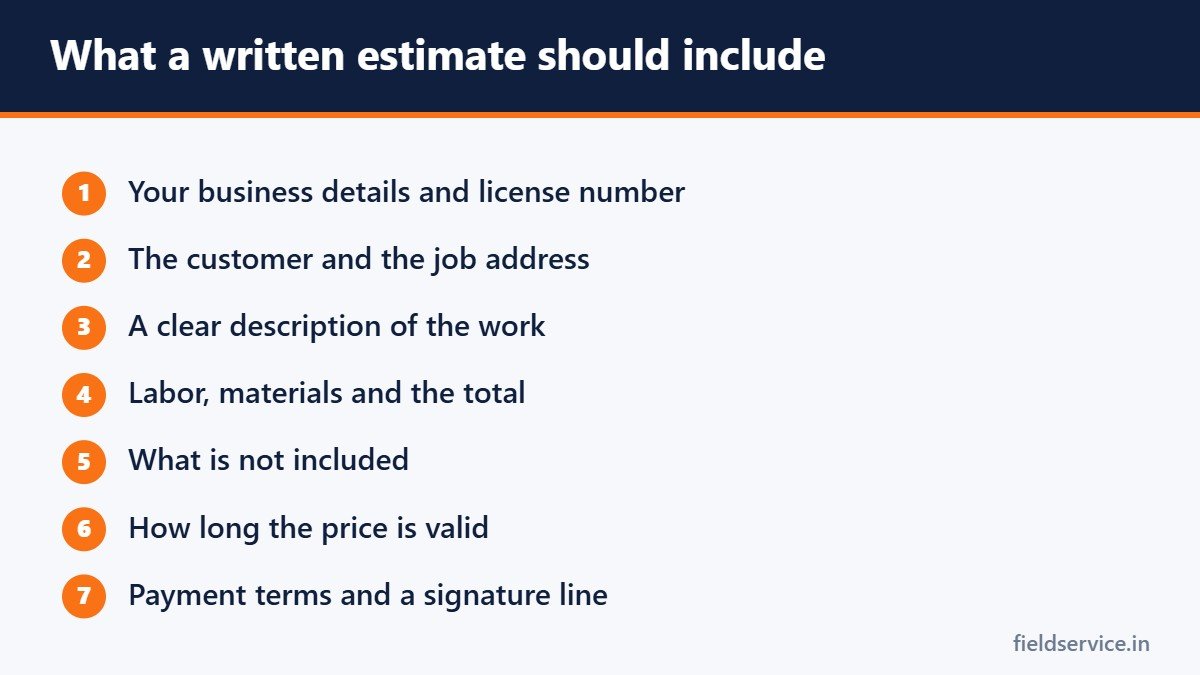
What to include
- Your business name, address, phone and license number.
- The customer’s name and the job address.
- The date and an estimate number.
- A description of the work, specific enough that someone else could tell what is and is not covered.
- Labor and materials, itemized or as a single price, according to your pricing model.
- Permits, disposal and other charges.
- Tax, where it applies.
- The total.
- Exclusions: what is not included.
- How long the price is valid.
- Payment terms: deposit, when the balance is due and how you accept payment.
- Warranty on parts and labor.
- A signature and date line for the customer’s approval.
Our service estimate worksheet on the templates page has these fields laid out.
Write the scope so it cannot be misread
| Vague | Specific |
|---|---|
| Fix AC | Replace failed dual run capacitor and pitted contactor on outdoor unit. Test operation and record readings. |
| Replace water heater | Remove and dispose of existing 50-gallon gas water heater. Supply and install new 50-gallon gas water heater with new supply lines, gas flex connector and relief valve discharge pipe. Permit included. |
| Repair leak | Cut out and replace approximately 3 feet of corroded half-inch copper supply line under kitchen sink. Wall and cabinet repair not included. |
The exclusions matter as much as the inclusions. Drywall repair, painting, electrical upgrades, bringing other items up to code and hidden damage are the usual sources of dispute.
Get the numbers right
An estimate is only as good as the cost behind it.
- Base labor on the time similar jobs have actually taken, including travel and setup.
- Use your loaded labor cost and overhead, not the technician’s wage. See loaded labor cost and service business overhead.
- Price materials at current cost. Supplier prices move.
- Add profit using margin, not markup. See markup vs. margin.
- Check the result with the job gross margin calculator.
Offer options
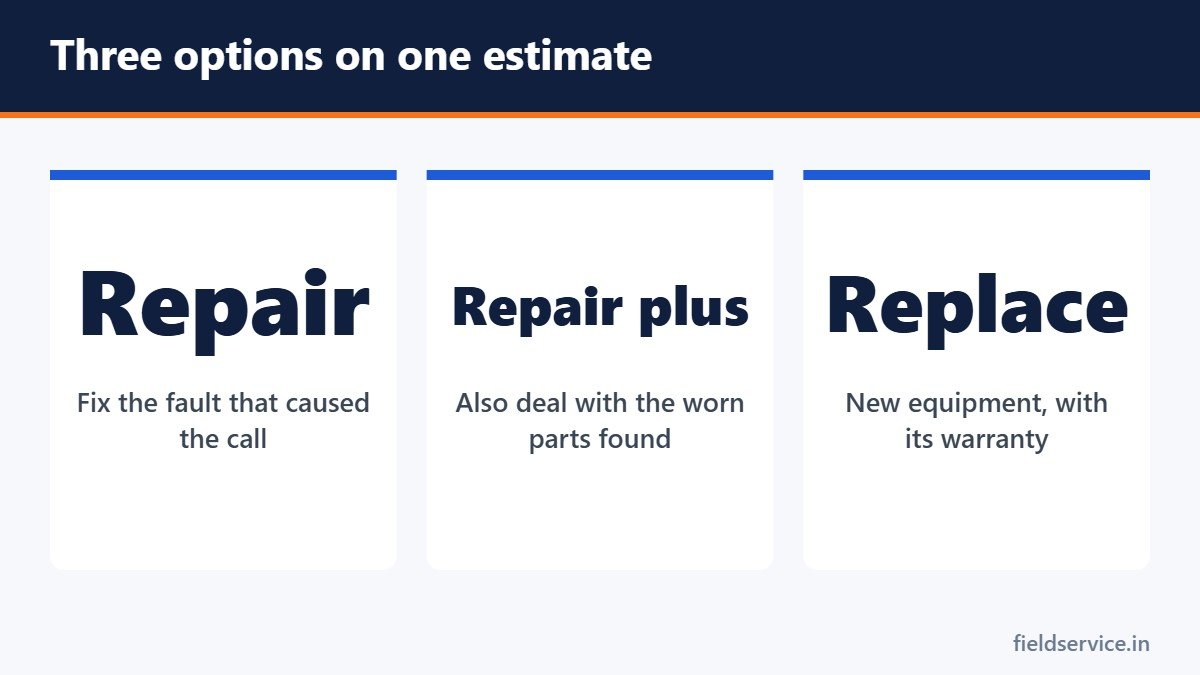
Two or three choices help the customer decide and raise the chance of a yes. For example: repair the failed part only; repair it and replace a second worn part found during diagnosis; replace the unit. Give each a price and a one-line explanation of what it does and does not solve. See close rate.
Present it
- Explain what you found before you show the price. See how to explain a repair to a customer.
- Walk through the estimate line by line.
- State the total clearly.
- Say what is not included.
- Give the customer a copy, on paper or by email or text.
- Get a signature, or a recorded approval, before any work begins.
When the scope changes
Hidden conditions turn up: rotten subfloor under a toilet, a corroded fitting that breaks when touched, wiring that does not meet code. When that happens:
- Stop work.
- Show the customer the problem. Take a photo.
- Explain what it means and what it will cost.
- Write a change order: a short document describing the added work and the added price.
- Get it signed before continuing.
Never do extra work and present the bill afterward. It is the single most common cause of payment disputes. It helps to put a sentence in every estimate saying that hidden conditions are not included and will be priced separately if found.
Deposits and payment terms
For jobs with significant materials or special-order equipment, a deposit protects you if the customer cancels. Some states limit the size of deposits for home improvement work, so check the rules. State when the balance is due, usually on completion. See taking payments in the field.
How long is the price good for?
Put a validity period on every estimate, commonly 30 days. Material and equipment prices change, and an open-ended estimate can be accepted a year later at a price that no longer covers your costs.
Follow up
Many estimates are lost because nobody followed up. Keep a list of open estimates and contact each customer a few days later to ask whether they have questions. Record why estimates were lost when you can find out. Patterns in the reasons tell you whether the issue is price, timing or presentation.
Common mistakes
- Giving a price verbally with nothing in writing
- A vague scope
- No exclusions
- No expiry date
- Starting work without a signature
- Doing additional work without a change order
- Pricing from memory instead of current costs
- Leaving out permits, disposal or travel
For technicians
On service calls, the estimate is often written by the technician at the kitchen table. The same rules apply on a small scale: describe the repair specifically, give the total, note what is not included and get approval before starting. It protects you as much as the company. See how to document a service call.
Related guides
- How to Raise Prices in a Service Business Without Losing Customers
- How to Write a Field Technician Resume
- How to Set Your Labor Rate as a One-Truck Service Business
Three Excel workbooks that take you from what a technician costs to what to charge, then show whether each job made money.
Not sure yet? Try two forms free or see all packs.
Frequently asked questions
What is the difference between an estimate and a quote?
An estimate is your best judgment of the likely cost and can change if the work differs from what was expected. A quote is a fixed price for a defined scope of work.
What should a service estimate include?
Your business details and license number, the customer and job address, a specific description of the work, labor and materials, the total, exclusions, how long the price is valid, payment terms, warranty and a signature line.
How long should an estimate be valid?
Thirty days is common. Stating a validity period protects you if material or equipment prices rise.
What should I do if I find extra work after starting?
Stop, show the customer, explain the additional work and its price, and get a written change order signed before continuing.
This article is general information and is not legal advice. Consumer protection rules on estimates and deposits vary by state.