


Field technicians spend a large part of the week behind the wheel, so the question of travel time pay comes up constantly. Is the drive from home to the first job paid? What about the drive between jobs, or a trip to another city? Under the federal Fair Labor Standards Act (FLSA), the answer depends on when the travel happens and what it is for. This guide explains the federal rules for hourly, non-exempt employees. Your state may require more.
The basic rule: commuting is not paid, travel during the workday is
Federal law separates ordinary commuting from travel that is part of the job. The U.S. Department of Labor’s position is straightforward:
- Home to work: ordinary travel from home to your first work site and from your last site back home is commuting. It is generally not counted as hours worked.
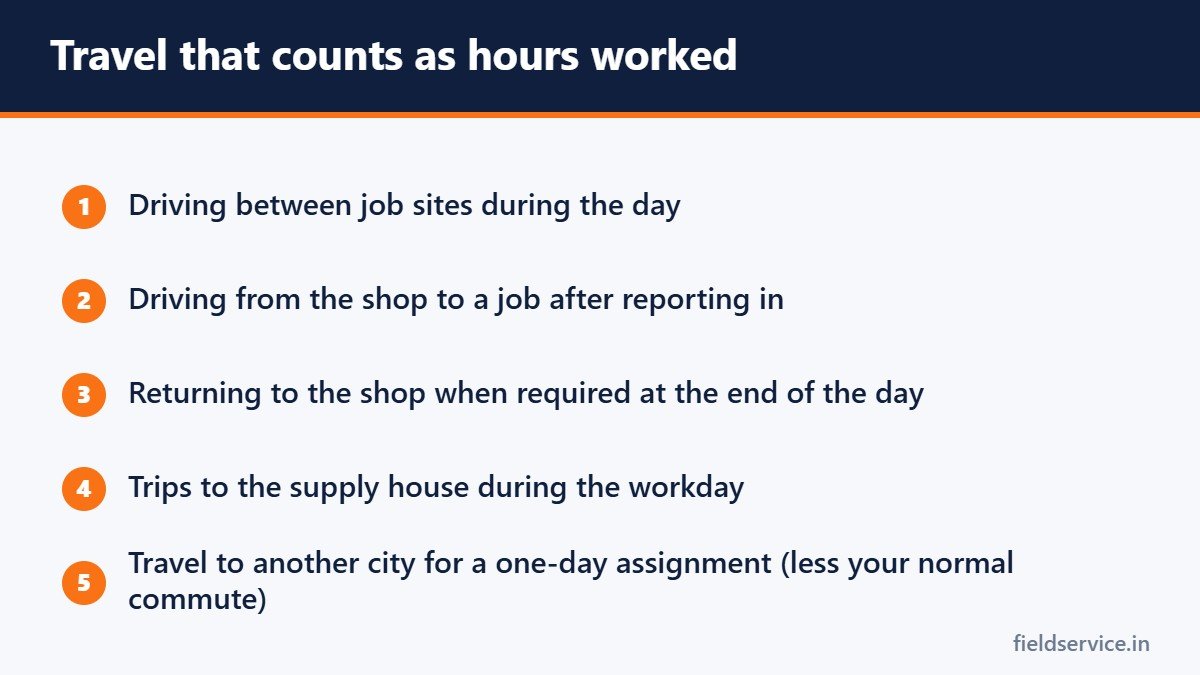
- Travel during the workday: time spent driving from one job site to another, or from the shop to a job after you have reported in, is hours worked and must be paid.
Driving a company vehicle from home
Many technicians take the truck home and drive straight to the first call. Under federal law, using an employer’s vehicle for the commute does not by itself make the commute paid time, provided the travel is within the normal commuting area for the business and the arrangement is agreed between employer and employee.
The commute can become work time if you do real work before or during it. Examples include being required to stop at the shop first to load parts or get assignments, or being required to take calls and schedule jobs while you drive. Once the workday has started, travel after that point is paid.
Travel between jobs and overtime
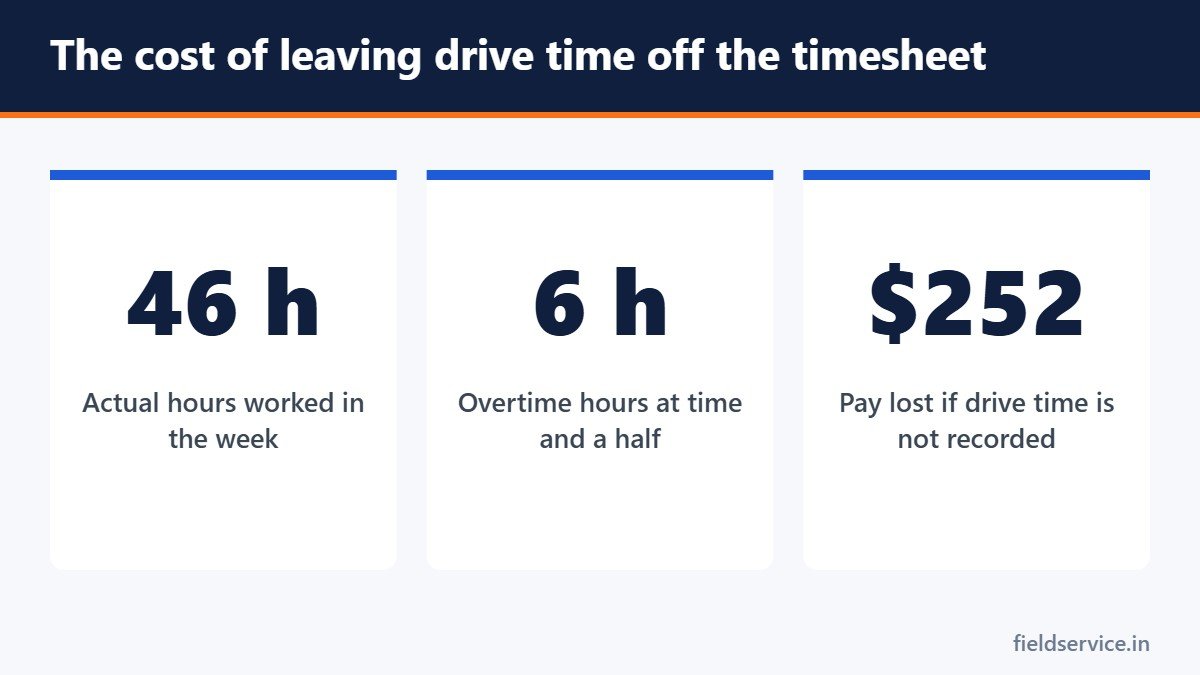
Because drive time between jobs is hours worked, it counts toward the 40-hour threshold for overtime. Leaving it off a timesheet is one of the most common ways technicians end up underpaid. Here is a typical week at $28 an hour:
| Item | Hours | Pay |
|---|---|---|
| On-site and shop time | 40 | $1,120.00 |
| Drive time between jobs | 6 | Overtime: 6 × $42.00 = $252.00 |
| Total for the week | 46 | $1,372.00 |
You can test your own numbers with the overtime pay calculator. For the rules on rates and exemptions, see overtime pay for field technicians.
Out-of-town travel
One-day trips to another city
If you normally work in one area and are sent to another city for a single day, the travel there and back is work time. The employer may deduct the time you would normally spend commuting to your regular work site.
Overnight travel
For trips that keep you away from home overnight, travel time counts as hours worked when it cuts across your normal working hours, and this applies on non-working days too. If you normally work 8 a.m. to 5 p.m. Monday to Friday, travel between those hours on a Sunday counts. Under Department of Labor enforcement policy, time spent as a passenger on a plane, train, bus or car outside your regular hours is not counted. If you are required to drive, the driving time is work time. Meal expenses on these trips are a separate matter; see per diem for field technicians.
On-call travel
If you are on call at home and are called out to a customer, the travel to that call is generally treated as work time, because the trip is made at the employer’s request outside the normal routine. Whether the waiting time itself is paid depends on how restricted you are. We cover that in on-call pay for technicians.
Can travel time be paid at a lower rate?
Federal law does not require the same hourly rate for every kind of work. An employer may set a lower rate for drive time, as long as it is agreed in advance, the rate is at least the minimum wage, and overtime is calculated correctly using the weighted average of the rates for the week. Some states restrict this, so check your state’s rules.
Paid time and mileage are different things
Travel time pay is wages for your hours. Mileage reimbursement covers the cost of using your own vehicle. Federal law does not require a set mileage rate, but an employer cannot let unreimbursed vehicle costs push your pay below the minimum wage. See the IRS mileage rate for 2026 and the mileage reimbursement calculator.
What to record
- The time you start work each day, including any required stop at the shop.
- Arrival and departure times at each job.
- Supply house runs and other trips made during the day.
- The time you finish your last job, and the time you reach the shop if you must return.
Keep your own copy. If your pay does not match your records, raise it with your employer first. Our guide on how to read your pay stub shows where hours and overtime appear.
Related guides
Sources
- U.S. Department of Labor: Fact Sheet #22, Hours Worked Under the FLSA
- Code of Federal Regulations: 29 CFR Part 785, Hours Worked
Six everyday forms in Word and PDF, plus Excel workbooks that total mileage reimbursement and overtime pay.
Not sure yet? Try two forms free or see all packs.
Frequently asked questions
Is driving from home to my first job paid?
Under federal law, ordinary travel from home to the first job site is commuting and is generally not paid, even in a company vehicle. It can become paid time if you are required to do work first, such as stopping at the shop to load parts.
Is drive time between jobs paid?
Yes. Travel from one job site to another during the workday is hours worked under the FLSA and must be paid.
Does travel time count toward overtime?
Yes. Any travel that counts as hours worked is included in the weekly total, and hours over 40 in a workweek must be paid at overtime rates for non-exempt employees.
Can my employer pay less for drive time?
Federal law allows different rates for different work if agreed in advance, the rate is at least the minimum wage and overtime is calculated on the weighted average. Some states have stricter rules.
Do state laws change these rules?
They can. Some states count more travel as paid time or limit lower travel rates. Where state and federal rules differ, the rule that is more favorable to the employee applies.
This article is general information about federal law and is not legal advice. State laws differ. For a specific situation, contact the U.S. Department of Labor’s Wage and Hour Division or your state labor agency.