


Most technicians look at one number on a pay stub: the amount that reached the bank. Everything above that line explains how the number was reached, and it is where mistakes hide. Missed overtime, unpaid drive time and a deduction that should have stopped months ago all show up on the stub if you know where to look. Reading it properly takes about five minutes per pay period.
Gross pay: what you earned
Gross pay is your total earnings before anything is taken out. On an hourly technician’s stub it is normally broken into lines:
- Regular hours at your hourly rate
- Overtime hours at one and a half times your regular rate, or more
- Other earnings such as bonuses, spiffs, commission, on-call pay and paid time off
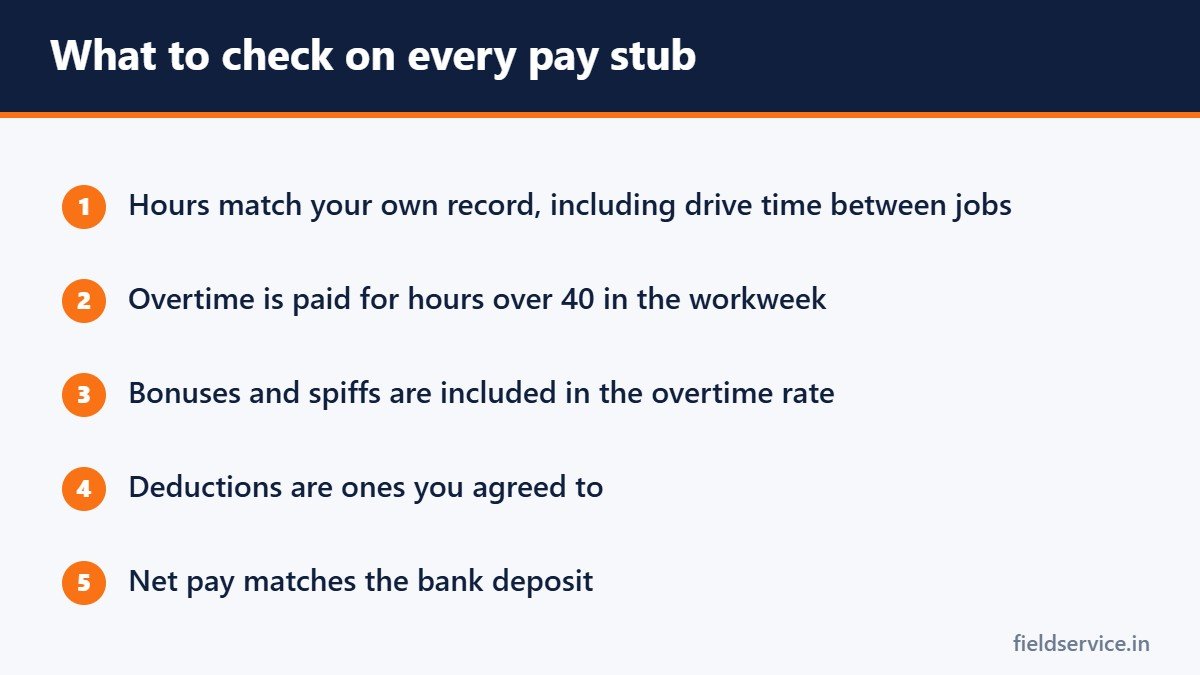
Check the hours first. Compare them with your own record of start and stop times, including the driving between jobs, which counts as work time. Our guide on how overtime pay works explains which hours count.
Pre-tax deductions
Some deductions come out before income tax is calculated, which lowers your taxable pay. Common ones are your share of health, dental and vision insurance premiums, contributions to a traditional 401(k), and money you put into a health savings account or flexible spending account.
Taxes
- Federal income tax. The amount withheld depends on the Form W-4 you gave your employer. It is an estimate of what you will owe for the year.
- Social Security. 6.2 percent of your wages, up to an annual wage limit.
- Medicare. 1.45 percent of your wages. An additional 0.9 percent applies to wages above $200,000 in a year.
- State and local income tax, where they apply. Some states have none.
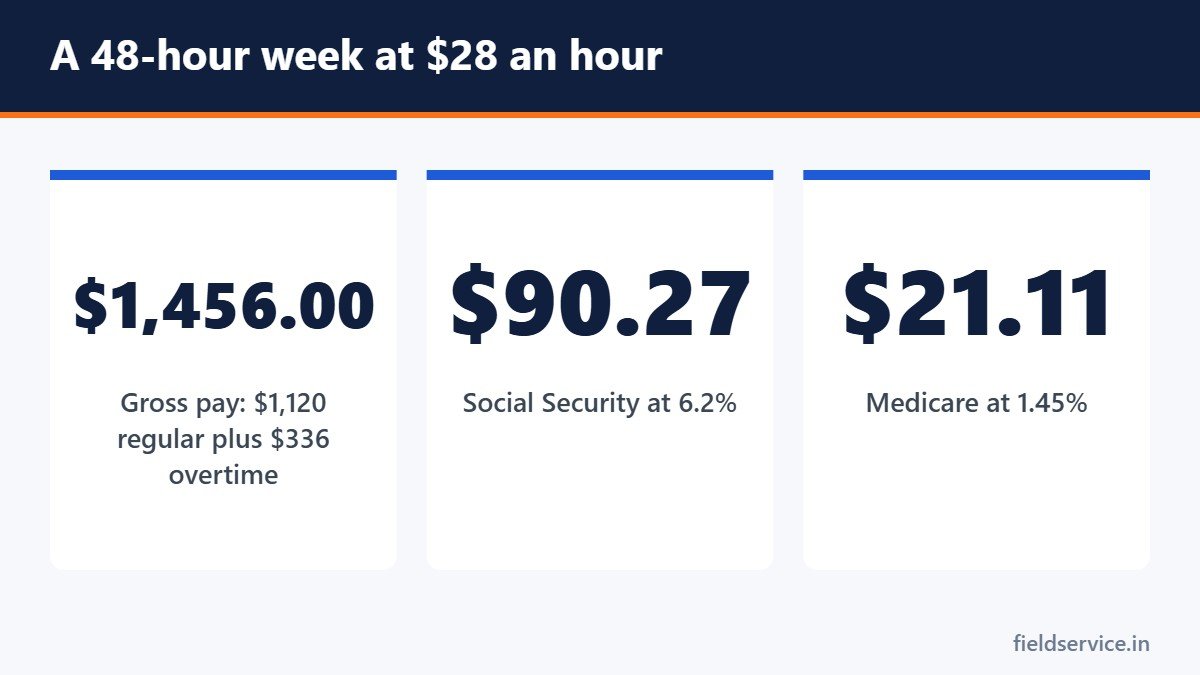
Social Security and Medicare together are often shown as FICA. On gross pay of $1,456 they come to $90.27 and $21.11, or $111.38 in total. Your employer pays a matching amount that does not appear in your deductions.
After-tax deductions
These come out after taxes have been calculated. Examples are Roth 401(k) contributions, union dues, wage garnishments, and charges for uniforms or tools. Federal law limits deductions for items that mainly benefit the employer: they cannot reduce your pay below the minimum wage or cut into required overtime pay. State rules are often stricter.
Net pay
Net pay is what is left: gross pay minus pre-tax deductions, taxes and after-tax deductions. It should match the deposit in your bank account.
Year-to-date totals
Most stubs show a year-to-date column next to the current figures. It is useful for checking that a deduction has stopped when it should have, for estimating your annual income, and for comparing with your Form W-2 in January.
Other items you may see
- Paid time off earned, used and remaining
- Employer-paid benefits, shown for information
- Reimbursements such as mileage or per diem, which are usually listed separately because they are not wages
Errors that are worth looking for
- Missing hours. A job that ran late or a Saturday call that never reached payroll.
- Drive time left out. Travel between job sites during the day is work time.
- Overtime calculated on the base wage only. If you earned a bonus or spiff that week, your overtime rate should usually be higher.
- Averaging across two weeks. Overtime is calculated for each workweek separately, even when you are paid every two weeks.
- A wrong rate after a raise.
- Deductions that did not stop, such as a tool purchase you finished paying off.
You can check the gross figure with the overtime pay calculator and see what your rate comes to over a year with the hourly to annual pay calculator.
If something looks wrong
- Gather your own record of hours for the pay period.
- Raise it with your supervisor or payroll as soon as you notice. Most errors are honest mistakes and are fixed on the next check.
- Ask for the correction in writing.
- If it is not resolved, your state labor agency and the U.S. Department of Labor’s Wage and Hour Division handle wage complaints.
Keep your pay stubs, or download them if they are electronic. You may need them for a loan application, a tax question or a dispute.
Six everyday forms in Word and PDF, plus Excel workbooks that total mileage reimbursement and overtime pay.
Not sure yet? Try two forms free or see all packs.
Frequently asked questions
What is the difference between gross pay and net pay?
Gross pay is everything you earned in the pay period before deductions. Net pay is what remains after taxes and other deductions, and it is the amount deposited in your account.
Why is my overtime rate higher in some weeks?
Overtime is based on your regular rate, which includes most bonuses, commissions and spiffs earned in that week. A week with a bonus usually has a higher overtime rate than a week without one.
Is mileage reimbursement taxed?
Reimbursement paid under an accountable plan at or below the IRS standard mileage rate is generally not taxable income, which is why it is usually shown separately from wages.
How long should I keep my pay stubs?
Keep them at least until you have checked them against your Form W-2 for the year. Many people keep a full year or more in case of a tax question, a loan application or a pay dispute.
This article is general information and is not tax or legal advice.
Related guides
- Hourly Pay vs. Billable Rate: Why a $30 Technician Bills at Over $100 an Hour
- On-Call Pay for Technicians: How It Works and What to Ask
- Commission vs. Hourly Pay for Service Technicians