


Being on call means your evening or weekend belongs partly to your employer. You may not be working, but you cannot travel far, you cannot have a drink, and your phone decides whether you sleep. How that time is paid varies more from company to company than almost any other part of a technician’s pay. Some arrangements are generous. Some pay nothing until the phone rings. Knowing the rules and the common practices helps you judge an offer and check a paycheck.
What federal law says about waiting time
Under the Fair Labor Standards Act, the question is whether you are free to use the time for yourself.
- If you must stay on the employer’s premises, or so close that you cannot use the time effectively for your own purposes, you are working while on call, and the time is paid.
- If you can be at home or elsewhere, doing what you like, and need only be reachable and able to respond, the waiting time is generally not hours worked.
The more restricted you are, the more likely the time counts. Factors that matter include how quickly you must respond, how often you are called out, whether you can swap shifts, and how far you may go. A requirement to be at a customer’s site within a few minutes of a call restricts you far more than a requirement to phone back within half an hour.
Time on an actual call always counts
Once you are called out, you are working. Phone calls with customers or dispatch, the drive to the job, the work and the paperwork are all hours worked, and they count toward overtime for the week.
Common ways companies pay for on-call
- A flat stipend. A fixed amount for each day or week on call, whether or not you are called out.
- A minimum call-out. A guaranteed number of paid hours for each call, often two or more, even when the job takes less.
- A premium rate. A higher hourly rate, or a share of an after-hours fee, for work done on call.
- A combination of the above.
- Nothing for waiting, with ordinary pay for time worked. This is lawful where the waiting time is not hours worked, but it makes on-call duty unpopular.
None of these is required by federal law. They are a matter of company policy or an employment agreement. Some states have their own rules, such as reporting-time pay, so check with your state labor agency.
On-call pay and your overtime rate
A stipend for being on call is part of your pay for the week, and it is included when your regular rate is calculated for overtime.
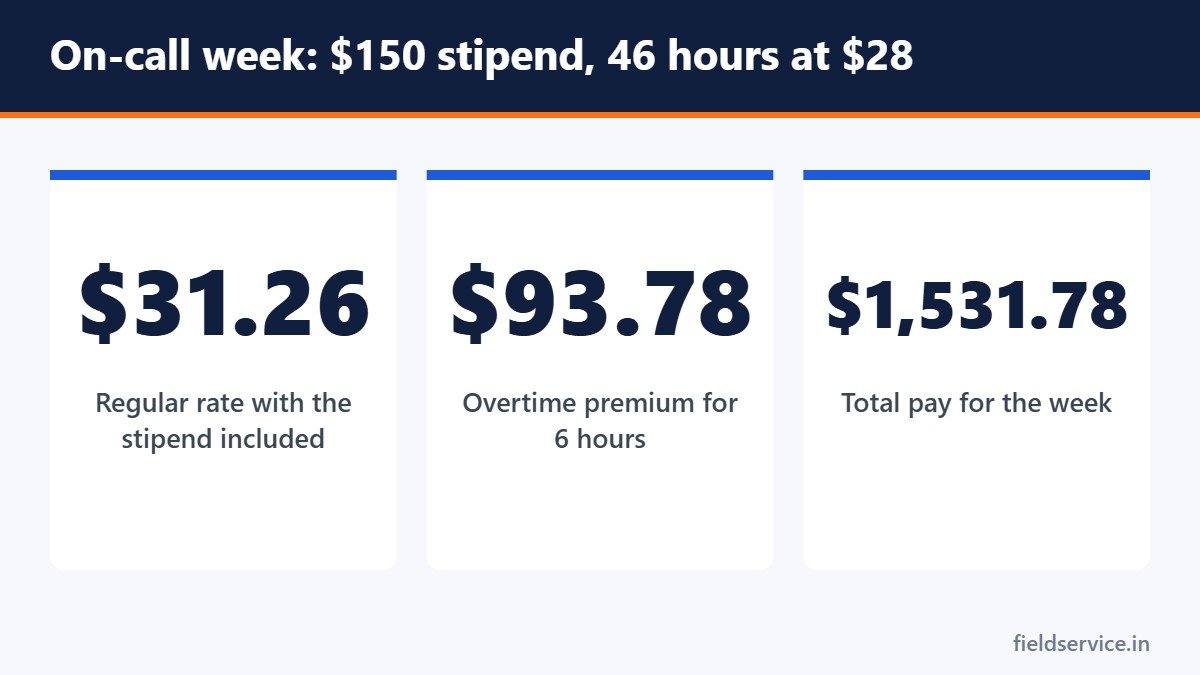
Take a technician paid $28 an hour who receives a $150 weekly on-call stipend and works 46 hours in total, including call-outs:
- Straight-time earnings: 46 × $28 + $150 = $1,438
- Regular rate: $1,438 ÷ 46 = $31.26
- Overtime premium: half the regular rate, $15.63, for 6 hours = $93.78
- Total: $1,438 + $93.78 = $1,531.78
If overtime had been calculated on the $28 wage alone, the total would have been $1,522. See how overtime pay works and the overtime pay calculator.
Questions to ask an employer
- Is there a payment for carrying the on-call phone? How much, and for what period?
- Is there a minimum number of paid hours per call-out?
- What rate applies to after-hours work?
- When does paid time start: when I take the call, or when I arrive?
- How quickly must I respond, and how far from the service area can I be?
- How often does the rotation come round, and how are holidays shared?
- How many calls does the on-call technician typically take in a week?
- If I am out most of the night, what happens the next morning?
Keep your own record
On-call work is where hours most often go missing. For every call, write down the time the phone rang, when you left, when you arrived, when you finished and when you got home. Record phone calls that did not lead to a visit too. Check your record against your pay stub. Our guide on how to read your pay stub shows where to look.
For owners
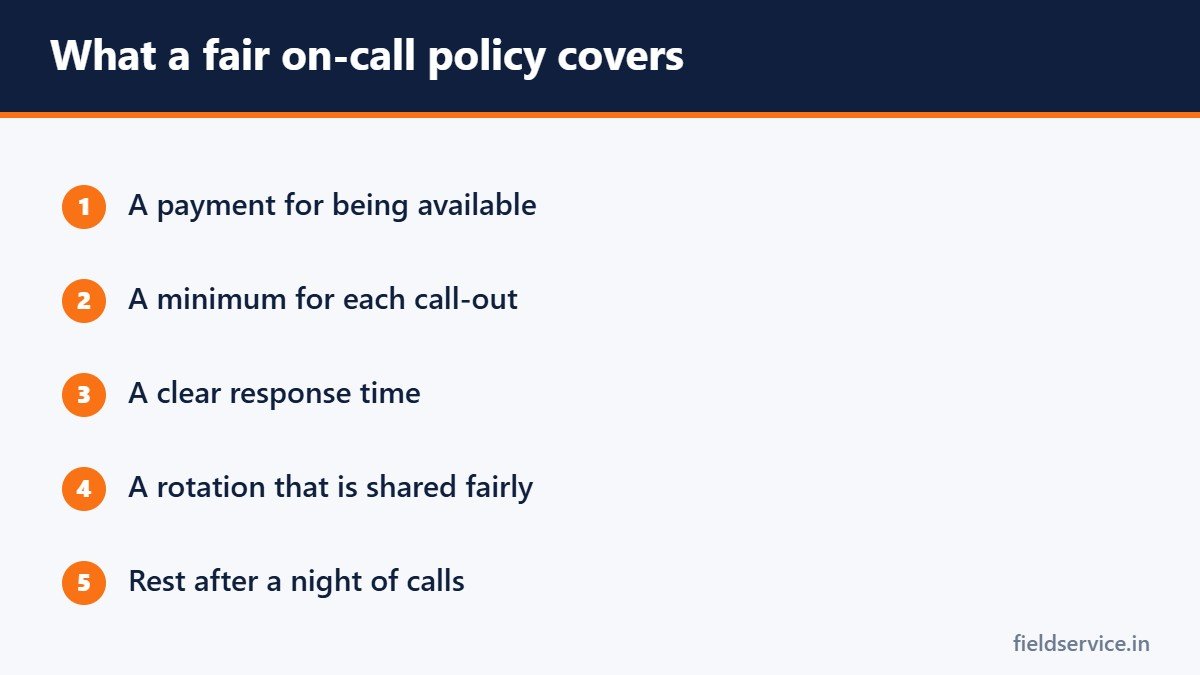
- Pay for availability. A stipend recognizes that on-call duty costs the technician something even on a quiet night.
- Set a call-out minimum. Nobody wants to get dressed and drive across town for twenty minutes of pay.
- Rotate fairly and publish the schedule early.
- Define an emergency. Without a clear policy, the on-call technician ends up running routine calls at night.
- Protect rest. A technician who worked until 3 a.m. should not be driving a truck at 7.
- Price after-hours work to cover it. The after-hours fee should pay for the stipend and the premium rate.
- Include on-call pay in the overtime calculation.
For the practical side of night calls, see how to prepare for emergency and after-hours service calls.
Is on-call worth it?
For some technicians it is the best-paid work of the week. For others, the disruption is not worth the money. Add up what a typical on-call week really pays, including the stipend and the call-outs, and compare that with what it costs you in sleep and plans. That is the figure to weigh, not the rate on paper.
Six everyday forms in Word and PDF, plus Excel workbooks that total mileage reimbursement and overtime pay.
Not sure yet? Try two forms free or see all packs.
Frequently asked questions
Do employers have to pay for on-call time?
Under federal law, on-call time is hours worked if you must remain on the employer’s premises or are so restricted that you cannot use the time for your own purposes. If you are free to use the time and need only be reachable, the waiting time is generally not paid. Time spent on an actual call is always paid.
Is an on-call stipend included in overtime?
Yes. Pay for being on call is included in the regular rate that overtime is calculated from.
Is there a required minimum pay for a call-out?
Federal law does not require one. Many employers set a minimum number of paid hours per call-out as a matter of policy, and some states have reporting-time pay rules.
When does paid time start on a call-out?
Under federal law, work time includes the time you spend responding, such as phone calls and travel to the job. Ask your employer how its policy defines it.
This article is general information and is not legal advice. State rules may differ.
Related guides
- How to Price a Service Call: Finding Your Minimum Charge
- Per Diem for Field Technicians: How It Works
- W-2 Employee or 1099 Contractor: What Technicians Should Know