

Some service companies hire technicians as employees. Others bring them on as independent contractors, often described as “1099” after the tax form involved. The hourly figure offered to a contractor is usually higher, and that makes it look like the better deal. Whether it is depends on costs and protections that do not show in the rate. The classification is also a legal matter, not just a choice the company gets to make.
The basic difference
- A W-2 employee works for the company. The company withholds taxes, pays its share of payroll taxes and follows wage and hour laws. At the end of the year the employee receives a Form W-2.
- A 1099 independent contractor is in business for themselves. They invoice the company, pay their own taxes and receive a Form 1099-NEC.
| Item | W-2 employee | 1099 contractor |
|---|---|---|
| Income tax withholding | Withheld by employer | You pay estimated tax quarterly |
| Social Security and Medicare | 7.65% withheld, employer pays the same again | You pay 15.3% self-employment tax |
| Overtime and minimum wage | Protected by law | Not covered |
| Unemployment insurance | Covered | Not covered |
| Workers’ compensation | Covered by employer | You arrange your own cover |
| Tools, vehicle, fuel | Often supplied or reimbursed | Your cost, deductible as business expenses |
| Benefits | May include health cover, PTO, retirement | None |
What a contractor pays that an employee does not
- Self-employment tax. An employee pays 7.65 percent for Social Security and Medicare and the employer pays the same again. A contractor pays both halves, 15.3 percent of net earnings, through self-employment tax, and can deduct half of it when working out income tax.
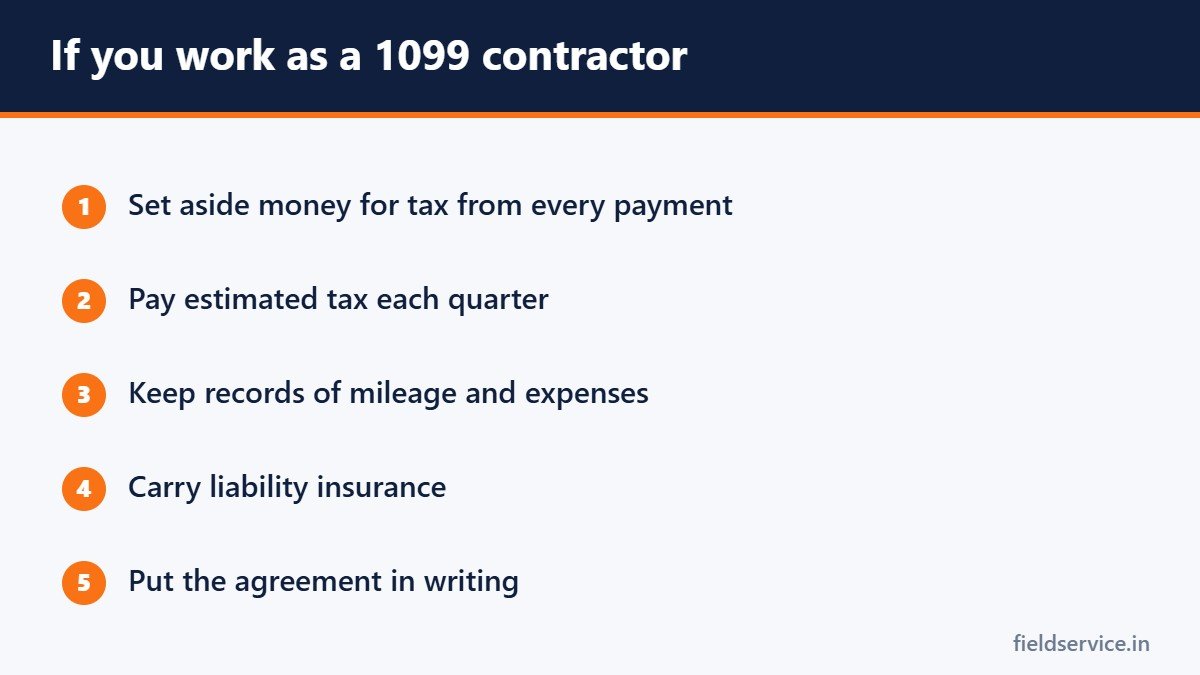
- Estimated taxes. With no withholding, a contractor generally has to pay income and self-employment tax in quarterly instalments.
- Insurance. Liability insurance, and cover for your own injuries, since an employer’s workers’ compensation policy does not cover contractors.
- Vehicle, tools and fuel.
- Unpaid time. No paid holidays, vacation or sick days, and no pay between jobs.
- Health insurance and retirement, entirely at your own cost.
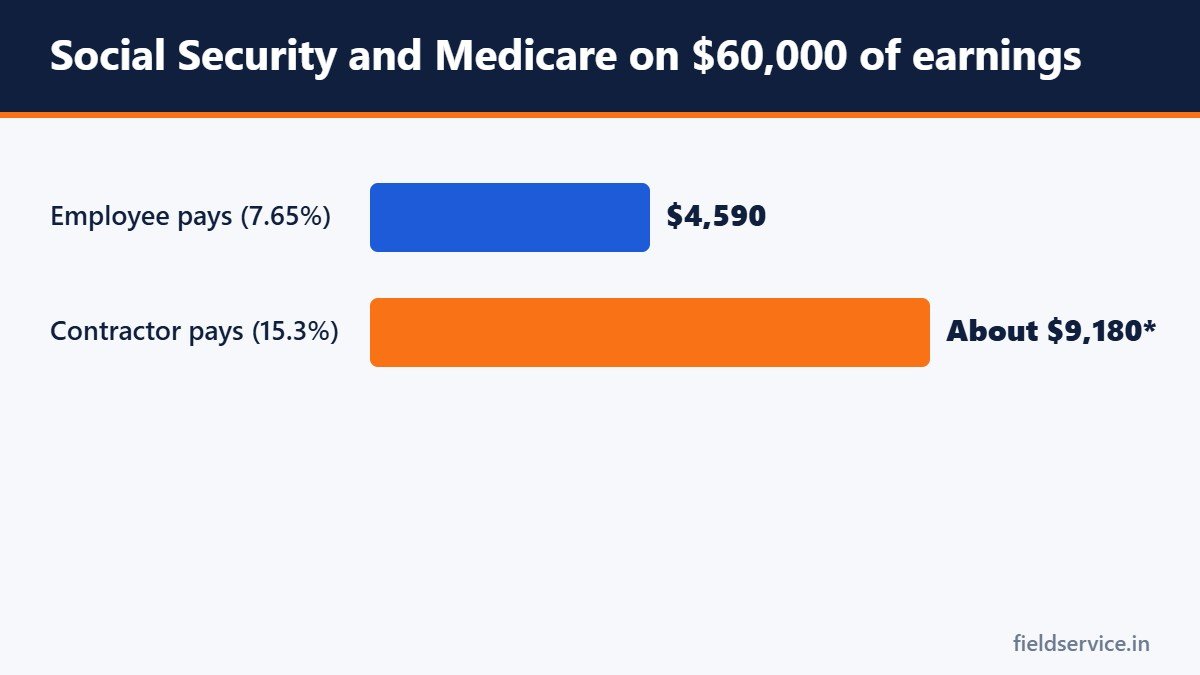
*Approximate. Self-employment tax is calculated on net earnings after business expenses, with an adjustment, so the exact figure is somewhat lower.
What a contractor gains
- A higher rate, at least on paper
- The ability to deduct legitimate business expenses
- Freedom to set your own hours and methods, and to work for several clients
- The chance to build a business of your own
How classification is decided
A worker’s status depends on the facts of the relationship, not on what the contract says or what either side prefers. The IRS looks at three groups of facts:
- Behavioral control. Does the company control how, when and where the work is done, and provide training in its methods?
- Financial control. Who supplies the tools and the vehicle? Can the worker make a profit or a loss? Is the worker free to offer services to others?
- The relationship. Is there a written contract? Are benefits provided? Is the work ongoing, and is it a central part of the company’s business?
The Department of Labor applies its own test under wage and hour law, and states have theirs. Some state tests are considerably stricter than the federal ones.
Signs you may really be an employee
- The company sets your schedule and dispatches your calls.
- You wear its uniform, drive its truck and use its tools.
- You work only for that company, full time and indefinitely.
- You must follow its procedures and price book.
- You cannot send someone else to do the work.
A technician in that position who is paid on a 1099 may be misclassified. Misclassification shifts costs onto the worker: the employer’s share of payroll tax, overtime, unemployment insurance and workers’ compensation.
If you think you are misclassified
- Raise it with the company. Some misclassification is a misunderstanding of the rules.
- You can ask the IRS to determine your status by filing Form SS-8.
- Your state labor agency and the U.S. Department of Labor’s Wage and Hour Division handle complaints about unpaid overtime and minimum wage.
- A tax professional or an employment lawyer can advise on your own situation.
Comparing a W-2 offer with a 1099 offer
Suppose you are offered $30 an hour as an employee or $40 an hour as a contractor. To compare them, work out what is left from the contractor rate after the costs you would carry:
- The additional 7.65 percent in Social Security and Medicare
- Vehicle, fuel and tools
- Liability and health insurance
- Weeks without pay for holidays, vacation, illness and slow periods
- No overtime premium for long weeks
For many technicians, a contractor rate needs to be well above the employee wage before the two are equal. Our article on loaded labor cost shows what an employer pays on top of a wage, which is roughly what a contractor has to cover alone. The hourly to annual pay calculator helps with the annual figures.
If you choose to work as a contractor
- Open a separate bank account for the business.
- Set aside a share of every payment for taxes.
- Keep receipts and a mileage log. See the 2026 IRS mileage rate.
- Check whether your state requires a contractor license for the work you do.
- Price your work from your costs. See hourly pay vs. billable rate.
For business owners
Treating workers as contractors when the facts make them employees carries real risk: back taxes, penalties, unpaid overtime and liability if someone is hurt. If you control the schedule, supply the truck and dispatch the calls, the worker is very likely an employee. Get advice before using contractors for core service work.
Three Excel workbooks that take you from what a technician costs to what to charge, then show whether each job made money.
Not sure yet? Try two forms free or see all packs.
Frequently asked questions
Is it better to be a W-2 employee or a 1099 contractor?
It depends on the rate and on what you would have to pay for yourself. A contractor pays both halves of Social Security and Medicare, has no overtime protection or benefits and covers their own vehicle, tools and insurance. Compare the totals, not the hourly figures.
Can a company choose to pay me as a 1099 contractor?
Not freely. Classification depends on the facts of the working relationship, such as who controls the work and who supplies the tools, not on what the company prefers or what the contract says.
Do 1099 contractors get overtime?
No. Federal overtime and minimum wage protections apply to employees. That is one reason correct classification matters.
What is self-employment tax?
It is the Social Security and Medicare tax paid by self-employed people. The rate is 15.3 percent of net earnings, covering both the employee and employer shares.
This article is general information and is not tax or legal advice.
Related guides
- HVAC Unit Conversions Every Technician Should Know
- What Is a Trip Charge and How Should You Set One?
- Break-Even Point for a Service Business: How to Calculate Yours