

If you drive your own truck or car to service calls, the IRS standard mileage rate is the number that decides what a fair reimbursement looks like. In 2026 that number changed twice, which does not happen often. Here is where it stands and what it means for people who drive for a living.
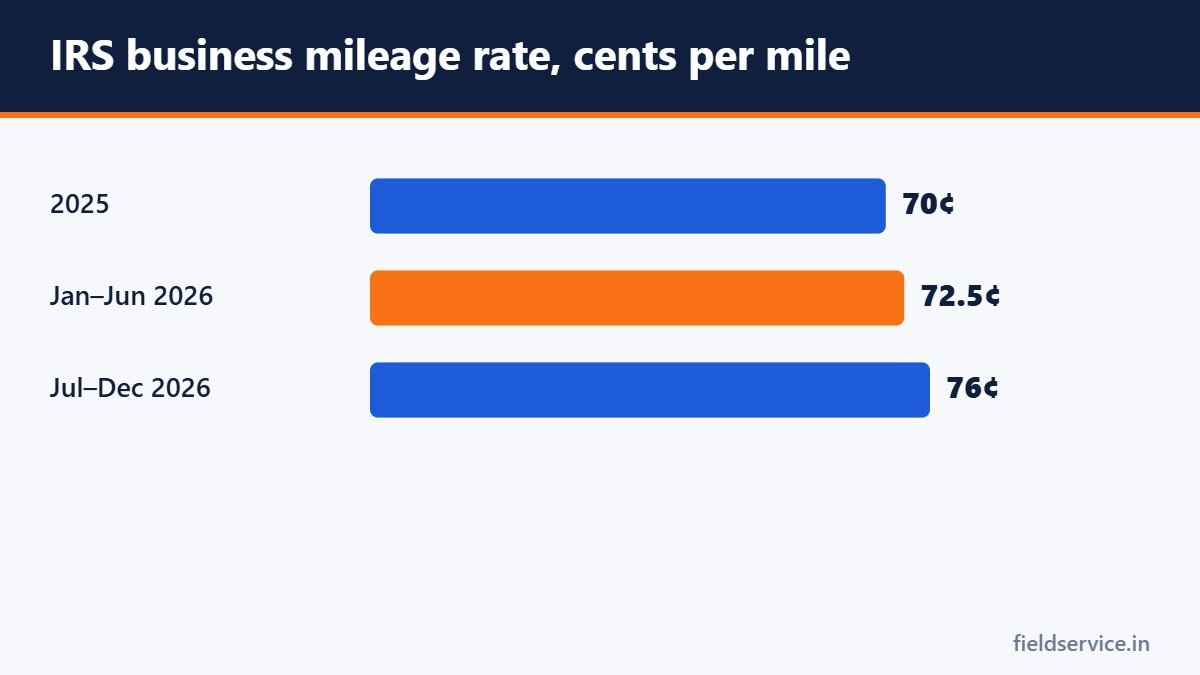
The 2026 rates
| Period | Business rate per mile |
|---|---|
| 2025 | 70 cents |
| January 1 to June 30, 2026 | 72.5 cents |
| July 1 to December 31, 2026 | 76 cents |
The IRS normally sets the rate once a year. The midyear increase of 3.5 cents was announced in response to higher fuel costs and applies to miles driven on or after July 1, 2026. Miles driven in the first half of the year stay at 72.5 cents.
What the difference is worth
Take a technician who drives 60 business miles a day, 20 days a month. That is 1,200 miles.
- At 72.5 cents: $870 a month
- At 76 cents: $912 a month
That is $42 a month, or about $250 across the second half of the year. Use the mileage reimbursement calculator with your own miles.
Your employer does not have to use the IRS rate
This surprises a lot of people. The IRS rate is a tax figure. It is the most a business can reimburse per mile without the payment counting as taxable income to the employee. Federal law does not require employers to reimburse mileage at that rate, or in most cases at all.
There are two limits on that:
- Minimum wage. Under federal wage law, work expenses you pay out of pocket cannot push your pay below the minimum wage for the week.
- State law. Some states go further. California and Illinois, for example, require employers to reimburse necessary work expenses.
If your reimbursement rate was set at 70 or 72.5 cents and has not moved, it is reasonable to ask whether the company plans to follow the July change.
Employees cannot deduct unreimbursed miles
Before 2018, employees could claim unreimbursed work mileage as an itemized deduction. That deduction was suspended in 2018, and the tax law passed in 2025 made the change permanent. If you are a W-2 employee and your employer does not reimburse you, you cannot make it up on your federal tax return.
If you are self-employed or work as an independent contractor, the rules are different. You can generally deduct business mileage using the standard rate or your actual vehicle expenses. Talk to a tax professional about which method suits you.
What counts as a business mile
- Counts: driving from one job to the next, trips to the supply house, driving from the shop to a customer.
- Does not count: your normal commute between home and your regular place of work.
For technicians dispatched from home, the answer depends on the arrangement, so check your company policy.
Keep a log that would survive a question
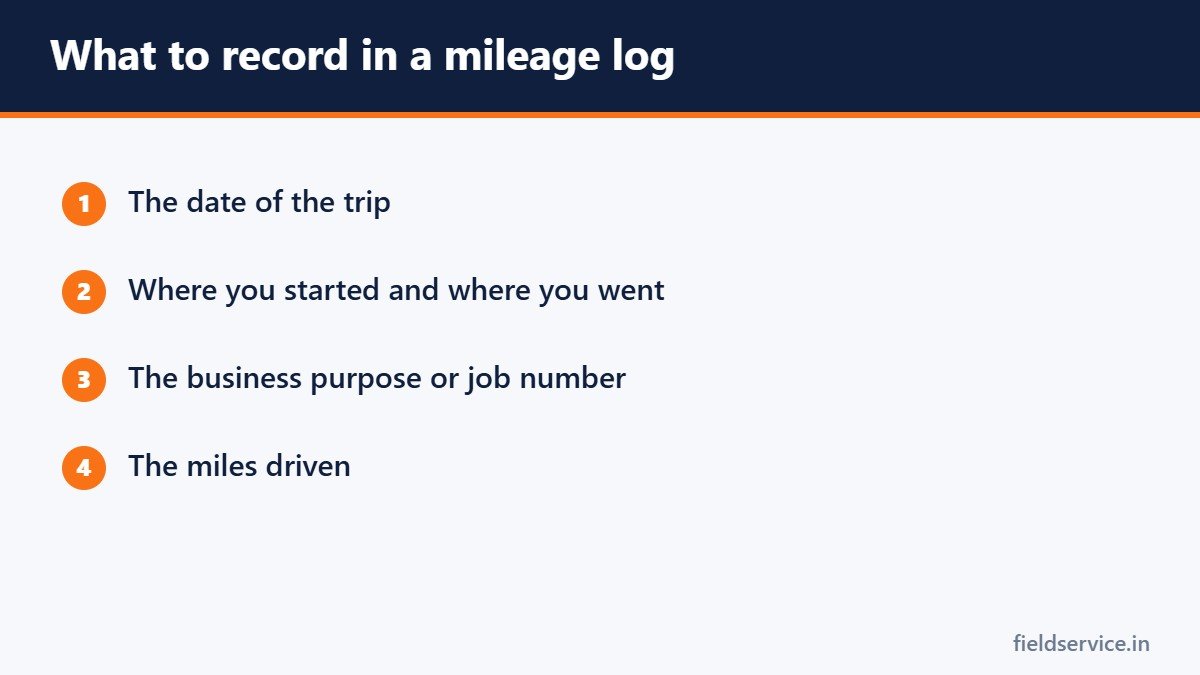
A reimbursement claim or a tax deduction is only as good as the record behind it. For every trip, write down:
- The date
- Where you started and where you went
- The business purpose, such as the customer name or job number
- The miles driven
Record it on the day. A log rebuilt from memory at the end of the month is the kind that gets challenged. Odometer readings at the start and end of the year are also worth having.
The rate is not your real cost
The IRS figure is a national average that covers fuel, insurance, maintenance, tires and depreciation. A half-ton pickup loaded with tools in stop-and-go traffic may cost more than that to run, and a small sedan on the highway may cost less. To see your own fuel cost per mile, try the fuel cost calculator.
This article is general information and is not tax advice.
Related guides
- Smart Thermostats: What Technicians Need to Know Before Installing One
- Flat Rate vs. Time and Materials: Which Pricing Model Fits Your Service Business?
- How to Price a Service Call: Finding Your Minimum Charge
Sources
- IRS, Standard mileage rates
- IRS news release on the 2026 business mileage rate
- Thomson Reuters, IRS announces midyear increase in standard mileage rates (Announcement 2026-11)
Six everyday forms in Word and PDF, plus Excel workbooks that total mileage reimbursement and overtime pay.
Not sure yet? Try two forms free or see all packs.