


Technicians who travel for work, on installation projects, storm restoration, commissioning jobs or work at remote sites, are often paid a per diem. The words mean “per day.” It is a fixed daily allowance meant to cover the cost of being away from home. How it is set up affects both what you take home and whether any of it is taxed.
What per diem covers
- Lodging
- Meals and incidental expenses, often shortened to M&IE. Incidentals are small costs such as tips for hotel staff.
Some employers pay a per diem for meals only and book or reimburse the hotel separately.
Where the rates come from
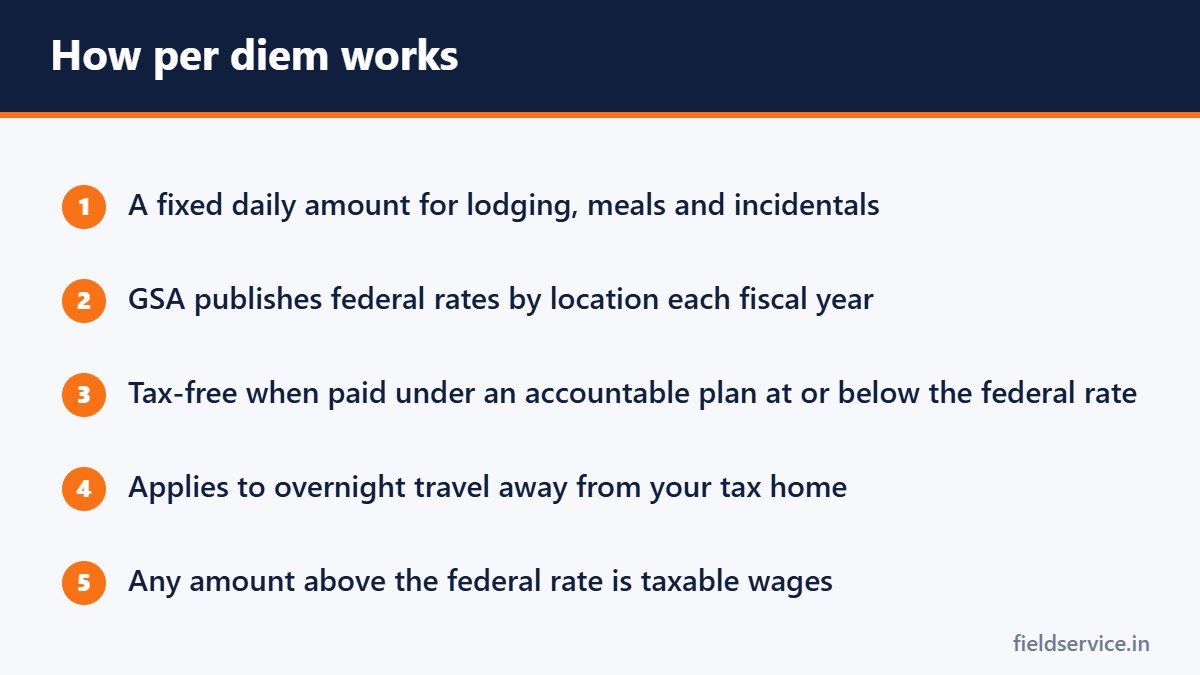
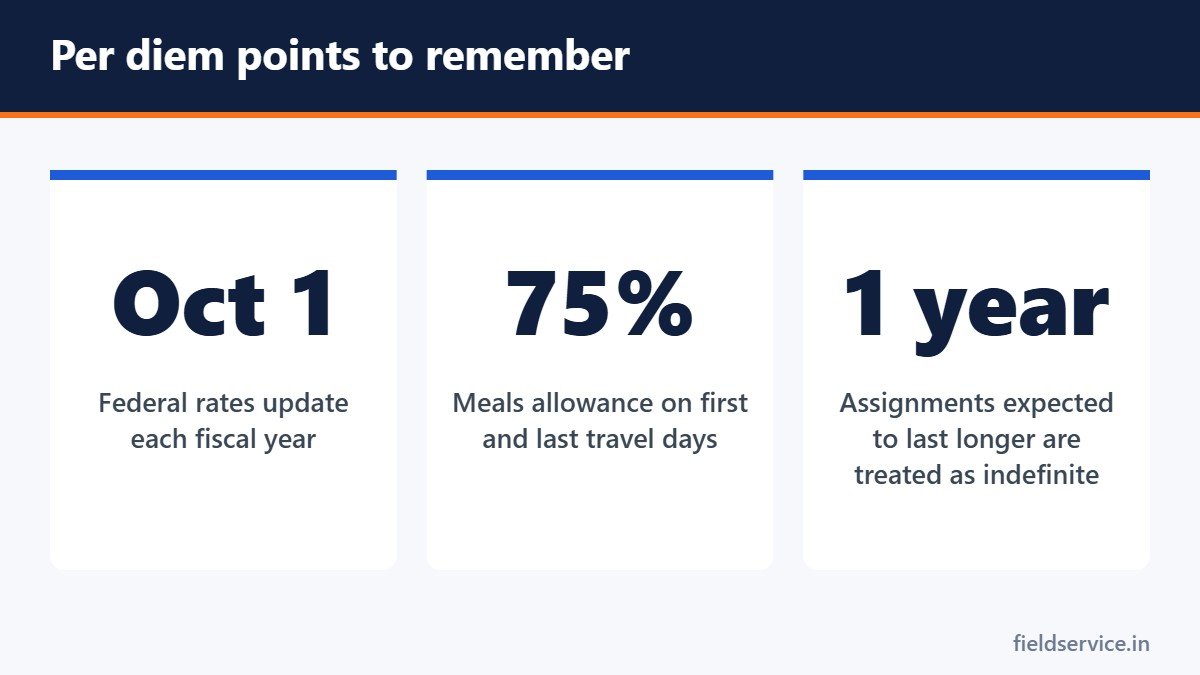
The U.S. General Services Administration (GSA) publishes per diem rates for federal employees traveling within the continental United States. There is a standard rate for most of the country and higher rates for more expensive cities and counties. The rates are updated for each federal fiscal year, which begins on October 1.
Private employers are not required to use the GSA rates. Many do, because the federal rates are also the ceiling the IRS uses to decide whether a per diem is tax-free.
When per diem is tax-free
A per diem is generally not taxable income to the employee when all of these apply:
- It is paid under what the IRS calls an accountable plan.
- The travel is for business and takes you away from your tax home overnight.
- You give your employer a record of the dates, the place and the business purpose of the trip.
- The amount is at or below the federal per diem rate for that location.
With a per diem you do not have to keep receipts to prove the amounts spent on meals. You still have to substantiate the time, place and purpose of the travel. If your employer pays more than the federal rate, the excess is treated as wages and taxed.
Partial days
Under the federal rules, the meals and incidentals allowance is 75 percent of the daily rate on the first and last day of a trip. Your employer may follow the same approach.
Per diem and your regular pay
A per diem that genuinely reimburses travel costs is separate from wages. It is not meant to replace part of your hourly pay. If you are offered a low hourly rate with an unusually large per diem, ask how it is structured. Payments that are really wages under another name can be reclassified, and a lower wage also reduces your overtime rate and your Social Security earnings record.
Long assignments
The tax treatment depends on the assignment being temporary. In general, the IRS treats an assignment in one location that is expected to last more than a year as indefinite. Travel payments for an indefinite assignment are taxable. If a project is likely to run long, raise this with your employer or a tax professional early.
If your employer does not reimburse you
Employees cannot deduct unreimbursed work travel on their federal tax return. That deduction was suspended in 2018 and the change has since been made permanent. Self-employed technicians follow different rules and can generally deduct business travel. Our article on the 2026 IRS mileage rate covers the same point for vehicle costs.
Questions to ask before you travel
- Does the per diem cover meals only, or lodging as well?
- What is the daily amount, and is it based on the GSA rate for the location?
- Is it paid for travel days and weekends on site?
- Is travel time paid, and at what rate?
- How are mileage or airfare handled?
- Is the per diem paid in advance or with payroll?
Keep your own record
Write down the dates you traveled, where you stayed and which job you were on. If your pay stub ever shows an error, or the payments are questioned later, that record settles it. For drive time and overtime while traveling, see how overtime pay works for field technicians, and use the mileage reimbursement calculator for miles in your own vehicle.
This article is general information and is not tax advice.
Related guides
- Revenue per Technician: What It Shows and How to Use It
- Loaded Labor Cost: What a Technician Really Costs Per Hour
- How to Read Your Pay Stub as a Field Technician
Sources
- U.S. General Services Administration, Per diem rates
- IRS Publication 463, Travel, Gift, and Car Expenses
Six everyday forms in Word and PDF, plus Excel workbooks that total mileage reimbursement and overtime pay.
Not sure yet? Try two forms free or see all packs.