


Many technicians wait for a raise to be offered. Some wait for years. In most service companies, pay goes up when someone makes a clear, reasonable case for it at a sensible time. A raise is a business decision, and the people who get one are usually those who show, in numbers, what they bring to the business. You do not need to be a salesperson to do that. You need a short list of facts and one conversation.
Think like the owner
A raise costs the company more than the figure on your check, because payroll taxes and insurance rise with it. The owner is weighing that cost against what you produce and what it would cost to replace you. Hiring and training a new technician is expensive and slow, and a truck sitting idle earns nothing. If you are reliable, productive and good with customers, you have more bargaining power than you may think. Our article on hourly pay vs. billable rate shows how the business sees your hours.
Know what the market pays
- Look at the pay ranges on current job postings for your trade and area.
- Check the U.S. Bureau of Labor Statistics wage data for your occupation and state.
- Ask people you trust in the trade, bearing in mind that people round up.
Compare total pay, not just the hourly rate: overtime, on-call pay, bonuses, a take-home vehicle, health cover and paid time off. The hourly to annual pay calculator helps you compare offers on the same basis.
Build your case with numbers
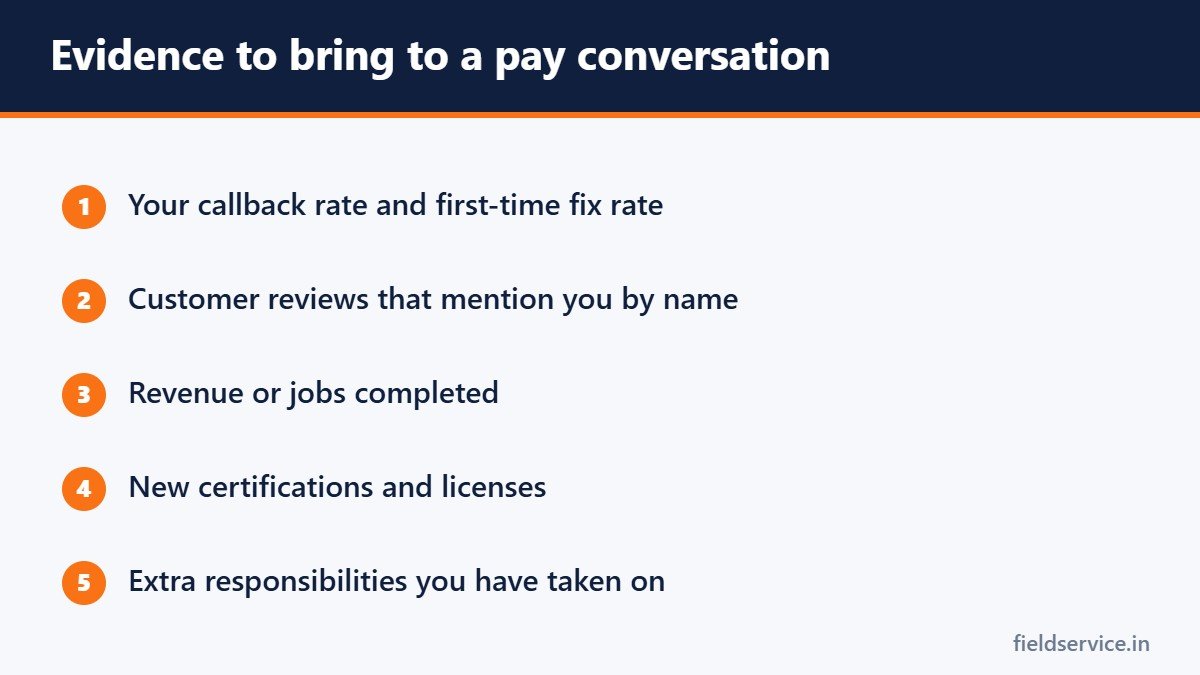
“I have been here three years” is the weakest argument, and it is the one most people use. Time served is not the same as value added. Bring evidence instead:
- Quality. Your callback rate and first-time fix rate, compared with the team average if you know it.
- Customers. Reviews that mention you, and customers who ask for you.
- Productivity. Jobs completed, revenue produced or billable hours.
- Skills. Certifications, licenses and manufacturer training completed since your last raise.
- Responsibility. Training apprentices, taking the hard diagnostic calls, covering on-call, helping other techs by phone.
- Reliability. Attendance, a clean driving record and no safety incidents.
If you do not have these numbers, ask for them, or start keeping your own. Our overview of field service KPIs explains what each one measures.
Choose the moment
- Good times: after a strong busy season, after you have earned a new license or certification, at a scheduled review, or when you have taken on new duties.
- Poor times: in the middle of a crisis, during the slowest month of the year, straight after a mistake, or in front of other people.
Ask for a meeting in advance. “I would like fifteen minutes this week to talk about my pay” gives your manager time to prepare and shows you are serious.
Decide what you are asking for
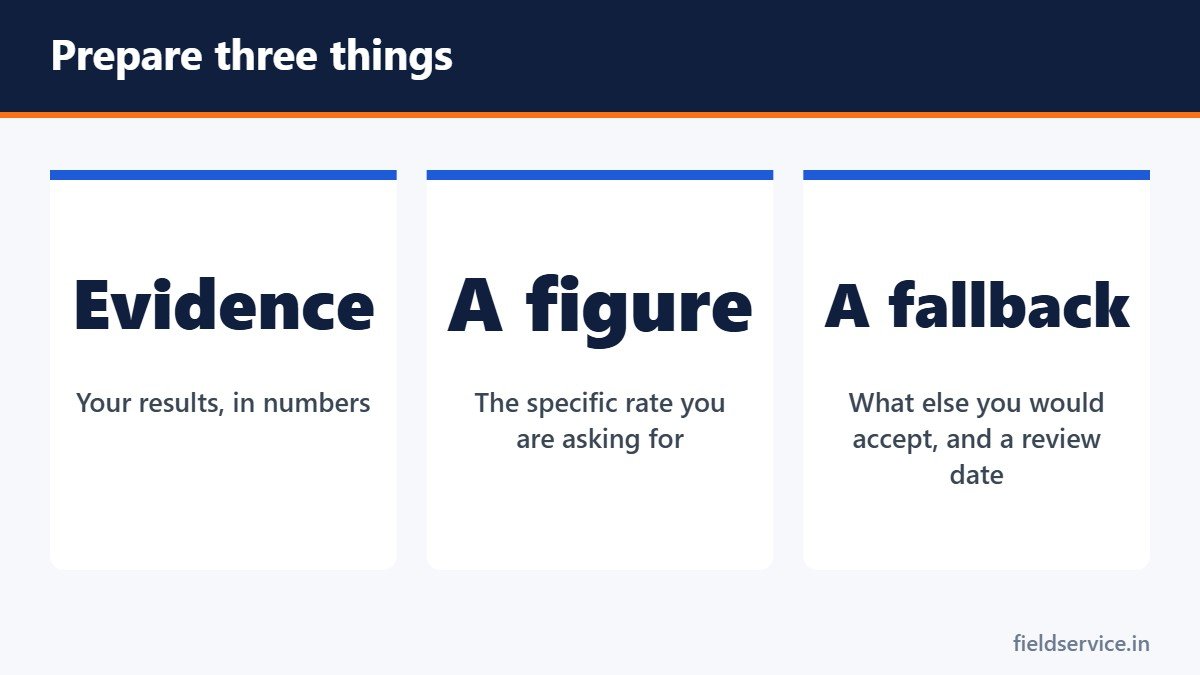
Have a specific figure, based on the market and on your results. A request for a particular hourly rate is easier to answer than “more money”. Know in advance what else you would accept: a smaller raise now with a review in six months, a bonus tied to results, a tool allowance, training paid for by the company, a better on-call arrangement or a take-home vehicle.
The conversation
- Start with what you like about the job and your intention to stay.
- Set out your results, briefly and factually.
- State the rate you are asking for.
- Stop talking and listen.
An example: “I have been running my own calls for two years. My callback rate is the lowest on the team, I got my universal EPA certification and my state license this year, and I trained the two newest apprentices. Based on that, and on what the market is paying, I would like to move to $34 an hour.”
Keep it calm and professional. You are having a business discussion, not asking for a favor.
What to avoid
- Comparing yourself with a named co-worker
- Using personal expenses as the reason
- Threatening to leave unless you mean it and have somewhere to go
- Apologizing for asking
- Bringing up old grievances
- Accepting a vague “we will see” with no date
If the answer is “not now”
Ask two questions. What would I need to do to earn this rate? When can we look at it again? Write down the answers and agree a date. If the reasons are about your performance, you now have a list to work on. If they are about the company’s finances, you have learned something about its prospects.
If the answer is always no, with no path and no date, that tells you something too. Looking at what other employers offer is reasonable, and it is the only way to know your real market value.
Pay structures other than the hourly rate
Sometimes the base rate cannot move but other parts can. A bonus tied to quality measures, a share of maintenance agreement sales, a higher on-call stipend or a change to commission may get you to the same place. See commission vs. hourly pay, spiffs and bonuses and on-call pay.
Make yourself worth more
The surest way to a raise is to be able to do things other technicians cannot. Add a license, learn the equipment nobody else wants to touch, become the person others phone for help. See skills that make a field technician more valuable and field service career paths.
For owners
A technician who asks for a raise with evidence is doing you a favor. They are telling you what they want before they go looking elsewhere. Give a clear answer, and if it is no, say what would make it yes and when you will review it. A published pay scale tied to skills and results removes much of the guesswork for both sides.
Related guides
- Average Service Ticket: What It Tells You and How to Raise It Honestly
- How to Raise Prices in a Service Business Without Losing Customers
- How to Write a Field Technician Resume
Six everyday forms in Word and PDF, plus Excel workbooks that total mileage reimbursement and overtime pay.
Not sure yet? Try two forms free or see all packs.
Frequently asked questions
When is the best time to ask for a raise?
After a strong busy season, when you have earned a new license or certification, at a scheduled review, or when you have taken on new responsibilities. Avoid the slowest part of the year and moments of crisis.
How much of a raise should I ask for?
Base the figure on what the local market pays for your trade and experience and on your own results. Ask for a specific rate, not just “more”.
What if my employer says no?
Ask what you would need to do to earn the raise and when the decision can be reviewed. Get a date. If there is never a path or a date, it is reasonable to look at other employers.
Should I mention another job offer?
Only if the offer is real and you are prepared to take it. Using an offer you do not intend to accept can damage trust.