


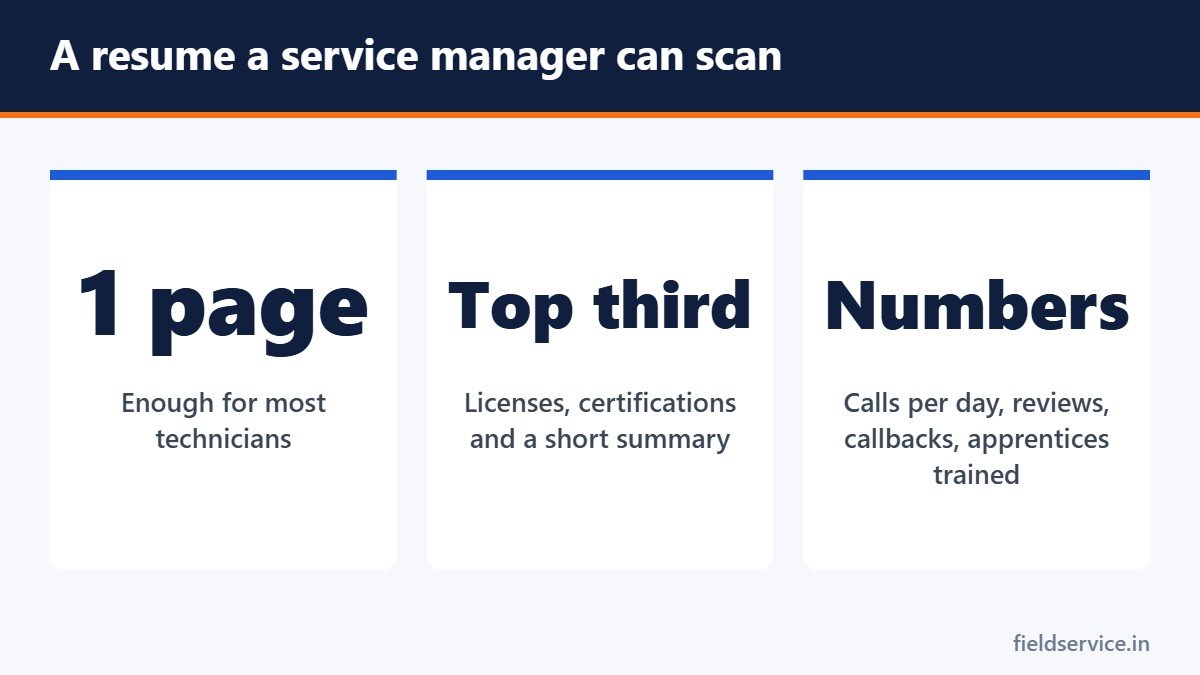
Good technicians are often bad at describing what they do. A resume that says “repaired HVAC systems” tells an employer nothing they could not guess. One that lists the licenses held, the equipment worked on and a couple of measurable results gets a phone call. Service managers read resumes quickly, and they are looking for specific things. Give them those things in the first third of the page.
What employers look for
- Licenses and certifications that let you work legally and independently
- The types of equipment and systems you have worked on
- Whether you have run your own service calls
- A valid driver’s license and a clean record
- Evidence that you are reliable and good with customers
- Stability, or a sensible explanation of moves
Structure
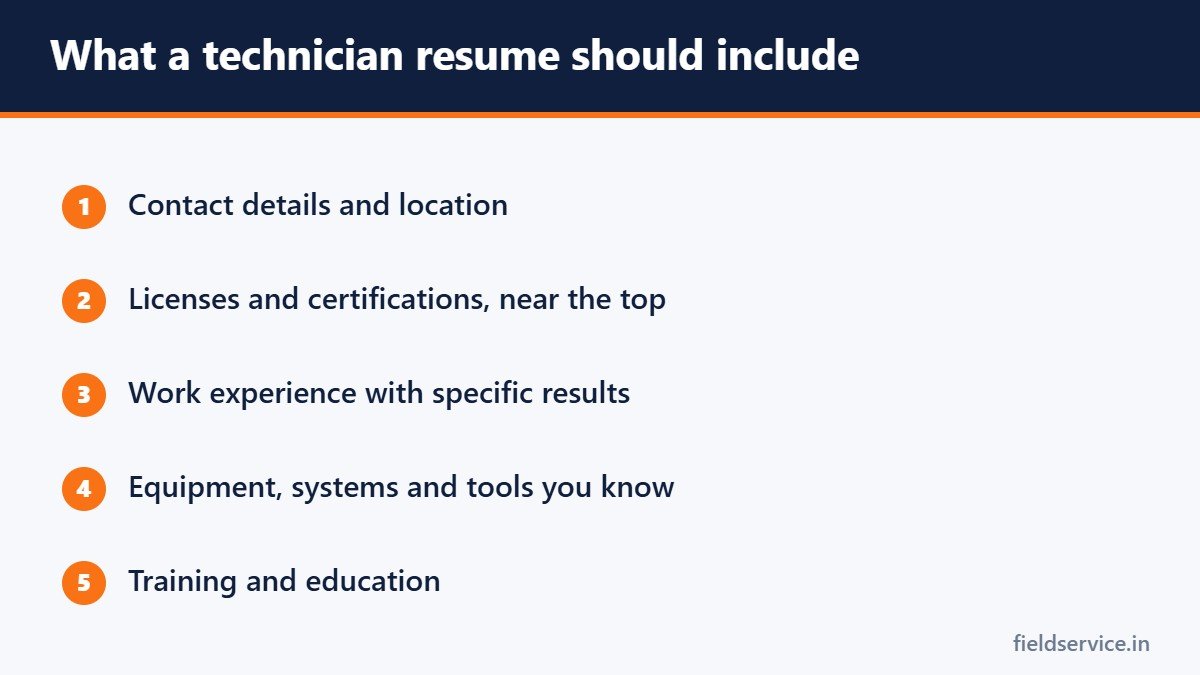
1. Contact details
Name, phone number, a professional email address, and your city and state. You do not need a full street address.
2. Summary
Two or three lines that say who you are. For example: “HVAC service technician with six years of residential and light commercial experience. EPA Universal certified, state journeyman license. Experienced in diagnosing heat pumps, gas furnaces and rooftop units.”
3. Licenses and certifications
Put these near the top. They are often the first thing a manager checks. List each with the issuing body and, where relevant, the license number, state and expiry date. Examples: EPA Section 608 certification, a state trade license, OSHA 10-hour or 30-hour training, manufacturer certifications, and a driver’s license class.
4. Work experience
List jobs with the most recent first. For each, give the employer, your title, the dates and three to five bullet points.
5. Skills and equipment
A short list of the systems, brands, tools and software you have used.
6. Education and training
Trade school, apprenticeship and significant courses.
Write bullets that show results
Each bullet should say what you did and, where you can, what came of it. Use numbers.
| Weak | Stronger |
|---|---|
| Repaired HVAC systems | Diagnosed and repaired residential split systems, heat pumps and gas furnaces, averaging five service calls a day |
| Good with customers | Named in more than 40 five-star customer reviews over two years |
| Did maintenance | Completed seasonal maintenance on 300 agreement customers a year, with documented readings on each visit |
| Helped train new hires | Trained three apprentices who now run their own service calls |
| Responsible for truck | Managed truck stock and kept a clean driving record across 25,000 miles a year |
If you know your own figures, such as a low callback rate or a high first-time fix rate, include them. Few applicants do, and managers notice. Only use numbers you can back up if asked.
List equipment specifically
- Systems: split systems, package units, heat pumps, boilers, mini-splits, rooftop units, walk-in coolers, tankless water heaters, panels, generators, and so on for your trade.
- Sectors: residential, light commercial, commercial, industrial.
- Tools and instruments: digital manifold, combustion analyzer, recovery equipment, megohmmeter, drain camera.
- Software: the field service or dispatch software you have used.
If you are new to the trade
- Lead with your training, certifications and any hands-on lab work.
- Include helper, installer or ride-along experience.
- List related experience: construction, automotive repair, maintenance, military technical roles, or any job that shows mechanical ability.
- Mention reliability, such as attendance and a clean driving record.
- Say what you want to learn.
Our guides to becoming an HVAC technician, an electrician or a plumber cover the credentials employers expect.
If you are changing trades or moving up
Bring out what transfers: electrical troubleshooting, customer contact, documentation, safe work practices and running jobs alone. If you are aiming at a lead or supervisor role, put training, quality checks and difficult calls you have handled near the top. See field service career paths.
Mistakes to avoid
- Listing duties without any results
- Burying licenses at the bottom
- Spelling mistakes. Have someone else read it.
- An unprofessional email address
- Unexplained gaps. A short line is enough: “Family care, 2023 to 2024.”
- Including a photo, age, marital status or Social Security number
- Running to three pages
- Criticizing former employers
- Claiming a license or certification you do not hold. Employers verify them.
Format
- One page for most technicians. Two if you have long experience.
- A plain layout with clear headings and a readable font.
- Save it as a PDF unless the employer asks for another format.
- Name the file sensibly, with your name and the word resume.
- Many companies use software to screen applications, so use the same terms the job posting uses for licenses and skills, where they are true of you.
Tailor it to the job
Read the posting. If it asks for commercial refrigeration experience and you have it, say so in the summary and the first bullet. A resume aimed at the job in front of you does better than a general one sent to twenty companies.
References and applications
Have two or three references ready: a former supervisor, a senior technician or an instructor. Ask them first. You do not need to list them on the resume. Many service companies also use an application form, so keep your dates, license numbers and employer details to hand.
After you apply
If you have heard nothing in a week, a short phone call or message to ask about the position is reasonable and shows interest. When the interview comes, see how to prepare for a field technician interview. When the offer comes, compare the whole package with the hourly to annual pay calculator.
Related guides
- How to Write a Service Estimate Customers Understand and Accept
- PPE for Field Technicians: What to Wear and When
- Going Out on Your Own: A Checklist for Starting a One-Truck Service Business
Six everyday forms in Word and PDF, plus Excel workbooks that total mileage reimbursement and overtime pay.
Not sure yet? Try two forms free or see all packs.
Frequently asked questions
How long should a technician resume be?
One page is enough for most technicians. Use two pages only if you have long experience that is relevant to the job.
Where should certifications go on a technician resume?
Near the top, straight after the summary. Licenses and certifications are often the first thing a service manager checks.
What if I have no field experience yet?
Lead with your training, certifications and lab work, then list any helper or related mechanical experience, and include evidence of reliability such as attendance and a clean driving record.
Should I include numbers on my resume?
Yes, where you can support them. Calls per day, customer reviews, apprentices trained and callback or first-time fix rates make a resume stand out.