

Every service business has callbacks. A repair that held on the day fails a week later, a customer reports the same noise, a drain backs up again. Because each one is small, callbacks are easy to treat as part of the job. Added up over a year, they are often one of the larger avoidable costs in the business.
What counts as a callback
A callback is a return visit to correct work that was reported as complete. It is different from a second visit to finish a job that was left open for a part. A common working definition is any return to the same equipment for the same or a related problem within 30 days, where the customer is not charged.
Pick a definition, write it down and apply it the same way every month.
Calculating the rate
Callback rate = callbacks ÷ completed jobs × 100
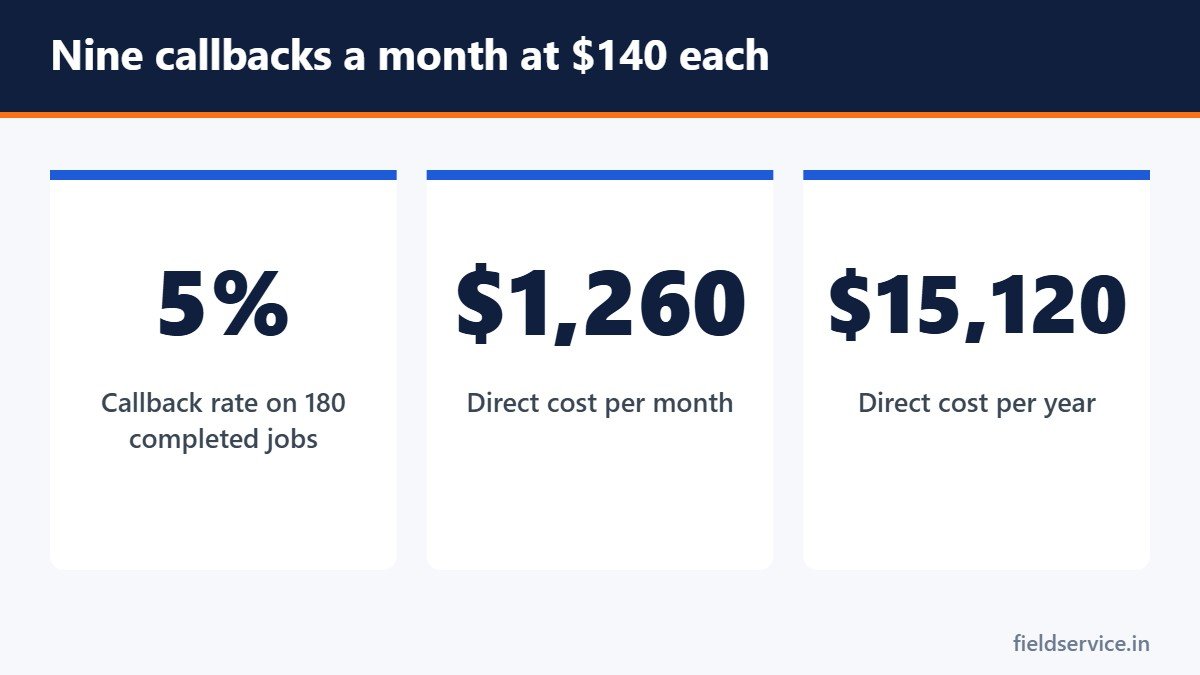
Nine callbacks on 180 completed jobs is a 5 percent callback rate. Run your own figures in the callback rate calculator.
What a callback really costs
Take one callback and add up the pieces:
- Labor. The technician’s time on site, at loaded cost and with nothing billed.
- Travel. A second round trip in paid time, plus fuel and vehicle wear.
- Parts. Anything replaced a second time, unless the supplier covers it under warranty.
- The job you did not run. That slot would otherwise have held a paying call. This is usually the largest cost and it never appears on a report.
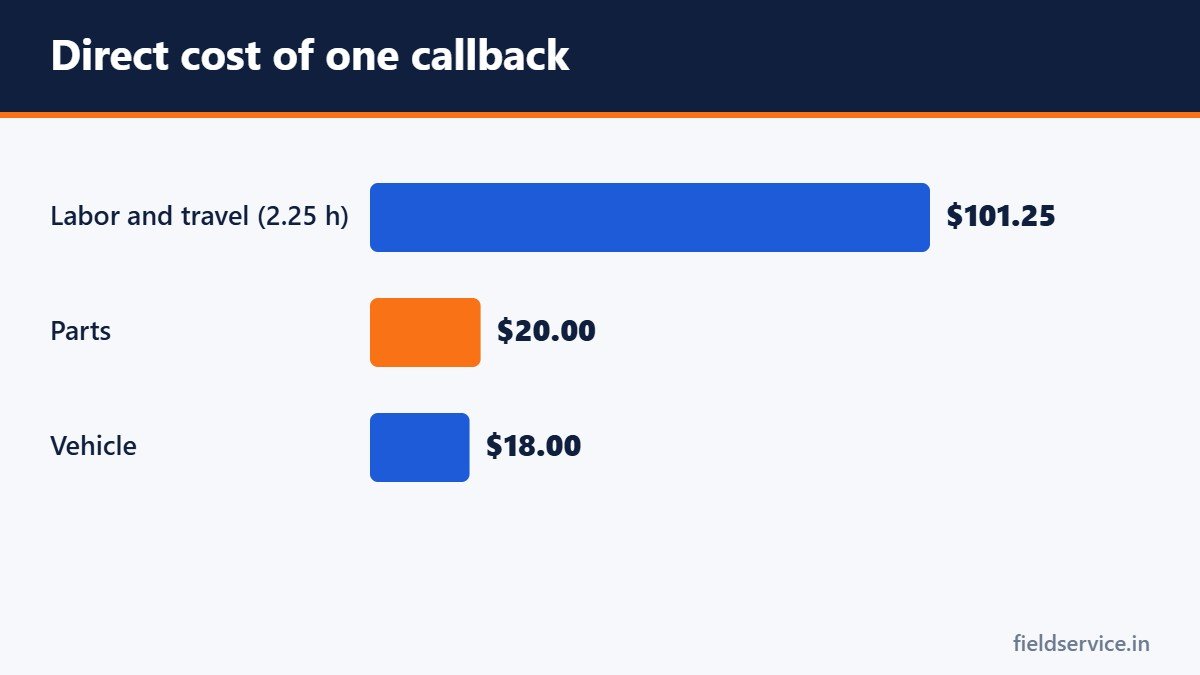
Here is a simple example. A technician with a loaded cost of $45 an hour spends 1.5 hours on a callback and 45 minutes driving. That is $101.25 in labor. Add $18 for the vehicle and $20 in parts and the direct cost is about $139. If the average ticket is $300, the lost appointment could have brought in that revenue as well.
At nine callbacks a month and $140 each, the direct cost is $1,260 a month, or roughly $15,000 a year, before counting the lost appointments.
The cost you cannot invoice
Customers remember whether the problem stayed fixed. A callback handled quickly and politely can keep a customer. Two in a row usually loses one, along with the reviews and referrals that customer would have given.
Where callbacks come from
Tag every callback with a cause. Most fall into a short list:
- The symptom was fixed and the cause was not. A blown capacitor is replaced without checking why it failed.
- The work was not tested. The system was not run through a full cycle before the tech left.
- Installation or workmanship errors. A loose connection, a poor braze joint, a fitting that was not tightened.
- A defective part. The replacement itself failed.
- The customer expected something different. The repair worked, but nobody explained what it would and would not do.
Also sort callbacks by technician and by job type. The point is not to rank people. A cluster around one type of job usually means a gap in training or procedure that affects everyone.
How to bring the rate down
Use a completion checklist
A short written list of checks before leaving, such as readings taken, the system cycled and the work area inspected, catches the most common causes. It works because it does not rely on memory at the end of a long day.
Look for the cause of the failure
Build the habit of asking why a part failed. A second failure of the same part is almost always a sign that something upstream was missed.
Record readings
Measurements written on the ticket prove the system was working when the tech left and give the next person a baseline. Our guide to documenting a service call covers what to record.
Explain the repair to the customer
Two minutes spent explaining what was done, what to expect and what was recommended but declined prevents many calls that are really misunderstandings.
Slow down the last job of the day
Rushed work at the end of a shift is a frequent source of callbacks. A schedule with some slack is cheaper than the returns it prevents.
Review every callback
Have the original technician return to their own callbacks where possible, and discuss a few each week as a group. People learn more from their own misses than from a training video.
Be careful with incentives
Docking pay for callbacks tends to make them disappear from the records without making them disappear from the field. Technicians stop logging them or argue over definitions. Rewarding a low team rate, and treating each callback as something to learn from, gives you honest data.
You will not get to zero. Parts fail and equipment is unpredictable. The aim is to know your rate, know what it costs and know where it comes from, so that the callbacks you still have are the ones nobody could have prevented.
Related guides
- How to Reduce Windshield Time in a Service Business
- Maintenance Agreements: How They Work and How to Price Them
- Technician Utilization: What It Measures and What a Good Number Looks Like
Three Excel workbooks that take you from what a technician costs to what to charge, then show whether each job made money.
Not sure yet? Try two forms free or see all packs.