

A spiff is a small payment for a specific result: $25 for a maintenance agreement sold, $100 for a lead that becomes a system replacement, $50 for a five-star review that names you. Service companies use spiffs and bonuses because they focus attention on what the business wants more of. For technicians they can add a meaningful amount to a paycheck. They also change your overtime rate and your tax withholding in ways that are easy to miss.
Common types
- Sales spiffs. A fixed amount for selling an agreement, an accessory or an upgrade.
- Lead bonuses. A payment when a lead you turned in becomes a sold job.
- Performance bonuses. Paid for hitting a target, such as a low callback rate, review scores or revenue for the month.
- Safety and attendance bonuses. Paid for a period with no incidents or no missed days.
- Retention and signing bonuses. Paid for joining or for staying a set length of time.
- Discretionary bonuses. Decided by the employer after the fact, with no prior promise, such as a holiday gift.
Discretionary and nondiscretionary
The distinction matters for overtime. A bonus is nondiscretionary when it is promised in advance, so that employees know what they must do to earn it. Nearly every spiff and performance bonus falls into this group. A bonus is discretionary only when both the decision to pay and the amount are entirely up to the employer, made at or near the end of the period, with no prior agreement or expectation.
How bonuses change your overtime rate
Under the Fair Labor Standards Act, overtime is one and a half times your regular rate, and the regular rate includes nondiscretionary bonuses. In a week where you earn a spiff and work overtime, your overtime rate goes up.
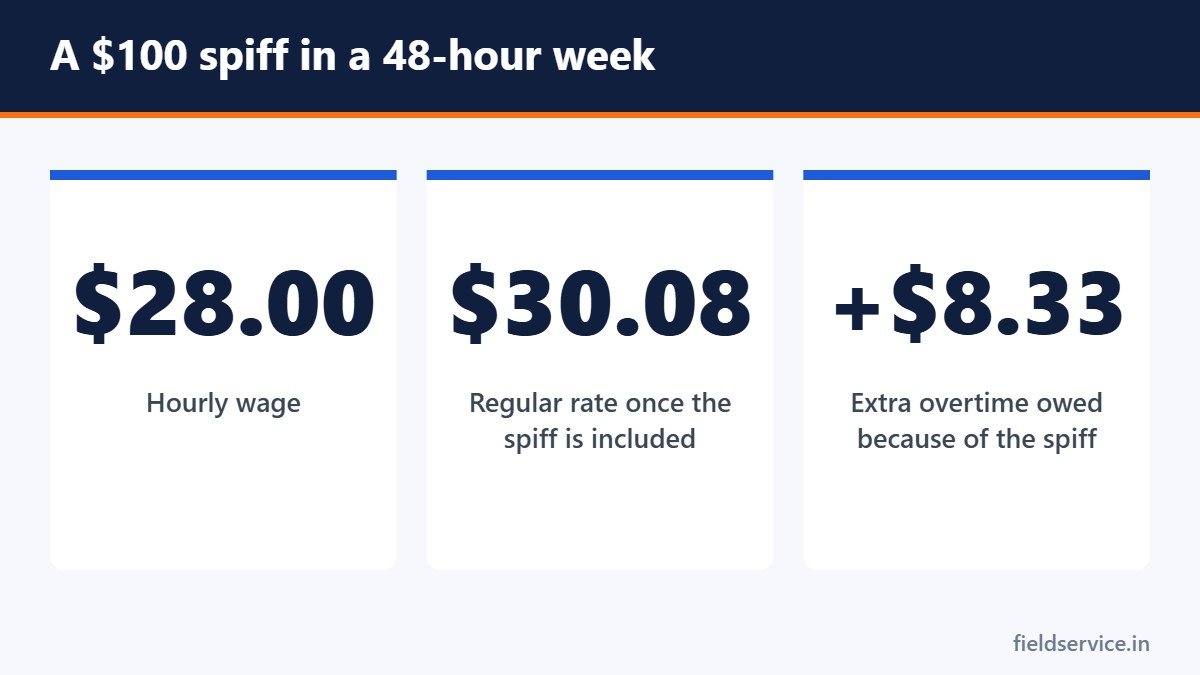
Take a technician paid $28 an hour who works 48 hours and earns a $100 spiff in the same week:
- Straight-time earnings: 48 × $28 + $100 = $1,444
- Regular rate: $1,444 ÷ 48 = $30.08
- Overtime premium: half the regular rate for each overtime hour, $15.04 × 8 = $120.33
- Total pay: $1,444 + $120.33 = $1,564.33
Without the spiff being counted, the week would pay $1,456 plus $100, or $1,556. The correct figure is $8.33 more. The overtime pay calculator gives the base figure, and our guide to overtime pay for field technicians explains the rule.
Bonuses that cover more than one week
A monthly or quarterly bonus is earned over several workweeks. When it is paid, the employer has to go back and spread it across the weeks in which it was earned, then pay the additional overtime for any of those weeks that included overtime hours. If you receive a quarterly bonus and you worked overtime during the quarter, look for an overtime adjustment on the same check or the next one.
How bonuses are taxed
Bonuses and spiffs are wages. They are subject to income tax, Social Security and Medicare like the rest of your pay. The IRS treats them as supplemental wages, and employers may withhold federal income tax on them at a flat 22 percent. That is why a bonus check can look as if it was taxed more heavily than usual. The withholding is an estimate. Your actual tax is settled when you file your return, and any excess comes back as a refund.
Spiffs paid by manufacturers or distributors
Sometimes a manufacturer or supplier pays a technician directly for selling its product. That money is still taxable income to you. If it does not come through your employer’s payroll, no tax will have been withheld, so set some aside. Check that your employer allows such payments.
What makes a spiff plan fair
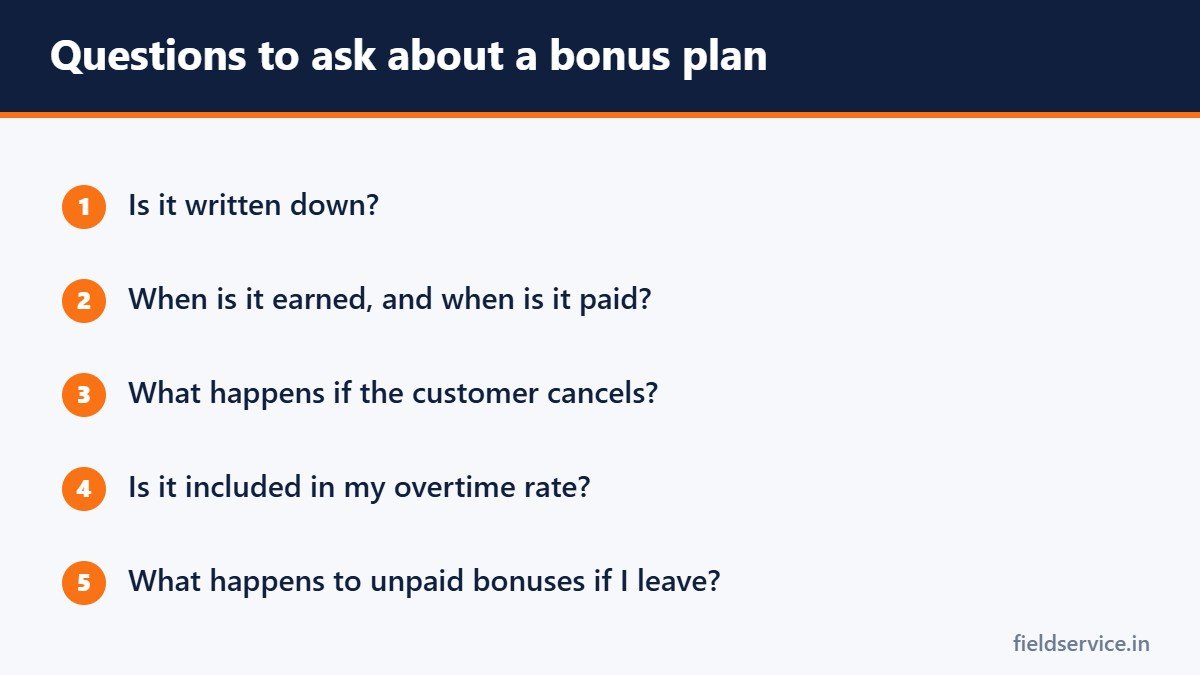
- It is written down, with the amounts and the conditions.
- It says when the spiff is earned and when it is paid.
- It says what happens if the customer cancels or the job is refunded.
- It rewards something the technician controls.
- Leads and opportunities are shared out fairly.
- It does not reward recommending work the customer does not need.
For owners
- Reward what you want more of. A plan that pays only for sales will get sales. Consider including quality measures such as first-time fix rate, callback rate and reviews.
- Keep it simple. If technicians cannot work out their own bonus, it will not change what they do.
- Pay promptly. A reward that arrives two months later loses most of its effect.
- Include bonuses in overtime. Leaving nondiscretionary bonuses out of the regular rate is one of the most common wage and hour mistakes.
- Watch for side effects. If complaints about overselling rise, the plan needs changing.
For technicians
- Keep your own list of spiffs earned, with dates and job numbers.
- Check each pay stub against the list. See how to read your pay stub.
- In overtime weeks, check that the overtime rate rose.
- Ask about any difference promptly and in writing.
For the wider choice between pay structures, see commission vs. hourly pay.
Six everyday forms in Word and PDF, plus Excel workbooks that total mileage reimbursement and overtime pay.
Not sure yet? Try two forms free or see all packs.
Frequently asked questions
What is a spiff?
A spiff is a payment to an employee for a specific result, such as selling a maintenance agreement or turning in a lead that becomes a sale.
Do bonuses count toward overtime pay?
Nondiscretionary bonuses, which are those promised in advance, are included in the regular rate used to calculate overtime under federal law. Truly discretionary bonuses are not.
Why was so much tax taken out of my bonus?
Bonuses are supplemental wages, and employers may withhold federal income tax on them at a flat 22 percent. The withholding is an estimate, and your actual tax is settled when you file your return.
Are spiffs from a manufacturer taxable?
Yes. Payments from a manufacturer or distributor are taxable income even when they do not come through your employer’s payroll.
This article is general information and is not tax or legal advice.
Related guides
- Maintenance Agreements: How They Work and How to Price Them
- Heat Pump Basics: How They Work and What Goes Wrong
- On-Call Pay for Technicians: How It Works and What to Ask