


Costs in a service business rise every year. Wages, insurance, fuel, parts and software all go up, and unless prices follow, the difference comes out of profit. Most owners know this and still put it off, because they are afraid customers will leave. That fear is usually larger than the risk. A modest, well-explained increase loses few customers, and the arithmetic shows that a business can afford to lose some and still come out ahead.
Signs that prices are too low
- Almost every quote is accepted without discussion. See close rate.
- You are booked out for days or weeks and still not making money.
- Your costs have risen and your prices have not changed in over a year.
- Your gross margin has slipped compared with a year or two ago.
- You cannot afford to pay technicians what competitors pay.
What a small increase does to profit
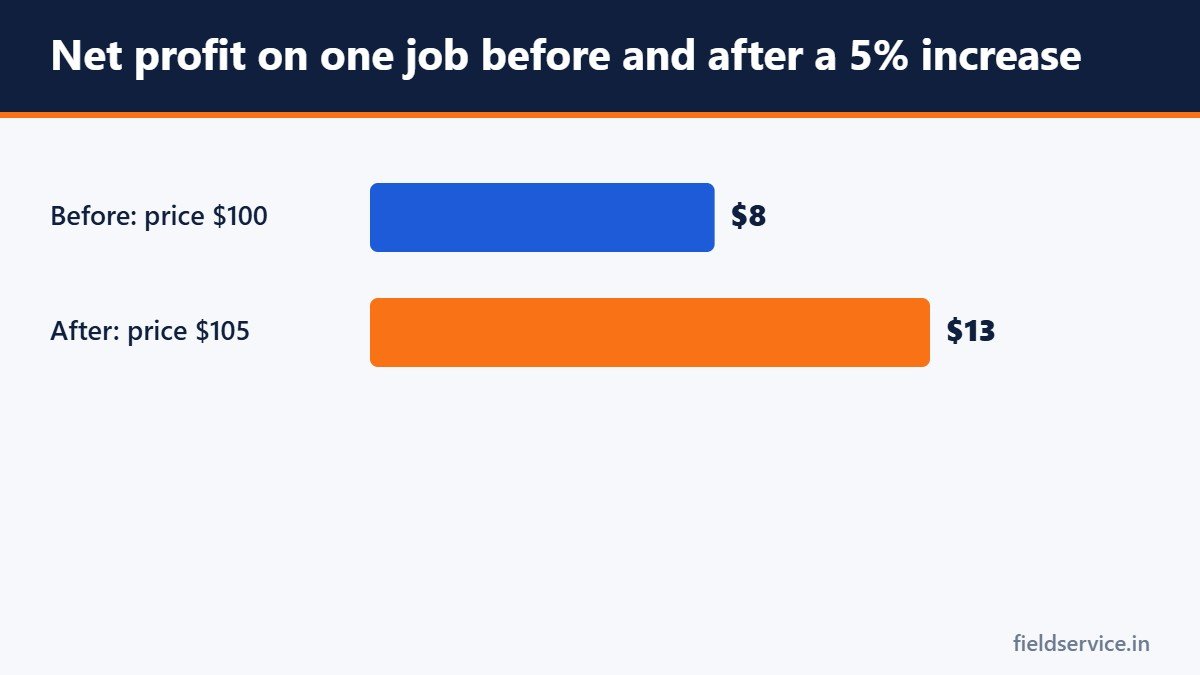
Take a job priced at $100 with direct costs of $55. The gross profit is $45, a 45 percent margin. Suppose overhead takes $37 of that, leaving a net profit of $8.
Raise the price by 5 percent, to $105. The costs are unchanged, so the gross profit becomes $50 and the net profit becomes $13. A 5 percent price increase has raised net profit by more than 60 percent.
How many customers can you afford to lose?
The usual fear is that a higher price will drive customers away. There is a simple way to work out how much volume you could lose and still earn the same gross profit:
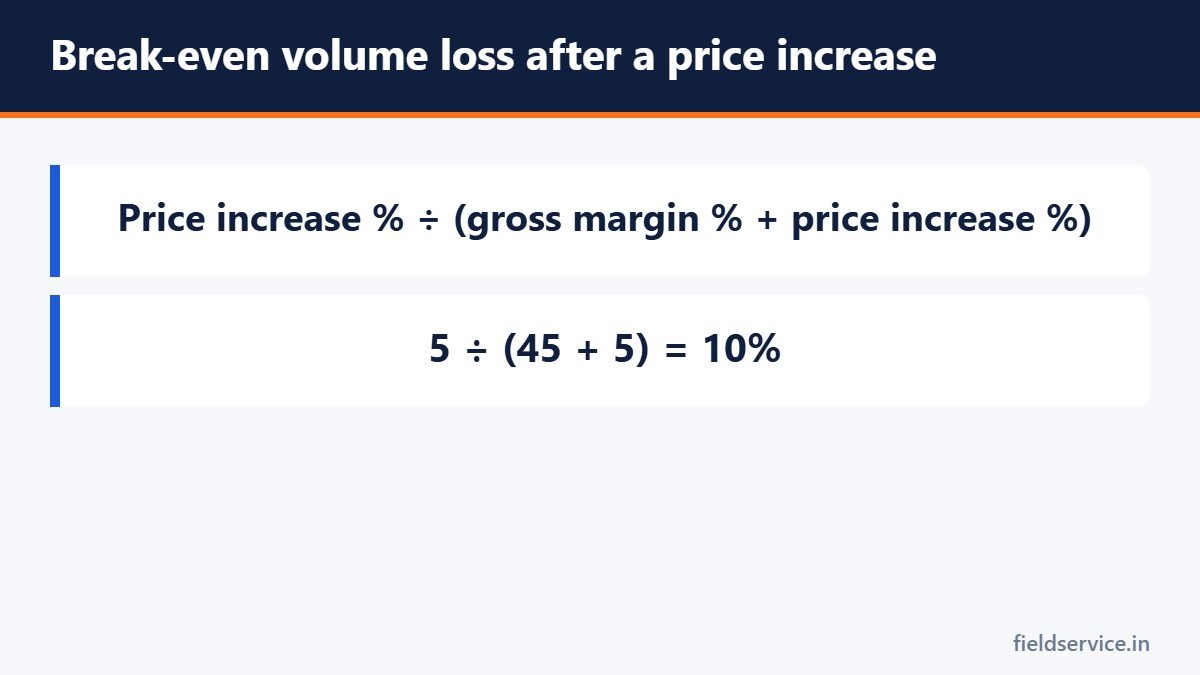
With a 45 percent gross margin and a 5 percent increase, you could lose 10 percent of your jobs and earn the same gross profit as before, while doing less work. In practice, a 5 percent increase rarely loses anything close to one customer in ten.
How to raise prices
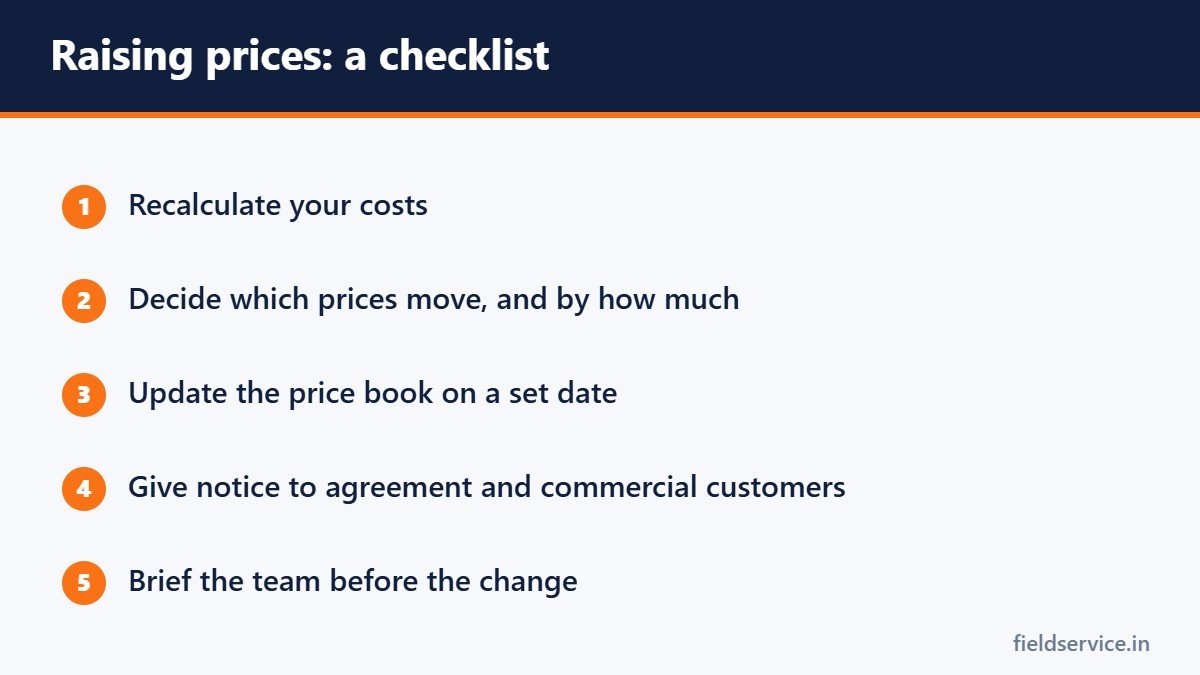
Start from your costs
Recalculate what a call costs you today. See how to price a service call, loaded labor cost and the service call minimum price calculator.
Choose small, regular increases
An increase of a few percent each year is easier for customers to accept than a 20 percent jump after five years of none.
Be selective
Not every price needs to move by the same amount. Look at where your margin is thinnest: the service call fee, small parts, after-hours work, jobs at the edge of your service area. Customers are far less sensitive to the price of an occasional emergency repair than to something they buy regularly and can compare.
Update the price book in one go
Change everything on a set date, so that every technician is quoting the same prices.
Add value where you can
A longer warranty on repairs, a tighter arrival window or a follow-up call costs little and gives customers something to associate with the new price.
Telling customers
- New and one-off customers do not need an announcement. The price is simply the price.
- Agreement and contract customers should be given notice in writing before renewal, as their agreement requires.
- Commercial accounts should get a letter or email with the new rates and the date they take effect, 30 to 60 days ahead.
Keep the message short. Thank them for their business, state the new rate and the date, and give a brief, honest reason, such as increases in the cost of labor, parts and insurance. Do not apologize at length, and do not invent reasons.
Prepare the team
Technicians and office staff are the ones who say the new price to the customer. If they do not believe in it, customers can tell.
- Explain why prices are changing and what the money pays for, including their own wages.
- Go through the new price book with them.
- Practice a simple answer to “that is more than last time”: “Yes, our prices went up this year, as our costs have. That price covers the part, the labor and a one-year warranty on the repair.”
- Make it clear that technicians should not discount on their own authority.
See how to explain a repair to a customer.
Handling objections
Some customers will comment. Most are checking, not leaving. Acknowledge it, restate what the price includes and move on. A few will go elsewhere. If the customers who leave are the ones who chose you only for the lowest price, the business is usually better off: they were the least profitable and the most likely to complain.
What not to do
- Raise prices and cut the quality of service at the same time
- Add surprise fees to the invoice in place of an honest price
- Apologize for the price
- Raise prices for existing agreement customers without the notice their agreement requires
- Copy a competitor’s price list without knowing your own costs
- Wait for a perfect moment
Measure the result
For three months after the change, watch:
- Close rate. A small dip is normal. A large one means look again.
- Average ticket and gross margin, which should rise.
- Job count and agreement renewals.
- Reviews and complaints that mention price.
Then recalculate your break-even point. A higher margin lowers it.
Make it routine
Put a pricing review in the calendar once a year, at the same time you review wages and insurance. A business that adjusts prices a little each year never has to make a painful large increase, and its customers get used to it.
Related guides
- How to Write a Service Estimate Customers Understand and Accept
- Arrival Windows: How to Schedule Service Calls Customers Can Plan Around
- Service Business Overhead: What Counts and How to Calculate It
Three Excel workbooks that take you from what a technician costs to what to charge, then show whether each job made money.
Not sure yet? Try two forms free or see all packs.
Frequently asked questions
How much should a service business raise its prices?
Base the increase on how your costs have changed and on the margin you need. Small annual increases of a few percent are easier for customers to accept than large, infrequent ones.
Will I lose customers if I raise prices?
Some, possibly, but usually far fewer than owners fear. With a 45 percent gross margin, a 5 percent increase leaves gross profit unchanged even if 10 percent of jobs are lost.
Should I tell customers about a price increase?
Customers with maintenance agreements or contracts should get written notice ahead of time. One-off customers are simply quoted the current price.
How often should prices be reviewed?
At least once a year, and whenever wages, insurance, fuel or parts costs change significantly.
This article is general information and is not financial advice.