

“No hot water” is one of the most common service calls there is. Tank water heaters are simple machines, and a methodical approach finds most faults in a few minutes. This water heater troubleshooting guide covers standard gas and electric storage heaters: what the symptoms point to, how to test the usual suspects, and when replacement is the honest recommendation.
Start with questions and the data plate
- Is there no hot water at all, not enough, or water that is too hot?
- Did it change suddenly or gradually?
- Has anything changed in the house: more people, a new fixture, recent plumbing or electrical work?
- How old is the heater? The serial number on the data plate usually encodes the date of manufacture.
- Is it gas or electric, and what are the tank size and input rating?
Look at the heater before you touch it. Water in the pan, rust at the base, scorch marks around a gas burner door or a melted wire nut at the junction box can tell you most of the story.
Safety first
- Electric heaters are usually 240 volts. Turn off the breaker, lock it out where you can, and prove the circuit is dead with a meter before removing a cover. See lockout/tagout basics.
- Never energize an electric element in an empty or partly filled tank. It will burn out in seconds.
- If you smell gas, do not operate switches or light anything. Follow your company’s gas leak procedure.
- Water at 140°F can scald in seconds. Take care when draining and testing.
- Never plug or cap a temperature and pressure relief valve or its discharge pipe.
Symptoms and likely causes
| Symptom | Electric heater | Gas heater |
|---|---|---|
| No hot water | Tripped breaker; tripped high-limit reset; failed upper element or upper thermostat | Pilot out; failed thermocouple or flame sensor; gas supply off; failed gas control |
| Not enough hot water | Failed lower element or lower thermostat; broken dip tube; sediment | Thermostat set low; broken dip tube; sediment; undersized tank |
| Water too hot | Thermostat set high or stuck closed; element shorted to ground | Thermostat set high; faulty gas control |
| Rumbling or popping | Sediment on the lower element | Sediment on the tank bottom |
| Rotten egg smell | Reaction between the anode rod and bacteria in the water | Same |
| Water at the base | Leaking element gasket, fitting or relief valve; tank failure | Leaking fitting or relief valve; condensation; tank failure |
Electric water heaters
A standard residential electric heater has two elements and two thermostats that do not run at the same time. The upper element heats the top of the tank first. When the top is hot, the upper thermostat switches power to the lower element. This sequence explains the two classic complaints:
- No hot water at all: suspect the supply, the high-limit reset, the upper element or the upper thermostat.
- A little hot water that runs out quickly: the upper element is working and the lower one is not. Suspect the lower element or lower thermostat.
Testing an element
- Turn off the breaker and verify zero voltage at the element terminals.
- Disconnect at least one wire from the element.
- Measure resistance across the two terminals and compare it with the expected value.
- Measure from each terminal to the tank. Any continuity to ground means the element has failed.
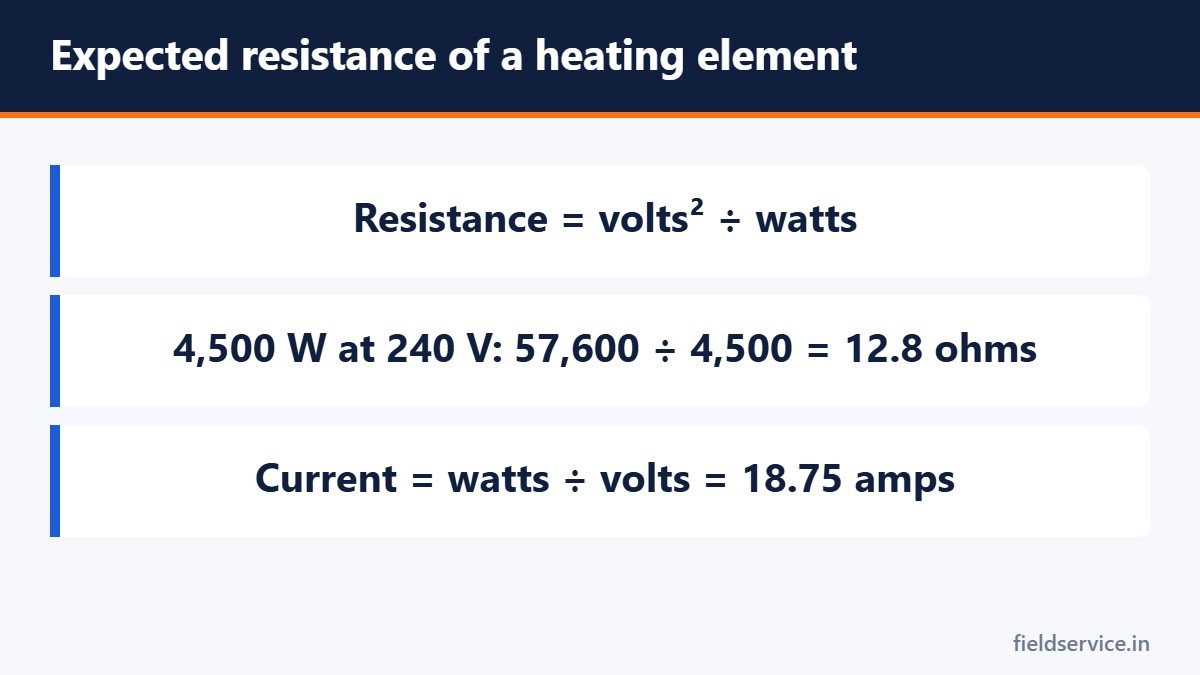
An open reading means a burned-out element. For the math behind this, see Ohm’s law for technicians, and for meter technique see how to use a multimeter.
If the red high-limit reset button has tripped, find out why before you simply reset it. A thermostat stuck closed, a grounded element that heats continuously, or a thermostat that is not held flat against the tank are the usual causes.
Gas water heaters
- Pilot will not stay lit: on standing-pilot heaters, a weak or failed thermocouple is the most common cause. Check that the pilot flame fully surrounds the tip, and test the thermocouple’s millivolt output against the manufacturer’s figure.
- Pilot or burner starved of air: newer heaters have a sealed combustion chamber with a flame arrestor and an air intake screen. Lint and dust clog them, and the heater shuts down on its thermal switch. Clean them as the manufacturer directs.
- Electronic ignition models: read the status light on the gas control. The flash code is listed on the label.
- Burner: the flame should be steady and mostly blue. Yellow, lifting or sooty flames call for cleaning and a check of gas pressure and combustion air.
- Venting: check the draft hood and vent connector for spillage, corrosion and correct slope. Carry a carbon monoxide monitor; see carbon monoxide safety.
Checks that apply to both types

A setting of about 120°F is a common recommendation for most households, because it reduces both scald risk and standby heat loss. Some situations call for a higher storage temperature with a mixing valve; follow local code and the customer’s needs.
Repair or replace?
Elements, thermostats, thermocouples, gas controls, relief valves and anode rods can all be replaced. A leaking tank cannot be repaired. If water is coming from the tank itself and not from a fitting, valve or element gasket, the heater needs replacing.
For an older heater with a failed major part, give the customer both prices and the facts: the age of the tank, its condition and what else is likely to fail. Our guide on offering good, better, best options shows how to present that choice fairly.
Related guides
Sources
Six everyday forms in Word and PDF, plus Excel workbooks that total mileage reimbursement and overtime pay.
Not sure yet? Try two forms free or see all packs.
Frequently asked questions
Why does an electric water heater run out of hot water quickly?
The most common cause is a failed lower element or lower thermostat. The upper element still heats the top of the tank, so there is a small amount of hot water that runs out fast.
What resistance should a 4,500-watt element read?
About 12.8 ohms at 240 volts. Resistance equals voltage squared divided by wattage. An open reading means the element has burned out.
Why will the pilot light not stay lit?
On standing-pilot heaters, the usual cause is a weak or failed thermocouple. A dirty pilot, a clogged air intake screen or a faulty gas control can also cause it.
What temperature should a water heater be set to?
About 120°F is a common recommendation for most households. Local codes or specific needs may call for a different setting, sometimes with a mixing valve.
Can a leaking water heater tank be repaired?
No. Leaks from fittings, valves and element gaskets can be fixed, but a tank that leaks through its own wall must be replaced.
This article is general information for trained technicians. It does not replace manufacturer instructions, local plumbing, gas and electrical codes or licensing requirements.