


The multimeter is the tool a service technician reaches for most. It answers the first questions on almost any electrical fault: is power present, is the circuit complete, and is the component drawing what it should? This guide covers the basic measurements and the habits that keep you safe while taking them.
What a multimeter measures
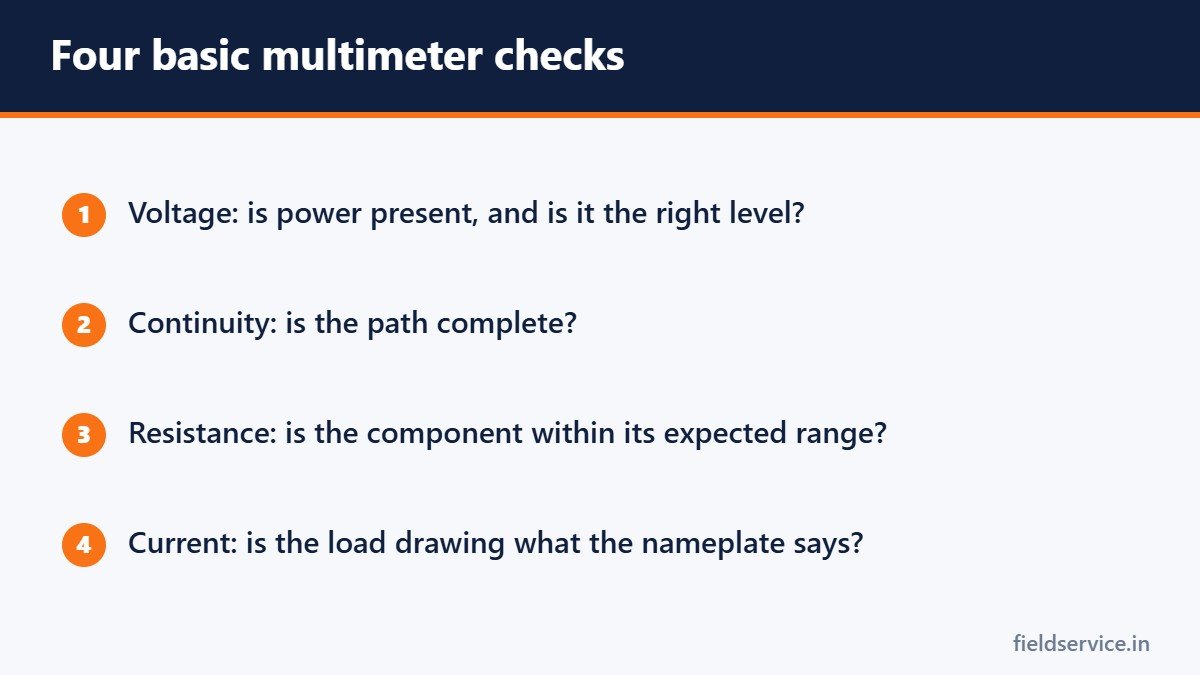
- AC voltage: the supply in homes and buildings.
- DC voltage: batteries, control boards and many sensors.
- Resistance in ohms: the opposition of a component to current.
- Continuity: a quick check, usually with a beep, that a path is complete.
- Current in amps: often measured with a clamp around a single wire.
Many meters also measure capacitance, frequency and temperature.
Measuring voltage
- Set the dial to AC or DC volts, whichever matches the circuit.
- Put the black lead in the COM jack and the red lead in the jack marked V.
- Touch the probes across the two points you want to compare, such as line to neutral or line to line.
- Read the display and compare it with what the equipment expects.
Voltage is measured across a component, with the circuit powered.
Measuring resistance and continuity
- Turn the power off and confirm that it is off.
- Isolate the component by disconnecting at least one lead, so you are not reading through other parts of the circuit.
- Set the meter to ohms or continuity and touch a probe to each end.
A reading near zero means a complete path. “OL” on most meters means open, with no path. Never take a resistance reading on a live circuit. It gives a false reading and can damage the meter.
Measuring current
A clamp meter measures current without breaking into the circuit. Clamp the jaws around one conductor only. Clamping around a cable that contains both the hot and the neutral gives a reading near zero, because the two currents cancel. Compare your reading with the amps on the equipment nameplate.

Category ratings
Meters and leads carry a category rating that describes where they are safe to use. As a general guide, CAT II covers loads plugged into a receptacle, CAT III covers distribution panels and fixed wiring in a building, and CAT IV covers the service entrance. Use a meter and leads rated for the place you are working and for the voltage present.
Habits that keep you safe
- Check your meter on a known live source before and after you test a circuit you believe is dead.
- Inspect leads for cracks and exposed metal before each use.
- Confirm the dial setting and the lead jacks before touching the probes to anything.
- Keep your fingers behind the guards on the probes.
- Wear the protective equipment your employer requires.
Common mistakes
- Leaving the red lead in the amps jack and then measuring voltage. This creates a short through the meter.
- Measuring resistance with power on.
- Reading through parallel paths because the component was not isolated.
- Trusting a meter with a weak battery.
Once the basics are routine, Ohm’s law tells you what the readings should be. This article is an educational overview and does not replace training, manufacturer instructions or your employer’s safety procedures.
Related guides
- How to Onboard a New Technician: A 90-Day Plan
- GFCI vs. AFCI: What Is the Difference?
- Superheat and Subcooling Explained for HVAC Technicians
Six everyday forms in Word and PDF, plus Excel workbooks that total mileage reimbursement and overtime pay.
Not sure yet? Try two forms free or see all packs.