


Most service calls on heating, cooling and appliance equipment come down to an electrical question. Is the right voltage arriving? Is the component drawing the current it should? Ohm’s law is the relationship that connects those readings, and a technician who is comfortable with it troubleshoots faster and guesses less.
The three quantities
- Voltage, measured in volts (V), is the electrical pressure pushing current through a circuit.
- Current, measured in amperes or amps (A), is the rate at which charge flows.
- Resistance, measured in ohms (Ω), is how much the circuit opposes that flow.
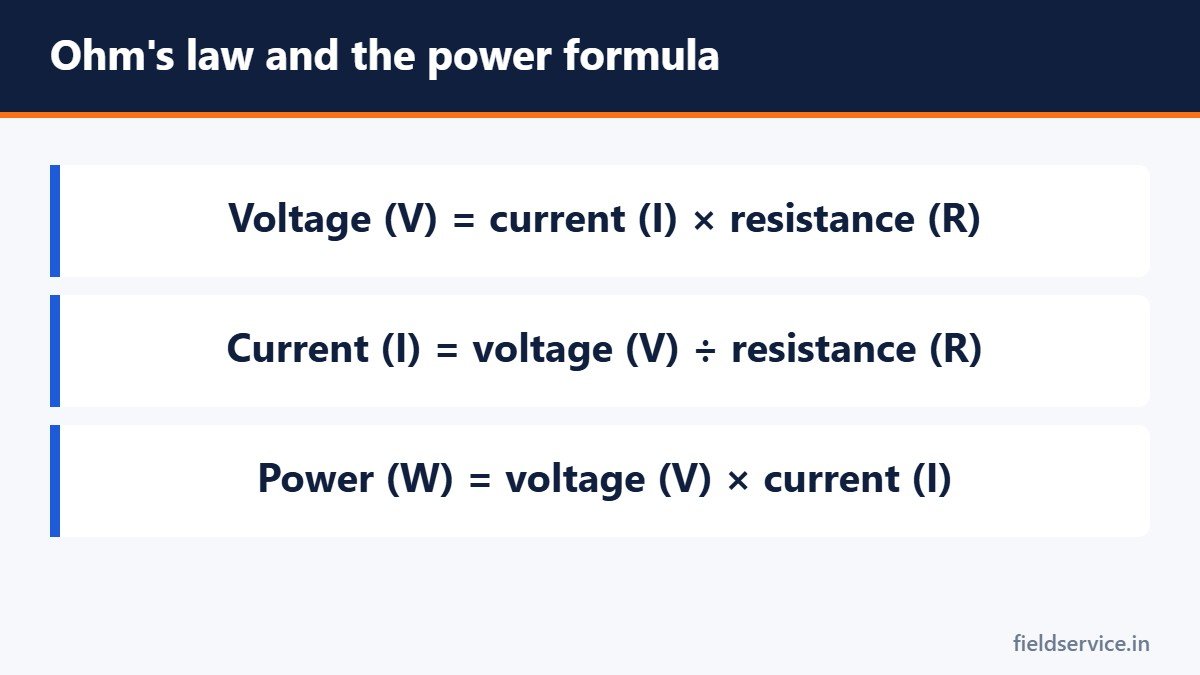
Ohm’s law says voltage equals current multiplied by resistance. Rearranged, current equals voltage divided by resistance, and resistance equals voltage divided by current. If you know any two, you can work out the third.
Adding power
Power, in watts (W), is voltage multiplied by current. Combined with Ohm’s law it lets you move between a nameplate wattage and the amps you should see on your meter.
Worked examples
A water heater element
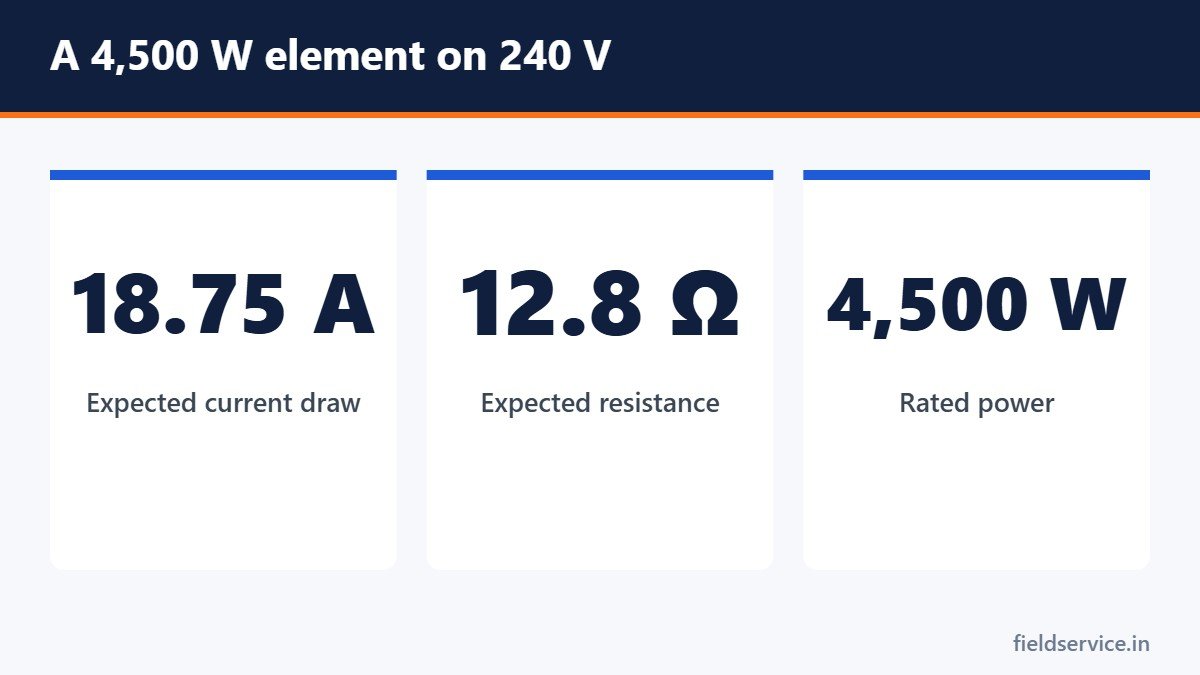
A 4,500-watt element on a 240-volt supply should draw 4,500 ÷ 240 = 18.75 amps. Its resistance should be about 240 ÷ 18.75 = 12.8 ohms. With the power off and the wires removed, an element that reads open or far from that value on your meter has failed.
A portable heater
A 1,500-watt heater on a 120-volt circuit draws 1,500 ÷ 120 = 12.5 amps. That is most of what a 15-amp circuit can supply, which explains why the breaker trips when something else is plugged into the same circuit.
How it helps you troubleshoot
- Low current on a resistive load with correct voltage means resistance is higher than it should be. Look for a failing element or a poor connection.
- High current means resistance is lower than it should be, as with a shorted winding or a partial short to ground.
- No current with voltage present means an open circuit somewhere in the path.
- Low voltage at the load with good voltage at the source points to voltage drop in the wiring or across a bad connection.
Voltage drop
Wire has resistance. The longer the run and the smaller the wire, the more voltage is lost before it reaches the equipment. A loose or corroded connection behaves like a resistor in series with the load. It takes some of the voltage for itself and turns it into heat, which is why bad connections discolor and burn. Measuring voltage across a connection while the circuit is under load is a quick way to find one. A good connection shows almost no voltage across it.
Where the simple formula stops
Ohm’s law in this form is exact for resistive loads such as heating elements. Motors and compressors on alternating current also have inductance, so their current depends on more than simple resistance, and a resistance reading on a motor winding will not predict its running amps. For those loads, compare your amp reading with the nameplate values.
Work safely
- Take resistance readings only with the power off and verified off.
- Use a meter and leads rated for the voltage and the location you are working in.
- Follow lockout and tagout procedures and your employer’s safety rules.
This article is an educational overview. Always follow manufacturer instructions and applicable electrical codes.
Related guides
- How to Use a Multimeter: A Field Guide for New Technicians
- HVAC Unit Conversions Every Technician Should Know
- Superheat and Subcooling Explained for HVAC Technicians
Six everyday forms in Word and PDF, plus Excel workbooks that total mileage reimbursement and overtime pay.
Not sure yet? Try two forms free or see all packs.