

A technician opens the disconnect on a rooftop unit, starts work on the fan motor, and a building employee who wonders why the air conditioning is off switches it back on. Incidents like this injure and kill workers every year. Lockout/tagout is the procedure that prevents them. It makes sure equipment cannot be energized, and cannot release stored energy, until the person working on it says so.
What lockout/tagout means
- Lockout is placing a lock on an energy-isolating device, such as a disconnect switch, breaker or valve, so that it cannot be operated.
- Tagout is attaching a warning tag that identifies who locked it out and why.
A lock physically prevents the equipment from being energized. A tag on its own is only a warning, so a lock is used wherever the device can accept one. OSHA’s standard on the control of hazardous energy, 29 CFR 1910.147, sets the requirements for general industry.
It is not only electricity
Hazardous energy includes:
- Electrical energy, including the charge stored in capacitors
- Mechanical energy in moving or spring-loaded parts
- Pressure in refrigerant, compressed air, steam, water and hydraulic systems
- Thermal energy in hot or very cold surfaces and fluids
- Gravity, where a part could fall
- Chemical energy, including fuel gas
The steps
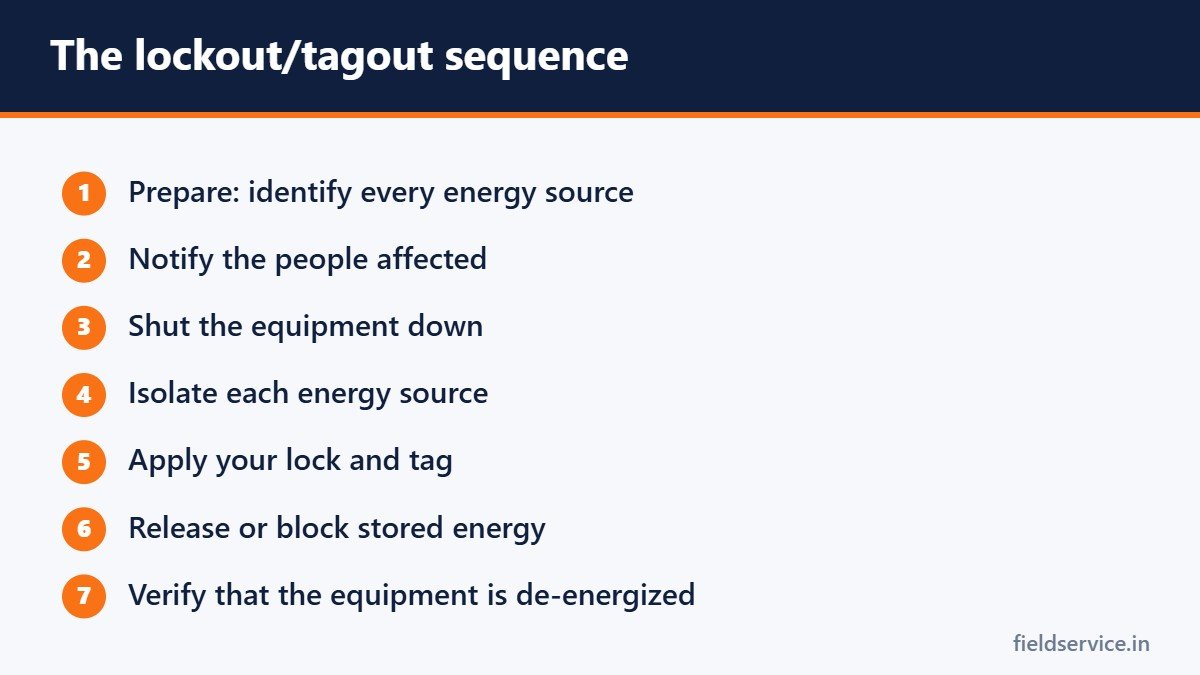
1. Prepare
Identify every source of energy feeding the equipment. Rooftop units, for example, can have more than one electrical supply, plus gas.
2. Notify
Tell the people who use or operate the equipment that it is being shut down and locked out.
3. Shut down
Turn the equipment off using its normal controls.
4. Isolate
Open the disconnect, switch off the breaker, close the valve. Do this for every energy source.
5. Lock and tag
Put your own lock and tag on each isolating device. Keep the key with you.
6. Deal with stored energy
Discharge capacitors with a suitable tool, bleed pressure, block parts that could move and let hot surfaces cool.
7. Verify
Test with a meter to confirm there is no voltage. Check your meter on a known live source before and after the test. Try the equipment’s start control to confirm it does not run, then return the control to off.
Restoring power
- Remove tools and check that guards and panels are back in place.
- Make sure everyone is clear of the equipment.
- Remove your lock and tag.
- Tell the affected people that the equipment is going back into service.
- Re-energize and test.
One person, one lock
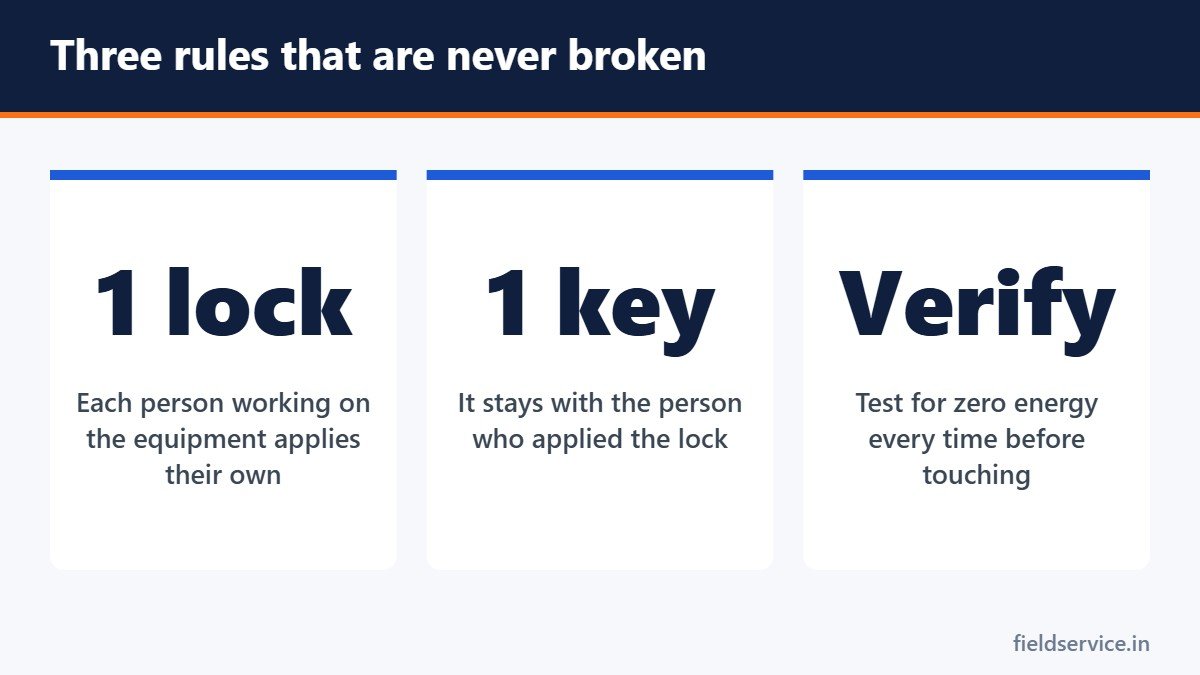
Every person working on the equipment applies their own lock. A lock is removed only by the person who put it on. When several people work on the same equipment, a multi-lock hasp lets each of them attach a lock, and the equipment stays locked out until the last lock comes off. Never remove someone else’s lock. Employers have a specific procedure for the rare case where the person is not available, and it is not something to improvise.
Shortcuts that hurt people
- Relying on a thermostat, control switch or emergency stop in place of a disconnect
- Opening a disconnect without locking it
- Skipping verification because “it is obviously off”
- Forgetting a second power supply or the control circuit
- Not discharging capacitors
- Assuming a breaker is labeled correctly
- Leaving the key in the lock
What about plug-in equipment?
The OSHA standard does not apply to work on cord-and-plug equipment when unplugging it removes the hazard and the plug stays under the exclusive control of the person doing the work. In practice that means the plug is within your reach and sight the whole time. If you walk away, someone can plug it back in.
In customers’ homes
Residential panels and disconnects are often unlabeled or mislabeled, and homeowners reset breakers without thinking. A breaker lockout device and a tag cost very little and fit in a tool bag. Tell the customer that the power is off and must stay off, then verify with your meter anyway.
A basic lockout kit
- Personal padlocks, keyed differently from anyone else’s
- Tags with your name
- Breaker lockout devices in the common sizes
- A multi-lock hasp
- Valve and plug lockouts suited to your trade
- A meter you trust, and the habit of testing it
What employers must provide
Under the OSHA standard, employers are required to have a written energy control program, equipment-specific procedures, training for employees and periodic inspections of the procedures. Electrical work is also covered by OSHA’s electrical safety-related work practice rules. Ask to see your company’s procedure, and follow it over any general guide.
For meter technique, see how to use a multimeter. For capacitors, see how to test a run capacitor.
Seven safety forms in Word and PDF, plus an Excel log that counts incidents, open actions and safety meetings.
Not sure yet? Try two forms free or see all packs.
Frequently asked questions
What is the difference between lockout and tagout?
Lockout uses a lock to physically prevent an energy-isolating device from being operated. Tagout uses a warning tag. A tag alone does not prevent the equipment from being energized, so a lock is used wherever the device can accept one.
Who can remove a lockout lock?
Only the person who applied it. Employers have a specific procedure for the rare situation where that person is unavailable.
Do I need lockout/tagout for plug-in equipment?
The OSHA standard does not apply when unplugging the equipment removes the hazard and the plug stays under the exclusive control of the person doing the work.
Why verify if the disconnect is already off?
Disconnects fail, panels are mislabeled and equipment can have more than one supply. Testing with a meter you have checked on a live source is the only way to know the equipment is de-energized.
This article is a general overview. Follow OSHA requirements and your employer’s energy control procedures.
Related guides
- What to Keep in a Service Vehicle: A Practical Stocking Guide
- How to Document a Service Call: A Checklist for Technicians
- PPE for Field Technicians: What to Wear and When