


Every building needs water brought in and waste taken out, and those systems leak, clog, corrode and wear. That makes plumbing one of the most dependable trades to work in. It pays well, the training is paid, and a licensed plumber can work for a contractor, a facility, a utility or themselves. Here is how people get into the trade and what to expect along the way.
What plumbers do
Plumbers install and repair pipes, fixtures and equipment that carry water, waste, gas and other fluids. The work covers water supply lines, drain, waste and vent systems, water heaters, fixtures, gas piping and, in many areas, hydronic heating. Pipefitters and steamfitters, who are grouped with plumbers in government statistics, work mainly on industrial and commercial piping for heating, cooling, steam and process systems.
Plumbing splits into service work, where you diagnose and repair problems in existing buildings, and construction work, where you install systems in new buildings and remodels. Service plumbers deal with customers all day. Construction plumbers work from drawings on job sites.
Pay and job outlook
| Measure | Figure |
|---|---|
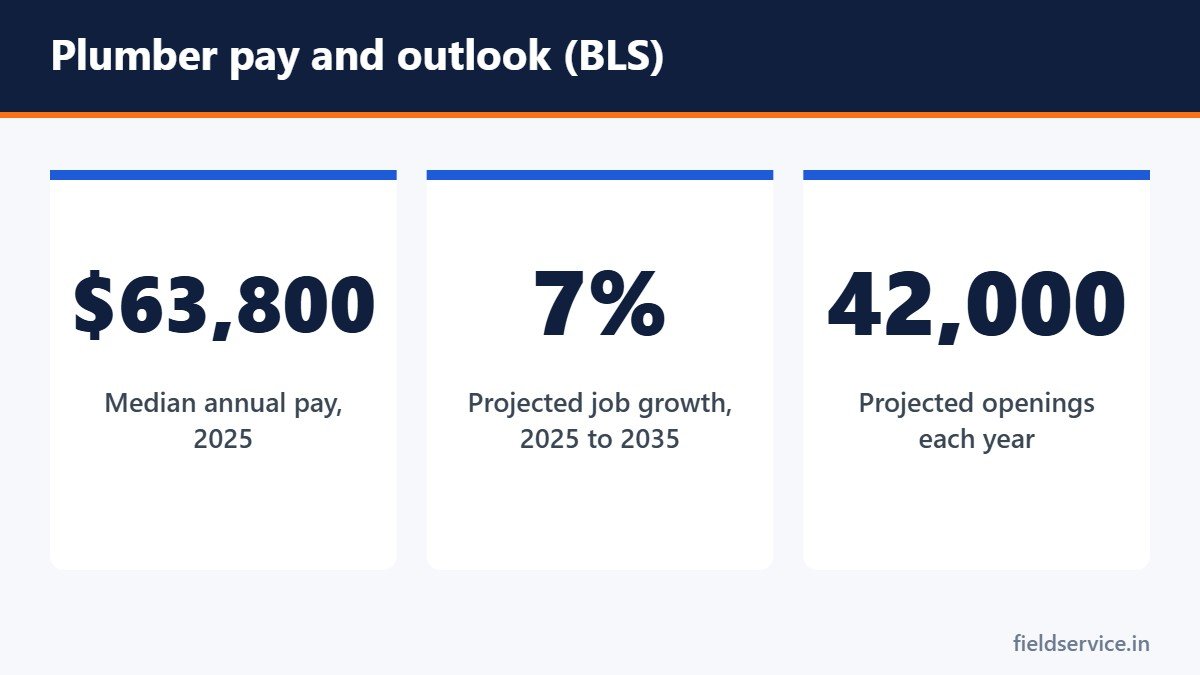
| Median pay, 2025 | $63,800 a year ($30.67 an hour) |
| Lowest 10 percent earned | Less than $44,150 |
| Highest 10 percent earned | More than $108,420 |
| Jobs, 2025 | 510,600 |
| Projected growth, 2025 to 2035 | 7 percent |
| Projected openings each year | About 42,000 |
These figures come from the U.S. Bureau of Labor Statistics and cover plumbers, pipefitters and steamfitters together. The BLS describes the projected growth as much faster than the average for all occupations. Service plumbers often add overtime and on-call pay to the base wage. Use the hourly to annual pay calculator to see what a rate comes to.
The apprenticeship
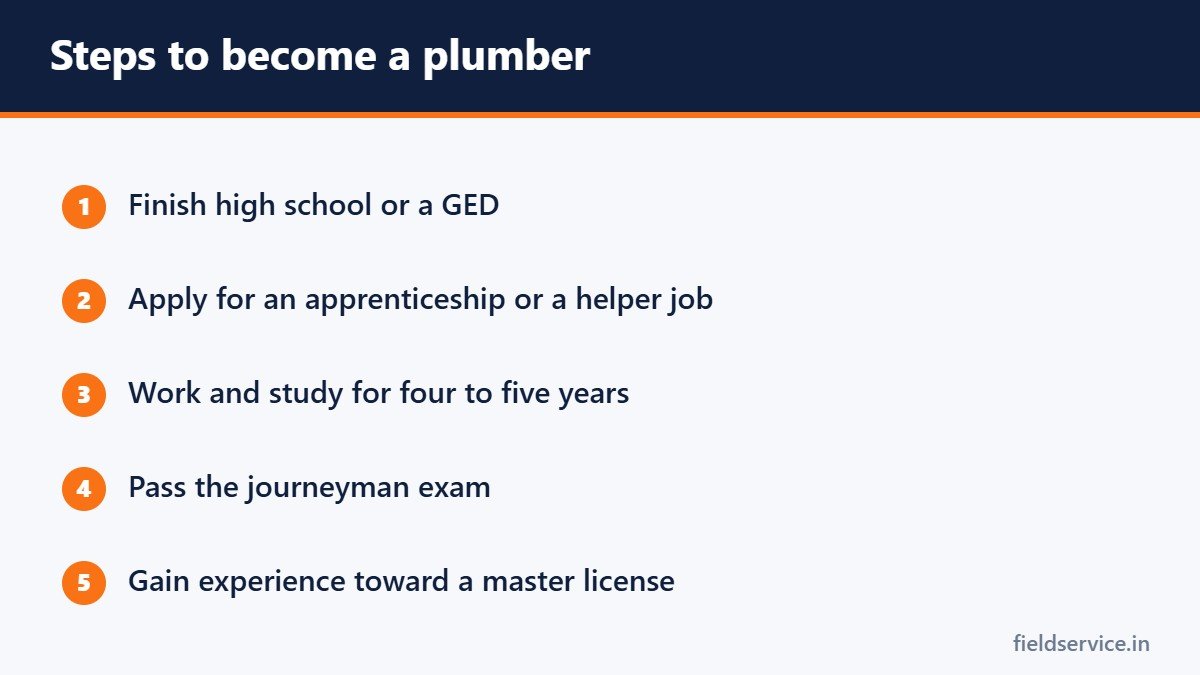
Most plumbers learn through an apprenticeship of four to five years, which combines paid work under a licensed plumber with classroom instruction. Apprentices study plumbing codes, blueprint reading, math, safety and the science behind water pressure, drainage and venting. Pay starts at a percentage of the journeyman rate and rises each year.
Apprenticeships are offered by union and contractor joint programs, by non-union contractor associations and by individual plumbing companies. Typical requirements are a high school diploma or equivalent, a minimum age of 18, a driver’s license and, for many programs, an aptitude test and a drug screen.
Other ways in
- Trade school. Certificate programs teach the basics and may count toward apprenticeship hours in some states.
- Helper jobs. Some people start as a helper with a plumbing contractor and move into an apprenticeship from there.
Our comparison of trade school and apprenticeship looks at the two routes in more detail.
Licensing
Most states require plumbers to be licensed, and some leave it to cities and counties. The usual sequence is apprentice, then journeyman, then master. To become a journeyman you need documented work hours and a pass on an exam covering the plumbing code and the trade. A master license needs further experience and another exam, and in many places it is required to pull permits and run a plumbing business.
Additional certifications apply to some work. Backflow prevention testing and medical gas installation each have their own credentials, and gas work is licensed separately in some states. See apprentice, journeyman and master for how the levels work.
Skills that matter
- Mechanical aptitude and comfort with tools
- Problem solving. Finding a leak or a blockage you cannot see takes method.
- Math for pipe sizing, slopes and offsets
- Physical stamina. The work involves lifting, crawling and awkward positions.
- Customer skills for service work. See how to explain a repair to a customer.
- Knowledge of the code adopted where you work
What the work is really like
It is physical, and some of it is unpleasant. Drain cleaning and sewer repairs are part of the trade. Service plumbers work in crawl spaces and under sinks, and emergencies come at night and on holidays. Construction plumbers work on open sites in heat and cold. In return, the skills are always in demand, the pay rises with experience and the work changes every day.
Where it can lead
Experienced plumbers become foremen, estimators, project managers, inspectors and instructors. Specialties such as medical gas, fire sprinkler fitting, hydronics and backflow testing pay a premium. Many plumbers eventually run their own business. Before setting prices, read how to price a service call.
Six everyday forms in Word and PDF, plus Excel workbooks that total mileage reimbursement and overtime pay.
Not sure yet? Try two forms free or see all packs.
Frequently asked questions
How long does it take to become a plumber?
Most apprenticeships take four to five years. After completing the required hours you can sit the journeyman exam in states that require a license.
How much do plumbers make?
The U.S. Bureau of Labor Statistics reports median pay of $63,800 a year in 2025 for plumbers, pipefitters and steamfitters. The highest 10 percent earned more than $108,420.
Do plumbers need a license?
In most states, yes. Requirements are set by each state, and sometimes by cities or counties, so check with the licensing board where you plan to work.
Is plumbing a good career?
Demand is steady, training is paid and the BLS projects 7 percent employment growth from 2025 to 2035. The work is physical and includes emergency calls, which suits some people better than others.
Related guides
- How to Become an Electrician: Training, Licensing and Pay
- How to Become an HVAC Technician: Pay, Training and Certification
- HVAC vs. Electrician vs. Plumber: Comparing the Three Big Service Trades