


Many technicians dislike selling. They diagnose the fault, quote the cheapest repair and leave. The customer never hears that the contactor is pitted or that the system has no surge protection, and three months later calls someone else when it fails. Good, better, best pricing is a simple way to fix this. You present three options, explain each one honestly, and let the customer decide. It is not a pressure technique. It is a way of giving people the full picture.
What good, better, best pricing means
- Good: the repair that fixes today’s problem and nothing else.
- Better: the repair, plus work that deals with related wear you found and reduces the chance of another breakdown soon.
- Best: the most complete solution, which might add protection, an upgrade or a maintenance plan, or replace the equipment when repair no longer makes sense.
All three options must be real. Each should be something you would be comfortable recommending to a family member in that situation.
Why one price is not enough
When you offer a single price, the customer’s only decision is yes or no. When you offer options, the question changes from “should I do this?” to “which of these suits me?” Customers also differ. One plans to sell the house next year and wants the minimum. Another works from home and wants the system to be as reliable as possible. You cannot tell which is which by looking at the driveway, so do not decide for them.
A worked example
An air conditioner is not cooling. You find a failed run capacitor. While testing, you also see a pitted contactor and note that the system has not been maintained for several years.
| Option | What is included | Price |
|---|---|---|
| Good | Replace the failed capacitor and test the system | $189 |
| Better | Capacitor and contactor replaced, condenser coil cleaned | $349 |
| Best | Everything in Better, plus a surge protector and a one-year maintenance plan | $499 |
The prices are examples only. Yours should come from your own costs; see how to price a service call.
What it does to the average ticket
Suppose ten customers have this same fault. If every one is offered only the basic repair, revenue is 10 × $189 = $1,890. Now suppose all ten are shown three options, and five choose Good, four choose Better and one chooses Best:
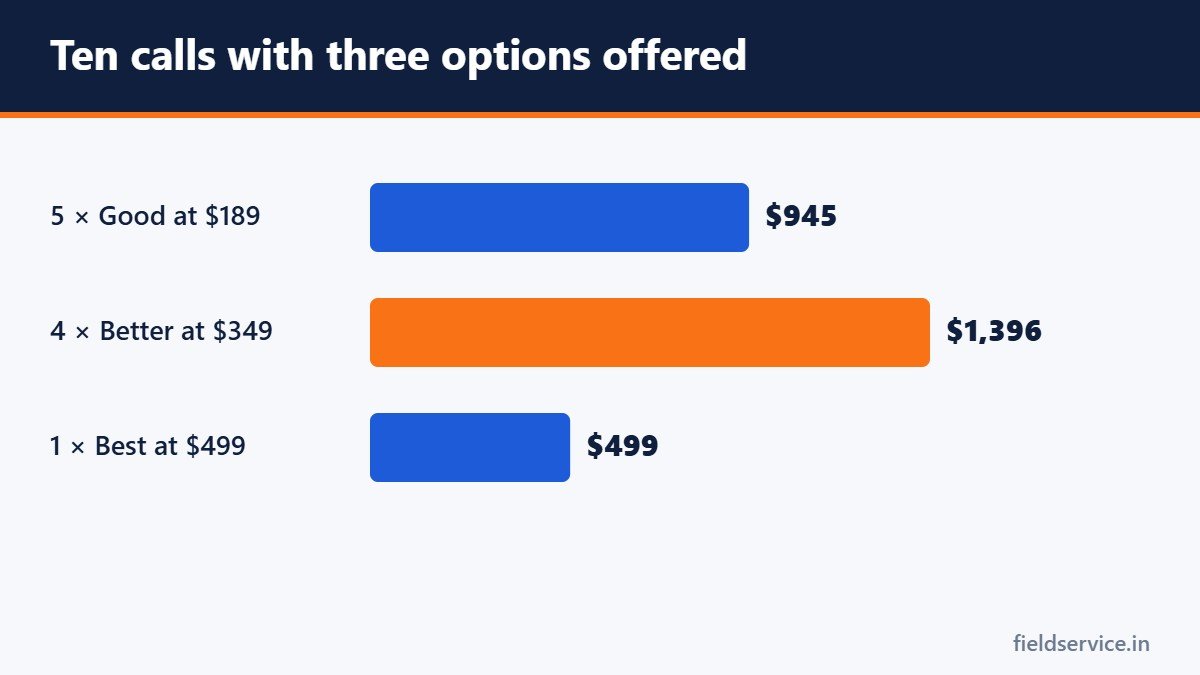
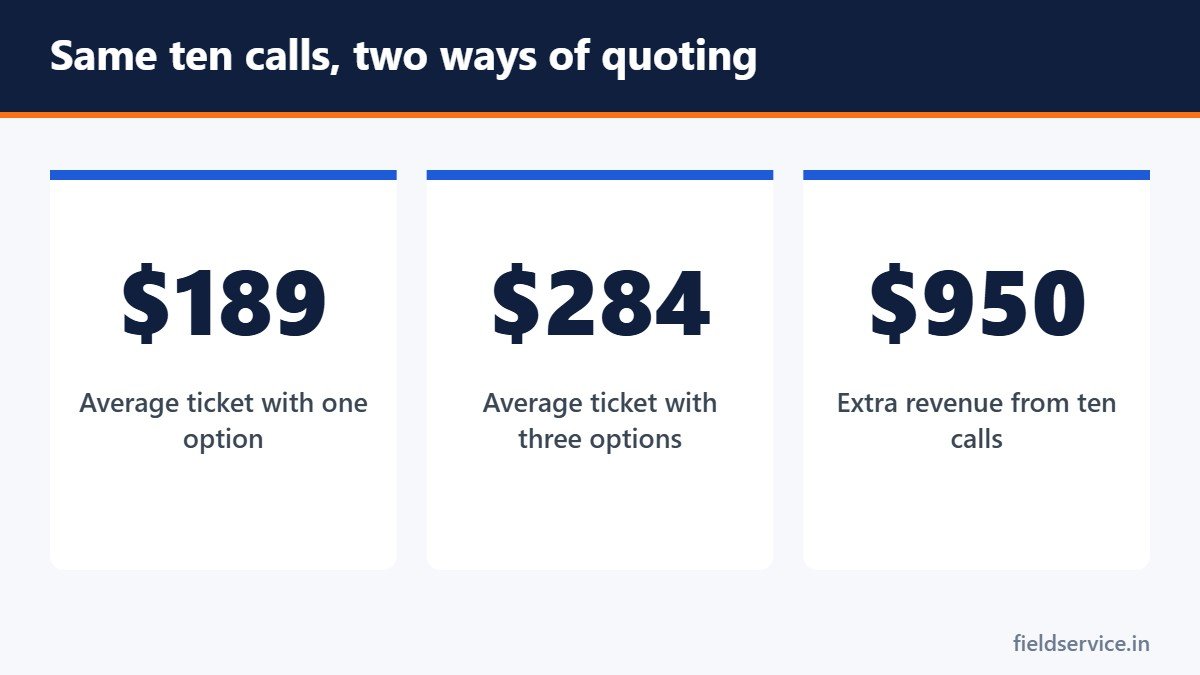
The split between options is an illustration, not a prediction; your own results will differ. Track them with the average service ticket calculator and read more in average service ticket explained.
How to build honest options
- Finish the diagnosis first. Options come from what you measured and saw, not from a script.
- Start with the fix. The Good option must fully solve the problem the customer called about.
- Add what you found. Worn parts, dirty coils, missing safety devices and overdue maintenance belong in Better.
- Think long term. Best addresses reliability, efficiency or the age of the equipment.
- Price each option in full. Give one total per option, not a list of add-ons to total up.
- Write them down. Options on paper or a tablet are easier to compare than three prices said aloud.
How to present the options
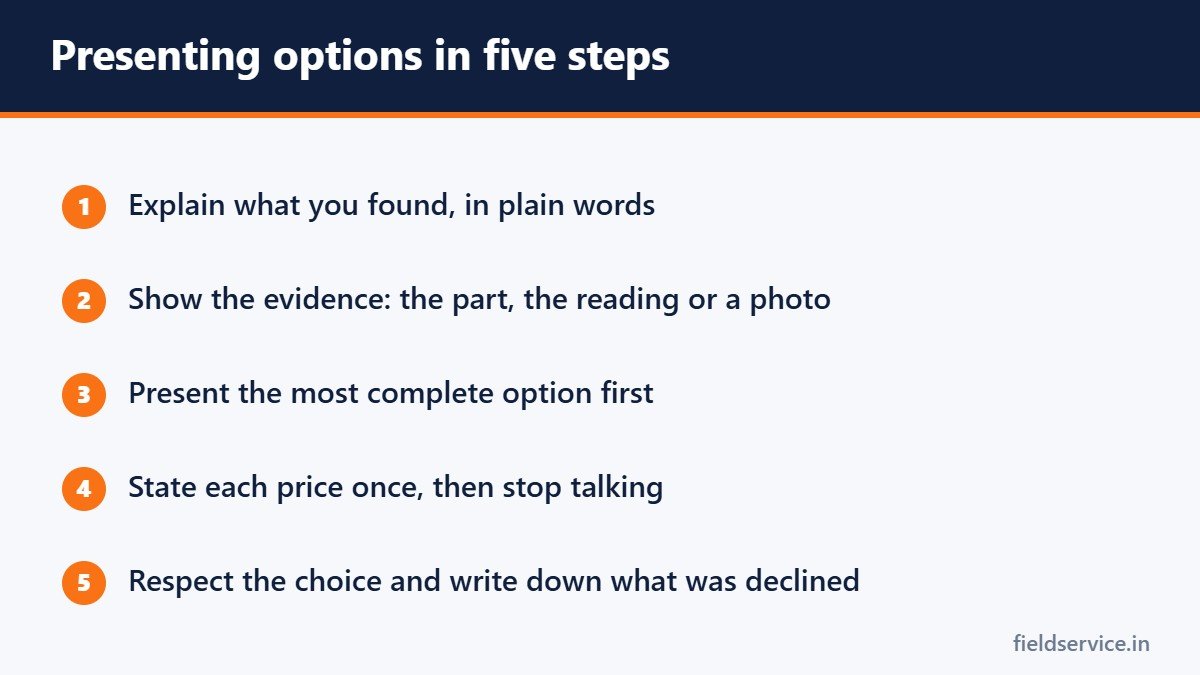
- Explain before you price. People cannot value a repair they do not understand. See how to explain a repair to a customer.
- Show the evidence. A pitted contactor in your hand, or a photo of it, is more convincing than a description. See photos and video on service calls.
- Present from the top down. Starting with the most complete option lets the customer see everything that could be done before choosing how much of it they want.
- Say the price and wait. Give the customer time to think. Filling the silence with more talking sounds like pressure.
- Accept the answer. If they choose Good, do an excellent basic repair. They may choose differently next time because you did not push.
Where the line is
Offering options becomes a problem when the options stop being honest. Do not:
- Invent faults or exaggerate the risk of a part that is fine.
- Make the Good option deliberately poor so nobody chooses it.
- Claim a safety hazard that does not exist.
- Recommend replacement when a sound repair is available, without also offering the repair.
- Keep pressing after the customer has decided.
Customers talk, and reviews last for years. A reputation for straight advice is worth more than any single ticket. If your company pays bonuses on sales, make sure the plan rewards the right behavior; see spiffs and bonuses for technicians.
Record what was declined
Write the options offered and the one chosen on the ticket, and have the customer sign. If the declined contactor fails in August, the record shows you recommended replacing it. It also gives the office a reason to follow up later. Our guide on how to write a service estimate shows how to lay options out.
Measure the result
Two numbers show whether options are working: the average ticket and the close rate. If the average ticket rises and the close rate holds, customers are finding value in the higher options. If the close rate drops, your prices or your explanations need work.
Running a small service business? JobDock, our own field service software, puts scheduling, dispatch, estimates and invoices on your own website for one price, with no fee per technician. Try the live demo.
Related guides
- Maintenance agreements explained
- Flat rate vs time and materials
- How to raise prices in a service business
Three Excel workbooks that take you from what a technician costs to what to charge, then show whether each job made money.
Not sure yet? Try two forms free or see all packs.
Frequently asked questions
What is good, better, best pricing?
It is a way of quoting that gives the customer three options at different prices: a basic repair, a more thorough repair, and the most complete solution. The customer chooses the one that suits their needs and budget.
Is offering options the same as upselling?
Not if the options are honest. Upselling pushes a customer toward something they do not need. Offering options informs the customer about everything you found and leaves the decision with them.
Should I present the cheapest or the most expensive option first?
Many service companies present the most complete option first, so the customer sees the full picture before deciding how much of it they want. Whichever order you use, explain every option fully.
How many options should I offer?
Three is the usual number. Two can feel like a yes-or-no choice, and more than four becomes hard to compare.
What if the customer always picks the cheapest option?
That is their right. Do the basic repair well and note what was declined. If nearly every customer chooses the lowest option, review whether the higher options offer clear value.
The figures in this article are examples. Set your own prices from your own costs.