


Ask a service business owner what a technician costs and the usual answer is the hourly wage. The wage is only the start. Payroll taxes, insurance, benefits and paid time off all sit on top of it, and together they are known as labor burden. The wage plus the burden is the loaded labor cost, and it is the number your prices should be built on.
What goes into labor burden
- Social Security and Medicare (FICA). The employer pays 7.65 percent of wages: 6.2 percent for Social Security, up to the annual wage limit, and 1.45 percent for Medicare.
- Federal unemployment tax (FUTA). The rate is 6 percent on the first $7,000 of each employee’s wages. Most employers receive a credit for state unemployment tax that brings the effective rate to 0.6 percent, or $42 per employee.
- State unemployment tax. Rates and wage bases vary by state and by the employer’s claims history.
- Workers’ compensation insurance. Premiums depend on the state and the trade classification, and they are higher for physical work.
- Health insurance and other benefits. The employer’s share of premiums, retirement contributions and similar costs.
- Paid time off. Holidays, vacation and sick days are paid hours in which no work is done.
A worked example
Take a technician paid $30 an hour for 2,080 hours a year, which is $62,400 in wages. The figures for state unemployment, workers’ compensation and health insurance below are assumptions for illustration. Replace them with your own.
| Item | Annual cost |
|---|---|
| Wages | $62,400.00 |
| FICA at 7.65% | $4,773.60 |
| FUTA | $42.00 |
| State unemployment (assumed) | $400.00 |
| Workers’ compensation (assumed 6%) | $3,744.00 |
| Health insurance (assumed) | $6,000.00 |
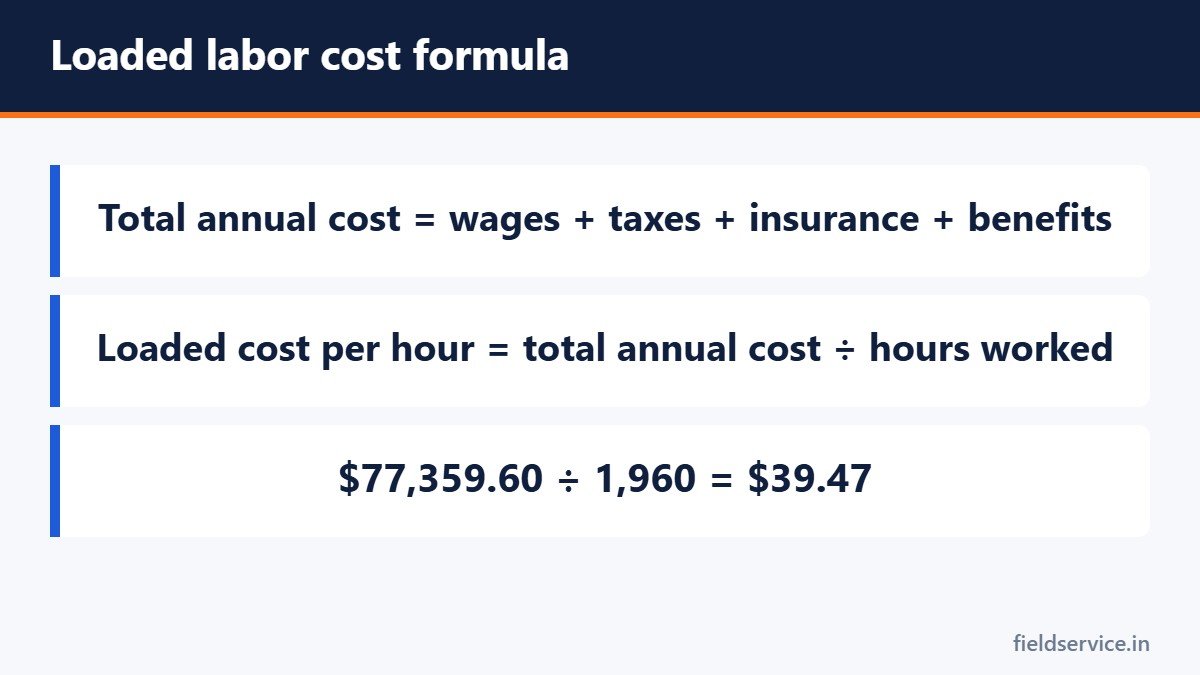
| Total | $77,359.60 |
Now account for paid time off. If the technician has three weeks of holidays and vacation, 120 of those 2,080 hours are paid and not worked. That leaves 1,960 hours on the job.
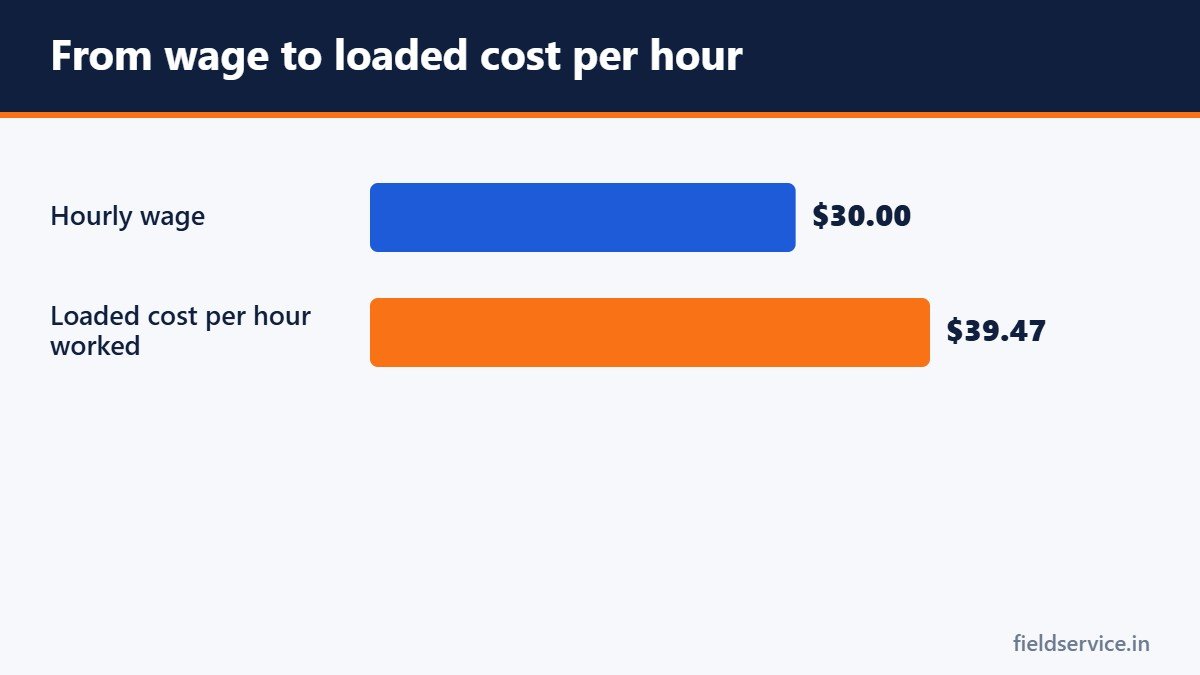
$77,359.60 ÷ 1,960 = $39.47 per hour worked.
The $30 technician costs almost $39.50 for every hour actually worked, about 32 percent more than the wage.
Costs people forget
- Uniforms, boots and safety gear
- Phone and tablet plans
- Training time and course fees
- Tools the company supplies
- Licenses and certifications the company pays for
Some owners count these in labor burden and some in overhead. Either is fine, provided each cost is counted once.
Why it matters
If you price work from the $30 wage, every hour you sell is underpriced by more than $9 before overhead is even considered. Loaded cost is the starting point for:
- Your billable rate. See hourly pay vs. billable rate.
- Your minimum service call price. Use the service call minimum price calculator.
- The cost of drive time. Use the travel time cost calculator.
- The true margin on a job. Use the job gross margin calculator.
How to calculate yours
- Pull last year’s payroll report for each technician.
- Add employer payroll taxes, workers’ compensation and benefits.
- Subtract paid time off from total paid hours to get hours worked.
- Divide total cost by hours worked.
- Repeat whenever wages, insurance rates or benefits change.
Your accountant or payroll provider can confirm the tax figures for your state. This article is general information and is not tax or accounting advice.
Related guides
- How to Set Your Labor Rate as a One-Truck Service Business
- Markup vs. Margin: The Pricing Mistake That Costs Service Businesses Money
- What Is a Trip Charge and How Should You Set One?
Sources
- IRS Topic no. 751, Social Security and Medicare withholding rates
- IRS Topic no. 759, Form 940 and federal unemployment (FUTA) tax
Three Excel workbooks that take you from what a technician costs to what to charge, then show whether each job made money.
Not sure yet? Try two forms free or see all packs.