

“We will be there between eight and five” was once normal for home service. Customers now expect better, and the company that offers a two-hour window and keeps it wins work from the one that cannot say when it will arrive. Narrow windows are harder to keep, though, and a promise broken does more harm than a wide window honestly kept. Choosing the right window is a balance between what customers want and what your schedule can deliver.
The main options
| Window | For the customer | For the business |
|---|---|---|
| All day | Very inconvenient | Easy to keep, hard to sell |
| Half day (morning or afternoon) | Tolerable | Flexible, fairly easy to keep |
| Two hours | Good | Needs accurate job times and routing |
| One hour or a set time | Best | Hard to keep beyond the first call of the day |
| First call of the day | Reliable | One per technician |
Many businesses use a mix: a fixed time for the first appointment, two-hour windows through the morning and wider windows in the afternoon, when the day’s delays have built up.
Why afternoon windows are harder
Every job that runs over pushes the next one. By mid-afternoon a technician has had four or five chances to fall behind. A window that is easy to keep at 8 a.m. is much harder at 2 p.m. Make afternoon windows wider, or leave a buffer before them.
Start from real job durations
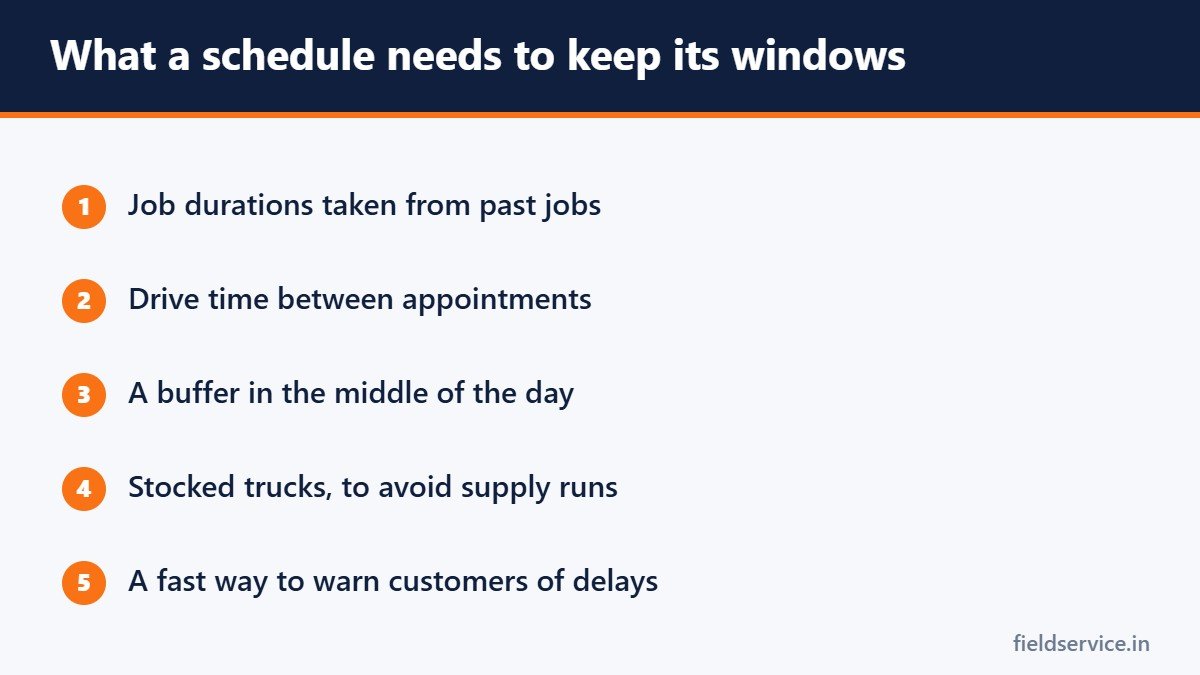
Look at how long each type of job has actually taken over the past few months, arrival to departure. Use those figures, not the time the job ought to take. If diagnostic calls average 75 minutes, schedule 75 minutes. Add travel time between jobs based on the route. See how to reduce windshield time.
How many jobs per technician
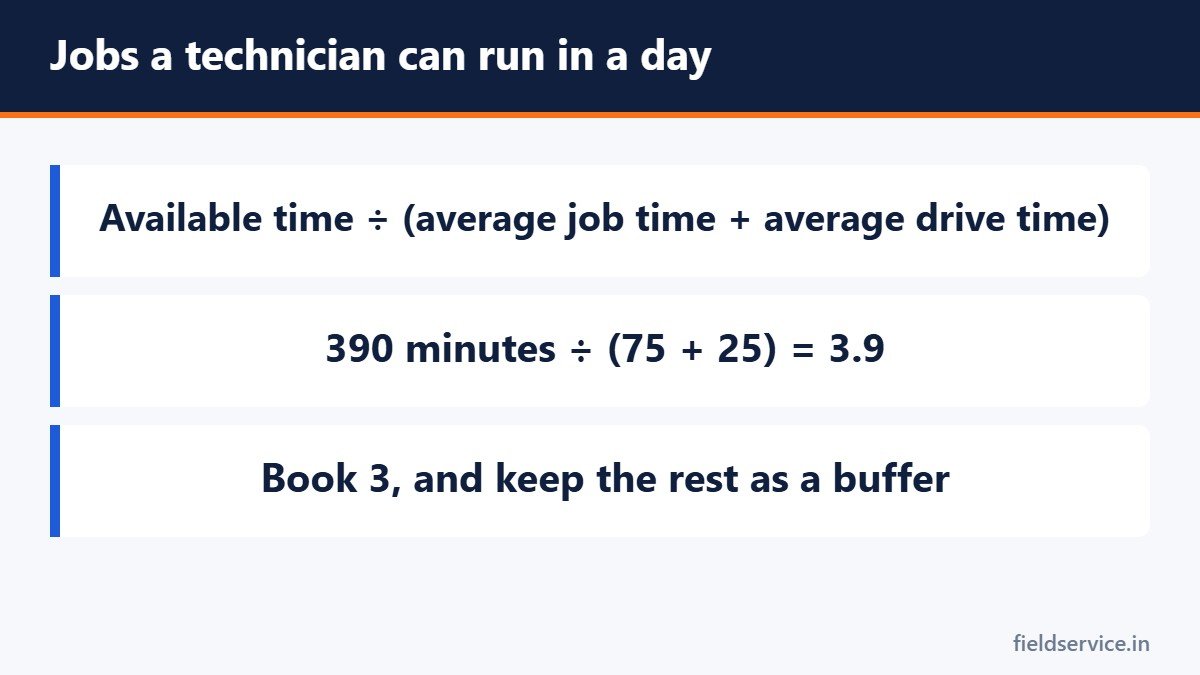
Work it out from the hours available. A technician with an eight-hour day might have about six and a half hours for jobs and driving after loading, a break and end-of-day tasks.
Example: jobs average 75 minutes and the drive between them averages 25 minutes. Each job uses 100 minutes. Six and a half hours is 390 minutes, which allows three full jobs with 90 minutes to spare. That spare time is your room for an overrun, an emergency or a fourth short job. Booking four 100-minute jobs into 390 minutes guarantees a late arrival.
Leave slack on purpose
- A buffer slot late in the morning absorbs overruns before the afternoon.
- One open slot per day across the team handles emergencies.
- A float technician in a larger business covers overruns and urgent calls.
- A list of flexible jobs, such as maintenance visits, can be moved into a gap or out of the way.
A schedule with no slack looks efficient on paper and fails every day in practice.
Group by area
Offer customers the days and windows when you will already be in their part of town. Scheduling by zone reduces drive time and makes windows easier to keep. See how dispatch affects technician productivity.
Tell the customer what to expect
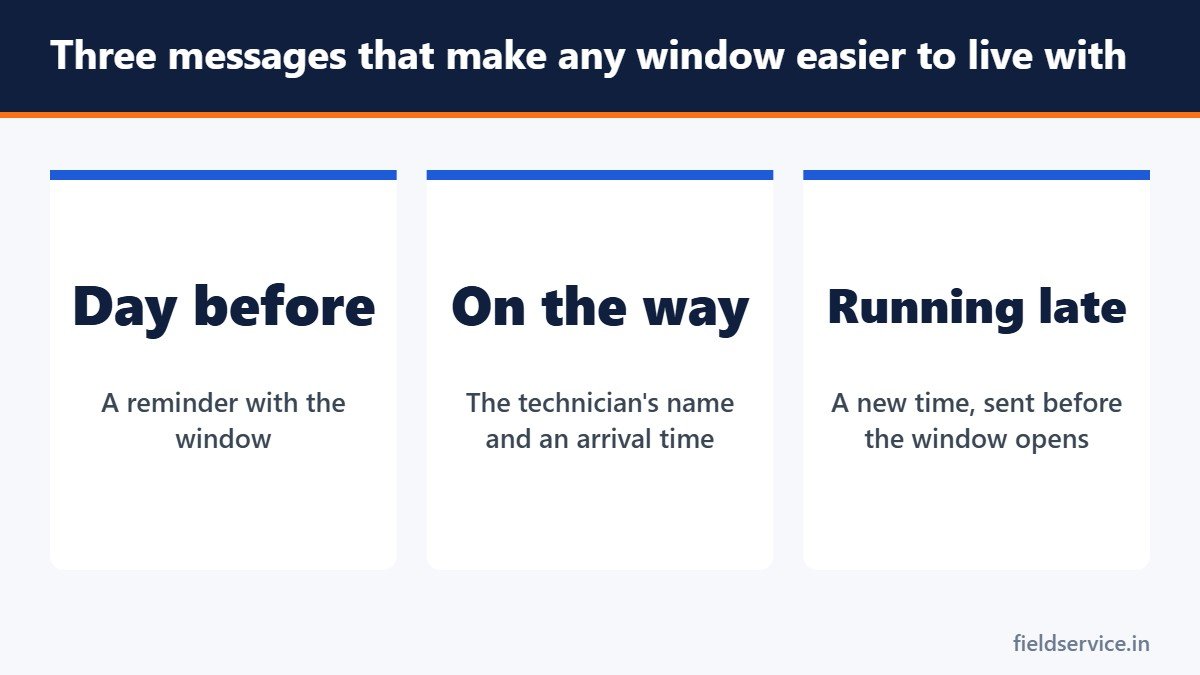
- State the window clearly when booking, and repeat it in a confirmation.
- Send a reminder the day before.
- Send an on-the-way message with an estimated arrival time when the technician leaves the previous job.
- If you are going to be late, say so before the window opens, and give a new time.
An on-the-way message does a lot of the work a narrow window does. A customer who gets thirty minutes’ notice can run errands in a four-hour window without much inconvenience. See texting customers for the messages and the consent rules.
When a job runs over
Give technicians a simple rule: as soon as it is clear a job will run more than, say, twenty minutes past its slot, tell dispatch. Dispatch then has choices: move the next job to another technician, call the next customer with a new time, or offer to reschedule. The earlier the warning, the more options there are. A technician who says nothing until the job is finished has removed all of them.
No-shows and customers who are not home
A trip to an empty house wastes a slot and the drive. Reminders and on-the-way messages reduce it. A stated policy on missed appointments, communicated at booking, helps too. If you charge a fee for a missed appointment, the customer has to have been told in advance.
Same-day and emergency calls
Decide how many same-day calls you can take without breaking promises already made. Options include holding back capacity each day, charging a premium for same-day service, or running a separate technician for urgent work in the busy season. See emergency and after-hours service calls.
Measure it
Track your on-time arrival rate by window and by time of day. If morning windows are met 95 percent of the time and afternoon windows 70 percent, the afternoon windows are too narrow or too many jobs are booked before them. Also track how often jobs run over their scheduled time, by job type. That tells you which duration estimates to fix.
Common mistakes
- Promising a window narrower than you can keep
- Scheduling from ideal job times
- Leaving drive time out
- Filling every slot
- Treating all job types as the same length
- Telling customers nothing when the schedule slips
Seasonal adjustment
In peak season, jobs take longer, traffic is heavier and emergencies are more frequent. Widen windows, add buffers and tell customers honestly what lead times are. In slower months you can tighten windows and offer more specific times.
Related guides
- How to Write a Service Estimate Customers Understand and Accept
- How to Onboard a New Technician: A 90-Day Plan
- Warranty Work: How to Track It and Stop It Draining Profit
Six everyday forms in Word and PDF, plus Excel workbooks that total mileage reimbursement and overtime pay.
Not sure yet? Try two forms free or see all packs.
Frequently asked questions
What is a reasonable arrival window for a service call?
Two hours is a good target for most residential service businesses, with a fixed time for the first appointment of the day. Use wider windows in the afternoon unless your schedule consistently holds.
How many service calls can a technician run in a day?
Divide the time available for jobs and driving by the average job time plus the average drive time, then book fewer than that number to leave a buffer. With 100 minutes per job including travel and 390 minutes available, three jobs is a realistic booking.
How do I stop appointments running late in the afternoon?
Schedule from actual job durations, include drive time, leave a buffer before the afternoon and use wider afternoon windows.
What should we do when a technician is going to miss the window?
Contact the customer before the window opens, give a realistic new time and offer to reschedule if that suits them better.