

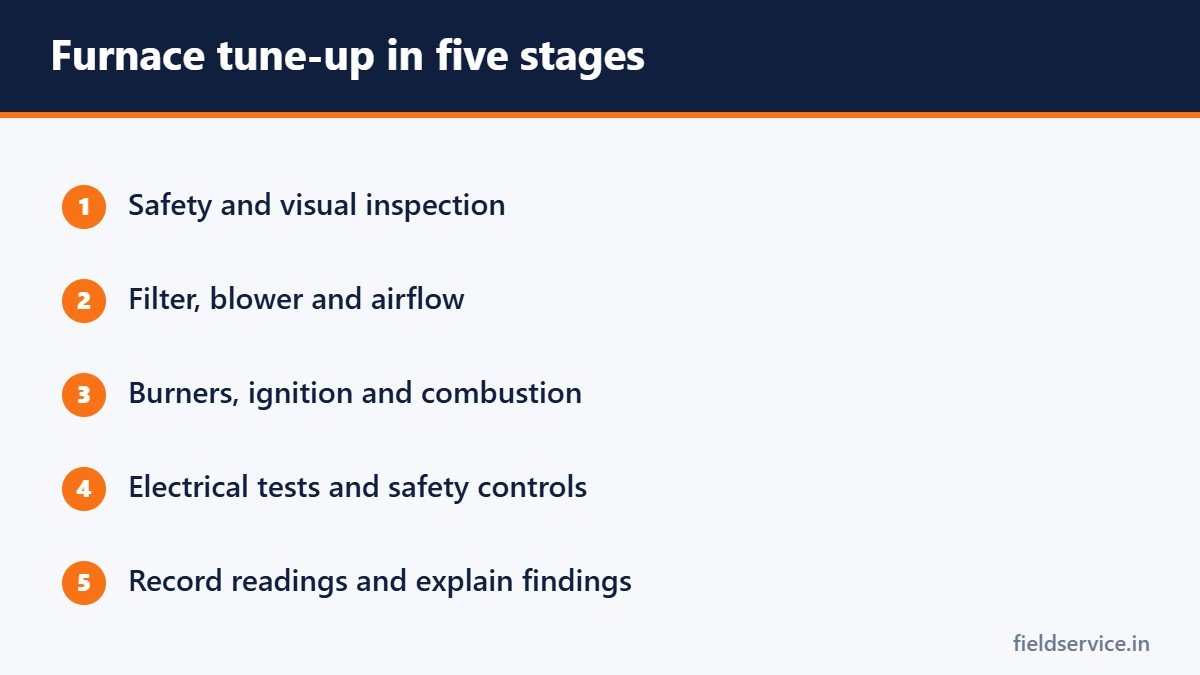
A furnace tune-up is more than a filter change and a quick look at the flame. Done properly, it is a set of measurements that show whether the furnace is safe, whether it is moving the right amount of air, and whether a part is about to fail. This furnace tune-up checklist follows the order most technicians work in: safety first, then airflow, combustion, electrical checks and paperwork.
Always follow the manufacturer’s installation and service instructions for the model in front of you. Limits such as temperature rise and gas pressure are printed on the nameplate or in the manual, and they take priority over any general guide.
Before you open the furnace
- Ask the customer what they have noticed: noises, smells, rooms that do not heat, short run times or high bills.
- Check the thermostat setting, mode and schedule, and replace its batteries if it uses them. Our thermostat wiring guide explains the terminals.
- Look at the vent termination and the intake outside for nests, snow lines, damage or blockage.
- Carry a personal carbon monoxide monitor into the mechanical room. See carbon monoxide safety for technicians.
- Confirm clearances around the furnace and that nothing flammable is stored against it.
Visual and safety inspection
Turn off power at the service switch and confirm it is off with a meter before you put your hands inside. Then work through the cabinet:
- Heat exchanger: look for cracks, rust-through, soot and signs of flame rollout such as scorched wiring or a discolored burner compartment.
- Vent pipe and connectors: check slope, support, joints, corrosion and white residue that points to condensation in a metal vent.
- Gas piping: check the shutoff, the drip leg and the flexible connector, and leak-test joints you disturb.
- Condensing furnaces: inspect the condensate trap, hoses and drain. A blocked trap is a common cause of pressure switch lockouts. Our guide to condensate drain problems covers the fixes.
- Wiring: look for loose connectors, brittle insulation and signs of overheating at the control board.
If you suspect a cracked heat exchanger or see evidence of rollout, stop and follow your company’s procedure. Do not leave an appliance running that you believe is unsafe.
Filter, blower and airflow
Most furnace problems that are not ignition problems are airflow problems. A furnace that cannot move enough air runs hot, trips its limit switch and wears out its heat exchanger early.
- Check the filter size, type and condition, and replace it if the customer agrees. A very restrictive filter in a marginal duct system can cause the problem you are there to prevent. See MERV ratings explained.
- Inspect the blower wheel for dirt. A thin layer of dust on the blades cuts airflow noticeably.
- On PSC motors, test the run capacitor against its rating. On ECM motors, check the connections and the selected speed taps or settings.
- Measure total external static pressure and compare it with the nameplate maximum. Our static pressure guide shows where to place the probes.
Measure temperature rise
Temperature rise is the difference between the supply air and return air temperatures with the furnace at steady state, usually after 10 to 15 minutes of running. The nameplate gives an acceptable range, often something like 35 to 65°F.
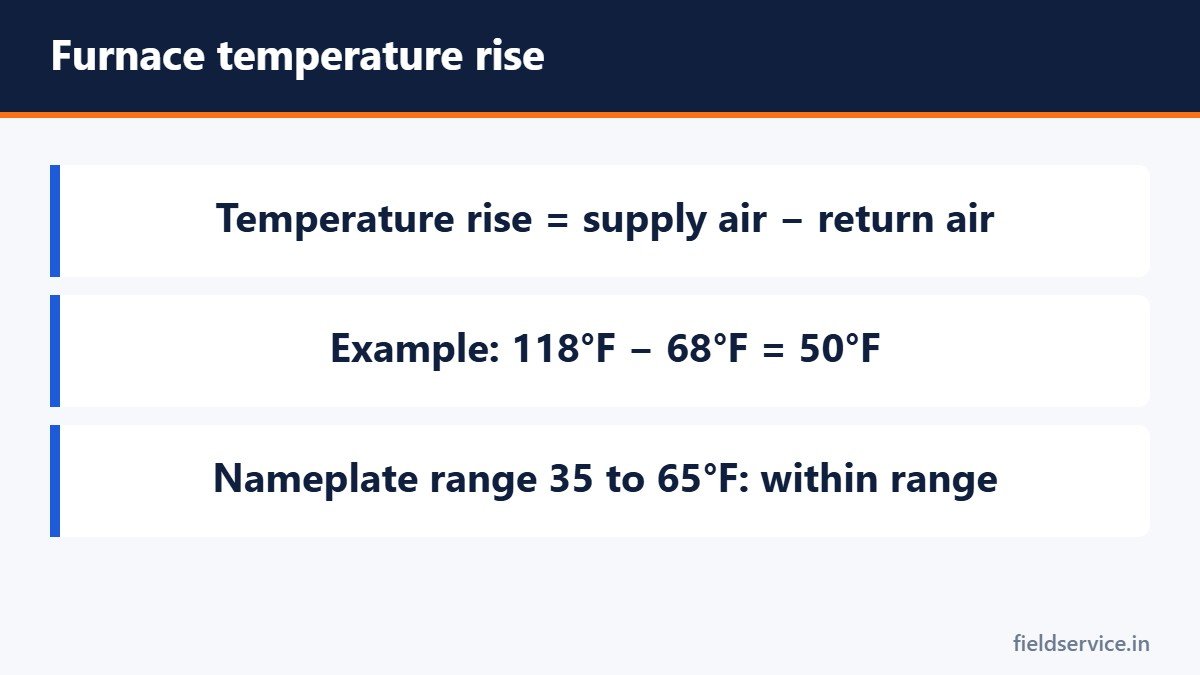
Measure the supply temperature far enough from the heat exchanger that the probe cannot “see” it, because radiant heat gives a false high reading. A rise above the range means too little airflow or too much gas input. A rise below the range means too much airflow or too little input.
Burners, ignition and combustion
- Remove and clean the burners if they are dirty, and check that they are aligned and that the crossover ports are clear.
- Clean the flame sensor with a light abrasive pad and measure the flame signal in DC microamps. Many controls need a steady reading of a few microamps; use the manufacturer’s figure.
- Inspect the hot surface igniter for cracks and measure its resistance if the manufacturer publishes a range. Do not touch the element with bare fingers.
- Measure inlet and manifold gas pressure with a manometer. Natural gas furnaces are commonly set near 3.5 inches of water column at the manifold and propane near 10 inches, but the nameplate value is the one to use.
- Watch the flame through several cycles. It should light smoothly, burn steady and blue, and not move when the blower starts. A flame that wavers when the blower comes on can point to a breached heat exchanger.
- Where your company’s procedure calls for it, perform a combustion analysis and record oxygen, carbon monoxide and stack temperature.
Electrical tests and safety controls
- Measure line voltage and the 24-volt control voltage. Our guide on how to use a multimeter covers the basics.
- Measure blower and inducer motor amps and compare them with the nameplate.
- Check the pressure switch hose and port for cracks and blockage, and confirm the switch closes when the inducer runs.
- Confirm that the limit switch and rollout switches are the correct parts, are not bypassed and are wired in the circuit.
- Run a full heating cycle from the thermostat and time the sequence: inducer, ignition, flame proven, blower on, burner off, blower off.
| Reading | Compare it with |
|---|---|
| Temperature rise | Range on the nameplate |
| Total external static pressure | Maximum on the nameplate |
| Manifold gas pressure | Value on the nameplate |
| Flame signal (DC microamps) | Control manufacturer’s minimum |
| Blower and inducer amps | Motor nameplate amps |
| Capacitor (microfarads) | Rating and tolerance printed on it |
Record the readings and explain them
A tune-up without recorded readings is hard to prove and hard to sell. Write down every measurement, even the normal ones. Next year’s technician can compare the numbers and spot a blower that is slowing down or a flame signal that is fading before it causes a no-heat call.
Then explain what you found in plain language, show the customer any worn part, and give priced options for repairs. Note on the ticket anything the customer declined. Our guide on how to document a service call shows a simple format, and maintenance agreements explains how tune-ups fit into a service plan.
Related guides
- Seasonal planning for service businesses
- Heat pump basics for technicians
- Temperature split (delta T) explained
Sources
- ENERGY STAR: Heating and cooling maintenance checklist
- U.S. Consumer Product Safety Commission: Carbon monoxide information center
Six everyday forms in Word and PDF, plus Excel workbooks that total mileage reimbursement and overtime pay.
Not sure yet? Try two forms free or see all packs.
Frequently asked questions
How long does a furnace tune-up take?
A thorough tune-up on a residential gas furnace usually takes about an hour to an hour and a half, depending on access, how dirty the unit is and whether combustion analysis is included.
What is temperature rise on a furnace?
It is the supply air temperature minus the return air temperature while the furnace runs at steady state. The result should fall within the range printed on the furnace nameplate.
How often should a furnace be serviced?
Most manufacturers recommend an inspection by a qualified technician once a year, ideally before the heating season starts.
What gas pressure should a furnace have?
Use the manifold pressure on the nameplate. Natural gas furnaces are commonly set near 3.5 inches of water column and propane furnaces near 10 inches, but models differ.
Does a tune-up include cleaning the flame sensor?
It should. A dirty flame sensor is a common cause of a furnace that lights and then shuts off after a few seconds, and cleaning it takes a couple of minutes.
This article is general information for trained technicians. It does not replace the manufacturer’s instructions, local codes or your employer’s procedures.