


One of the quickest checks on an air conditioner needs nothing more than a thermometer. Measure the temperature of the air going into the indoor unit and the air coming out, and subtract. The result is the temperature split, usually called delta T. It will not diagnose a system by itself, but it tells you in two minutes whether the system is roughly doing its job and which direction to look in if it is not.
What delta T measures
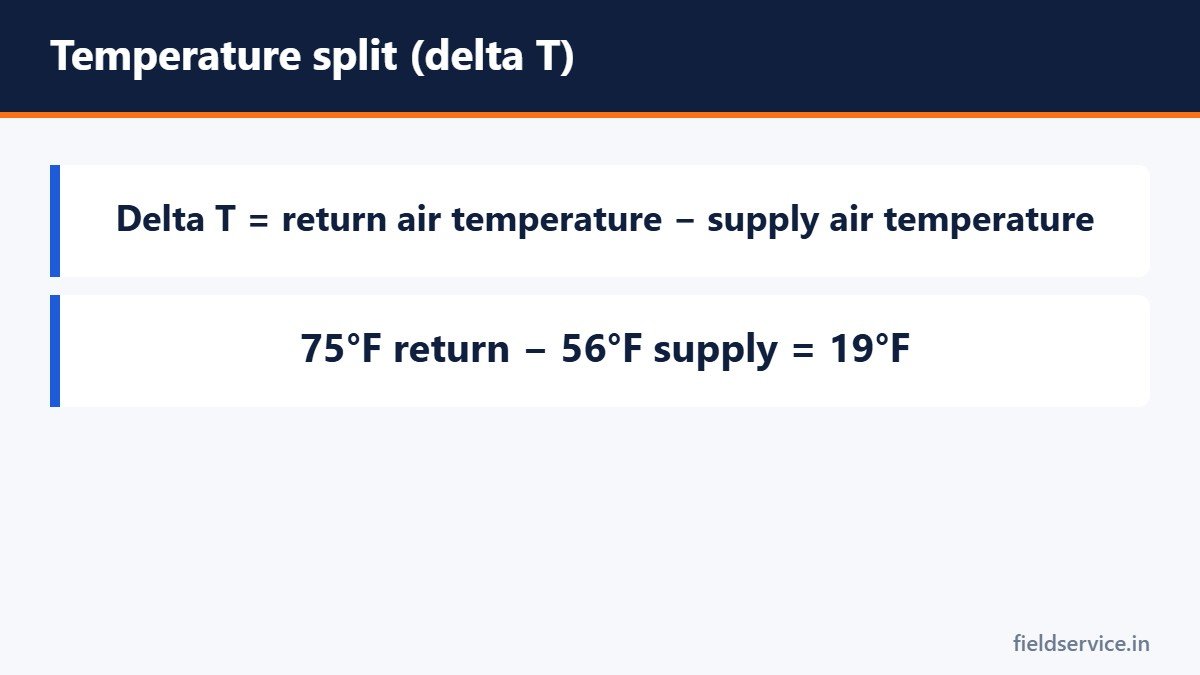
In cooling, the evaporator coil removes heat from the air passing over it. Delta T is how many degrees the air temperature falls across the coil. If return air enters at 75°F and supply air leaves at 56°F, the delta T is 19°F.
How to measure it
- Let the system run for at least 15 minutes so that it stabilizes.
- Measure the return air temperature close to the indoor unit, after the filter if you can.
- Measure the supply air temperature in the supply plenum, a short distance from the coil and out of its direct line of sight.
- Subtract supply from return.
Readings taken at a distant return grille and a far supply register include the heat gained or lost in the ducts, so they tell you about the ducts as well as the equipment. Measuring at the unit isolates the equipment.
What range to expect
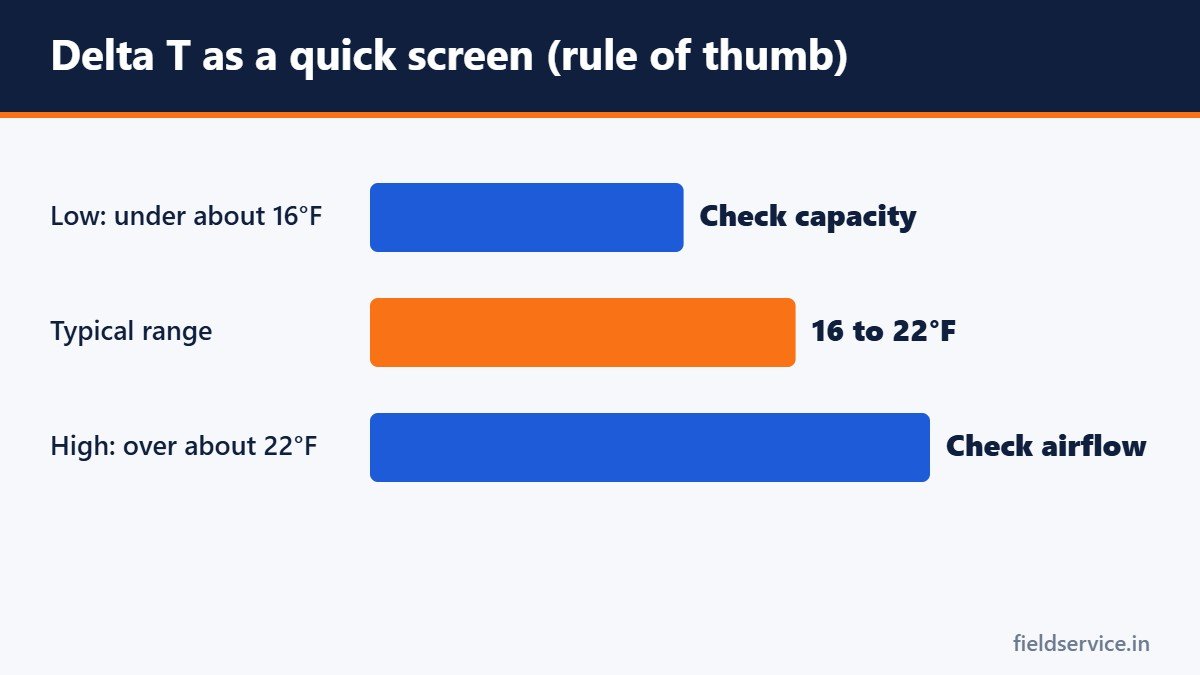
Under typical indoor conditions, a delta T of roughly 16 to 22°F in cooling is a widely used rule of thumb. It is only a guide. The right figure for a given system depends on indoor humidity, airflow and the equipment design.
Humidity matters most. When indoor air is humid, the coil spends more of its capacity removing moisture and less lowering the temperature, so delta T falls. In a dry climate it runs higher. A system starting up in a hot, humid house may show a low split for the first hour and still be working correctly.
| Reading | What it often suggests |
|---|---|
| Delta T higher than expected | Low airflow: dirty filter, dirty coil, blower problem or restricted ducts |
| Delta T lower than expected | Low capacity: low refrigerant charge, a compressor problem, or more airflow than the system needs |
| Delta T low on a humid day | May be normal while the system removes moisture |
A high delta T
When less air passes over the coil, each cubic foot of air is cooled more, so the split rises. A reading well above the expected range points to an airflow problem. Check the filter, the coil, the blower wheel and the ducts. Our guide to static pressure covers how to confirm it. Low airflow left alone can freeze the coil.
A low delta T
A low split means the coil is not removing as much heat as it should. Possible causes include a low refrigerant charge, a metering device fault, a compressor that is not pumping properly, a reversing valve leaking internally on a heat pump, duct leakage pulling hot attic air into the return, or a blower set too fast. The next step is to connect gauges and check superheat and subcooling.
Delta T in heating
On a furnace, the equivalent check is temperature rise: supply air temperature minus return air temperature. The acceptable range is printed on the furnace nameplate, for example 35 to 65°F. A rise above the range means too little airflow for the heat being produced. A rise below it means too much airflow or too little heat.
Temperature rise can also be used to estimate airflow on a gas furnace or electric air handler with the sensible heat formula: airflow in cubic feet per minute equals heat output in BTU per hour divided by 1.08 times the temperature rise.
The limits of the measurement
- It does not tell you the refrigerant charge. Never add refrigerant on the basis of delta T alone.
- It changes with humidity, so the same system will read differently on different days.
- It says nothing about how much air is moving unless you combine it with another measurement.
- Thermometers that disagree by a degree or two can distort the result. Use the same instrument for both readings, or a matched pair.
How to use it on a service call
- Take delta T early, as a screening check.
- If it is high, look at airflow first.
- If it is low, look at the refrigerant circuit and the ducts.
- Record return, supply and delta T on the ticket, along with the outdoor temperature.
- Take it again after the repair to show the change.
Recorded readings give the customer evidence of the improvement and give the next technician a baseline. See how to document a service call.
Related guides
- Average Service Ticket: What It Tells You and How to Raise It Honestly
- Ohm’s Law for Technicians: The Formulas You Will Use Every Day
- Voltage Drop Explained: Causes, Calculation and Limits
Six everyday forms in Word and PDF, plus Excel workbooks that total mileage reimbursement and overtime pay.
Not sure yet? Try two forms free or see all packs.
Frequently asked questions
What is a good delta T for an air conditioner?
A range of roughly 16 to 22 degrees Fahrenheit is a common rule of thumb under typical indoor conditions. The correct figure for a particular system depends on humidity, airflow and the equipment.
What does a high temperature split mean?
It usually indicates low airflow across the evaporator coil, for example from a dirty filter, a dirty coil or restricted ducts.
What does a low temperature split mean?
It suggests the coil is not removing enough heat. Causes include low refrigerant charge, a compressor or metering device problem, duct leakage or too much airflow. High indoor humidity also lowers the reading.
Where should I measure supply and return air temperature?
Measure close to the indoor unit: return air just before the unit and supply air in the plenum a short distance from the coil. Readings at distant registers include duct gains and losses.
This article is an educational overview. Follow the equipment manufacturer’s service instructions.