

A furnace or air handler is built to move a certain amount of air against a certain amount of resistance. When the duct system resists more than the equipment was designed for, airflow drops, and a long list of problems follows: poor cooling, frozen coils, tripped limits, noise and early failure of blower motors. Static pressure is the measurement that shows how hard the blower is working, and it takes only a few minutes to check.
What static pressure is
Static pressure is the pressure air exerts on the walls of a duct. It is measured in inches of water column, written in. w.c. or in. w.g. On the return side of the blower the pressure is negative, because the blower is pulling air in. On the supply side it is positive.
A common comparison is blood pressure. It does not tell you everything about the system, but a reading well outside the normal range tells you something is wrong.
Total external static pressure
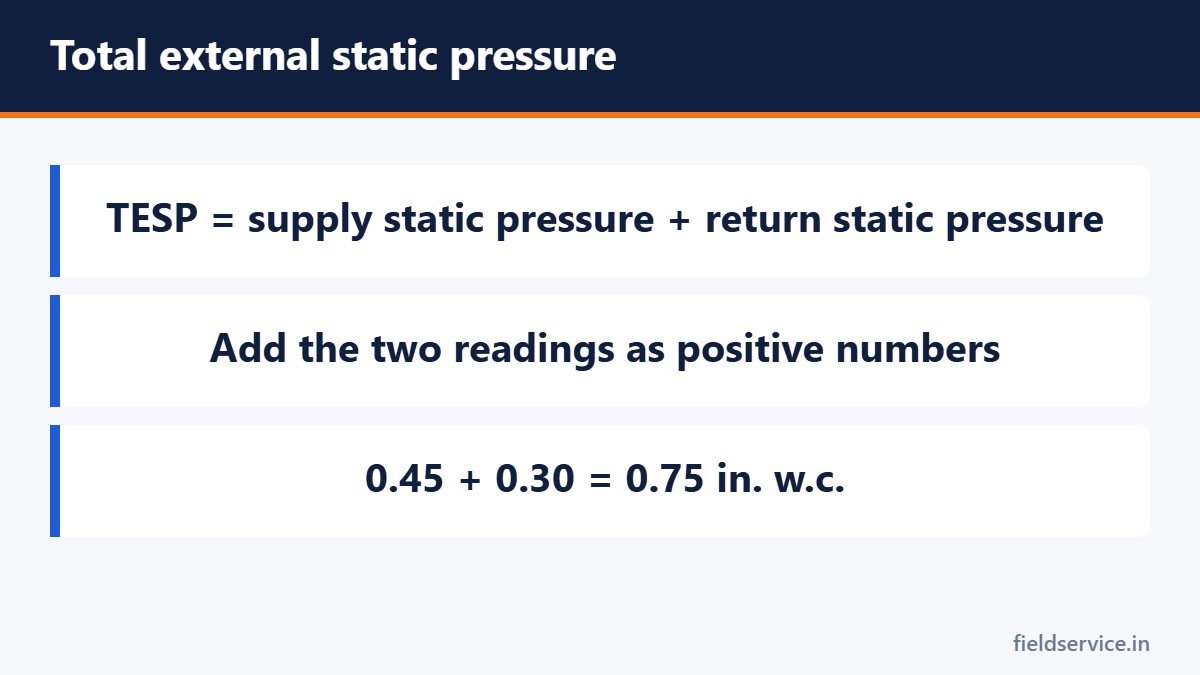
Total external static pressure, or TESP, is the resistance of everything outside the equipment cabinet that the blower has to overcome: the ductwork, the filter, the coil where it is a separate component, and the registers and grilles. You find it by measuring the pressure where air enters the equipment and where it leaves, then adding the two readings together as positive numbers.
If the return side reads −0.30 and the supply side reads +0.45, the TESP is 0.75 in. w.c.
What the number should be
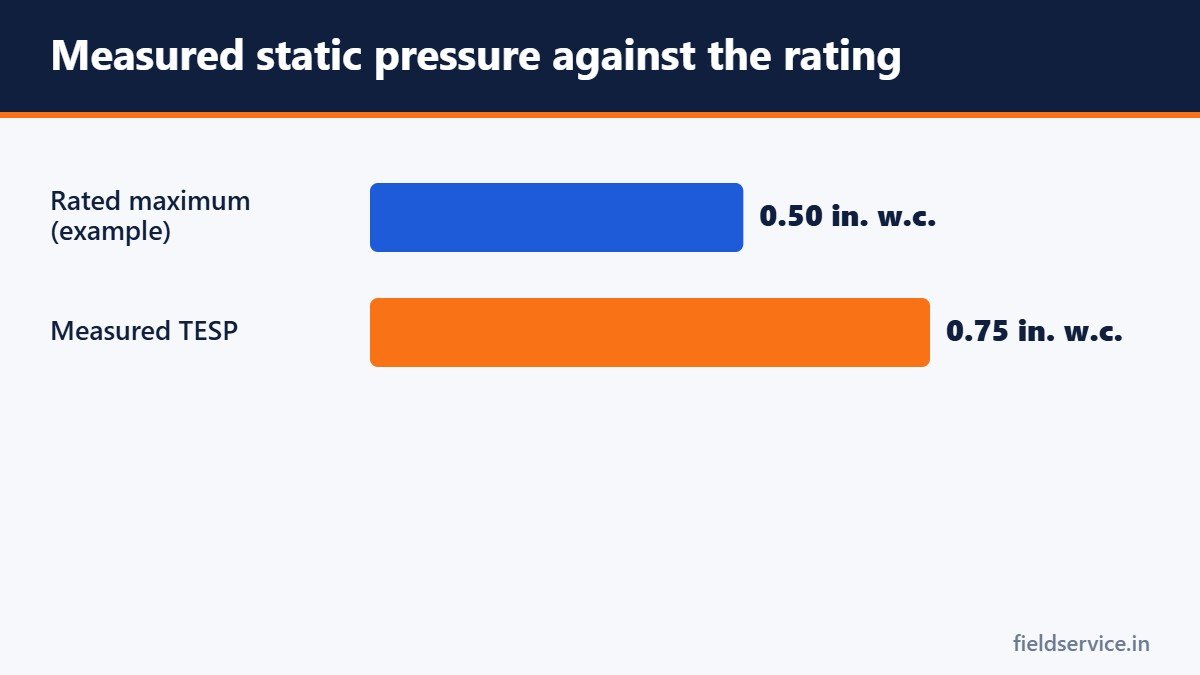
The maximum is printed on the equipment nameplate or given in the installation instructions. Many residential furnaces and air handlers are rated for a maximum of 0.50 in. w.c., though some are rated higher. Always use the figure for the equipment in front of you.
In the example above, 0.75 against a rating of 0.50 means the blower is working against half as much resistance again as it was designed for.
How to measure it
- Use a manometer with static pressure probes.
- Make a small test port on the return side, between the filter and the blower.
- Make a second port on the supply side, where the air leaves the equipment and before any external coil or accessory that the manufacturer does not count as part of the unit.
- Run the blower at the speed used for the mode you are testing.
- Insert the probe with its tip facing into the airflow and read each pressure.
- Add the two readings, ignoring the minus sign.
- Seal the test ports when you finish.
Where exactly the ports belong depends on the equipment configuration, so check the manufacturer’s instructions. Take care when drilling near a coil or electrical components.
What causes high static pressure
- A dirty filter, or a filter that is too restrictive for the system
- Return ductwork or return grilles that are too small
- Supply ducts that are undersized, crushed, kinked or too long
- A dirty evaporator coil or blower wheel
- Closed or blocked registers and dampers
- Too many sharp turns and fittings close to the equipment
Measuring the pressure drop across individual components helps find the cause. Take a reading before and after the filter, and before and after the coil. A component with a pressure drop far above its rating is the place to look.
What high static pressure does
- Airflow falls below what the equipment needs
- In cooling, the evaporator coil can get too cold and freeze
- In heating, the furnace can overheat and trip its high limit
- Rooms at the end of long duct runs are uncomfortable
- The system is noisy at the registers and the return grille
- Blower motors work harder, which raises energy use and shortens their life
Low static pressure
A reading well below normal is less common. It can point to duct leaks, a disconnected duct, a missing filter or a blower that is not running at the right speed.
Why check it on every maintenance visit
Charging a system by superheat or subcooling assumes the airflow is correct. If static pressure is high and airflow is low, the refrigerant readings will mislead you. Checking static pressure first avoids adding refrigerant to a system that really has a duct problem. Record the reading on the ticket so the next visit has a baseline.
Related guides
- R-410A in 2026: What the EPA Rule Change Means for HVAC Technicians
- HVAC Unit Conversions Every Technician Should Know
- Temperature Split (Delta T): What It Tells You About an Air Conditioner
Six everyday forms in Word and PDF, plus Excel workbooks that total mileage reimbursement and overtime pay.
Not sure yet? Try two forms free or see all packs.
Frequently asked questions
What is a normal static pressure for a residential system?
It depends on the equipment. Many residential furnaces and air handlers are rated for a maximum total external static pressure of 0.50 inches of water column. Check the nameplate or installation instructions for the unit you are working on.
Can a dirty filter cause high static pressure?
Yes. A loaded filter is one of the most common causes. A clean filter that is too restrictive for the duct system can have the same effect.
Does high static pressure damage equipment?
Over time it can. Low airflow can freeze the evaporator coil in cooling, cause the furnace to overheat in heating and make blower motors work harder than they were designed to.
What tool measures static pressure?
A manometer with static pressure probes. Digital manometers are the most common in the field.
This article is an educational overview. Follow the equipment manufacturer’s instructions for test locations and limits.