

In many small service businesses, the owner is also the dispatcher, the bookkeeper, the customer service desk and a working technician. That works until it does not. Calls go to voicemail while the owner is under a house, invoices pile up on the truck seat, and evenings disappear into paperwork. The first office hire is often the change that lets a small business grow, but only if it is planned properly.
Signs it is time
- Calls are regularly missed during working hours.
- Invoices go out days or weeks after the work.
- You spend evenings and weekends on scheduling and paperwork.
- Technicians wait for answers about addresses, parts and next jobs.
- You turn down work because you cannot coordinate more.
Does the hire pay for itself?
An office hire earns its cost in three ways: work you capture that you currently miss, faster invoicing and payment, and time that you, the owner, can move back to billable work or to growing the business.
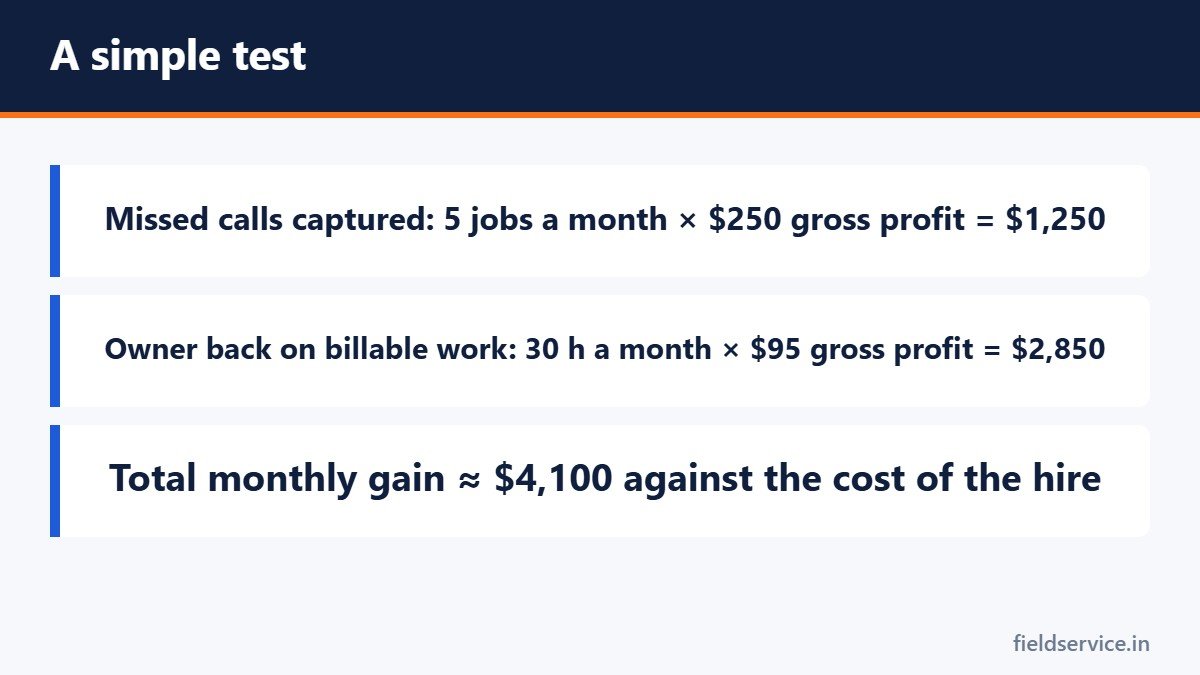
Compare the gain with the full cost of the role, including payroll taxes, benefits, equipment and software. Your figures will differ, but if the gain clearly exceeds the cost, the hire is worth making. The same logic applies to technicians; see when to hire your next technician.
What the role covers
| Area | Typical tasks |
|---|---|
| Calls and booking | Answering calls, booking jobs, confirming appointments, handling reschedules |
| Dispatch | Assigning jobs, handling emergencies, rerouting when jobs run long |
| Billing | Sending invoices, recording payments, chasing overdue accounts |
| Customer service | Answering questions, logging complaints, requesting reviews |
| Admin | Ordering parts, keeping records, maintaining agreements and renewals |
In a small business one person often does all of these. As you grow, dispatch and billing usually split into separate roles.
What to look for
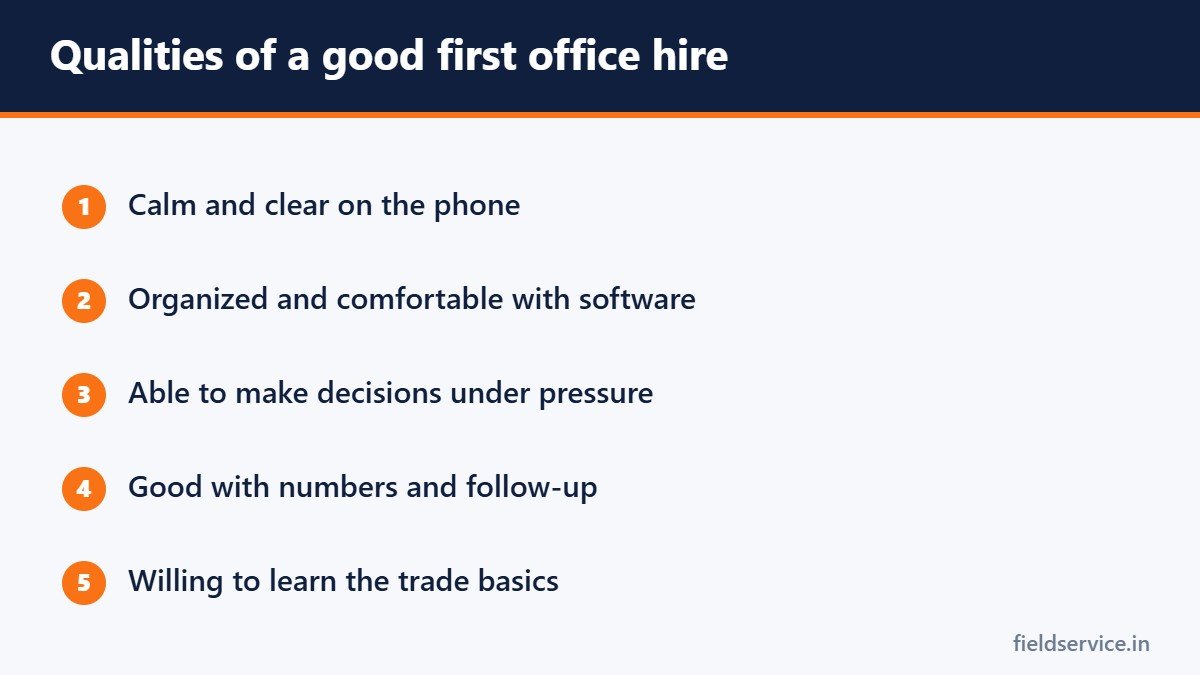
Trade experience helps but is not essential. A good dispatcher learns which jobs take longer, which technician suits which customer, and when an “emergency” can wait until morning. Previous work in a busy service desk, scheduling or customer support is good preparation.
Set them up to succeed
- Write down how you do things today: pricing rules, which jobs need which technician, what counts as an emergency. See emergency and after-hours service calls.
- Give them a price book so they can quote standard work without calling you.
- Decide what they can approve alone and what needs you.
- Make sure they have proper tools: a scheduling system, not a paper diary. See choosing field service software.
- Plan a few weeks of overlap where you work alongside them.
Measure the result
- Share of calls answered live.
- Days from job to invoice.
- Overdue invoices.
- Jobs per technician per day.
- Your own billable or business-building hours.
Good dispatch shows up directly in technician productivity; see how dispatch affects technician productivity and arrival windows and scheduling.
Employee, part-time or outsourced?
If the workload is not yet full-time, a part-time employee or an outsourced answering and booking service can be a stepping stone. Check how any outside service handles your customers and data, and whether it can book directly into your schedule. If you hire someone, confirm whether they should be treated as an employee; see W-2 vs 1099 workers.
Related guides
Estimate, invoice and work order templates in Word and PDF, plus Excel workbooks for job scheduling and maintenance agreement renewals.
Not sure yet? Try two forms free or see all packs.
Frequently asked questions
When should a service business hire an office manager?
When missed calls, late invoicing and owner paperwork are costing more than the role would, often once a business has several technicians or the owner can no longer answer the phone during the day.
What does a dispatcher do in a field service business?
A dispatcher books and assigns jobs, manages the schedule through the day, handles emergencies and reschedules, and keeps technicians and customers informed.
Does a dispatcher need trade experience?
It helps, but organization, calm communication and comfort with software matter more. Trade knowledge can be learned on the job.
Can I outsource dispatching?
Some businesses use answering or booking services, especially at first or after hours. Check how they handle customers and data and whether they can book into your schedule.
Figures in this article are an example. This is general information and not employment or legal advice.