


Hiring another technician is one of the biggest decisions a small service business makes. Hire too early and the new wage eats the profit while the schedule has gaps. Hire too late and you turn away work, burn out the team you have and let customers drift to competitors. The good news is that the decision does not have to be a gut feeling. You can measure demand, capacity and cost, and see whether the numbers support a hire.
Signs you may need another technician
- Customers regularly wait more than a few days for routine work.
- You are turning away jobs or letting calls go to voicemail at busy times.
- Overtime has become normal rather than occasional.
- Maintenance visits are being pushed back to fit in repairs.
- Callbacks are rising because technicians are rushing.
- Your best technicians are tired and talking about leaving.
One or two of these in peak season is normal. Several at once, for months, is a sign that demand has outgrown your capacity.
Measure capacity
Capacity is the billable hours your current team can realistically deliver in a week. It is not 40 hours per technician. Drive time, shop time, training and paperwork all take a share. If each technician can bill about 30 hours a week, three technicians give you about 90 billable hours. See technician utilization explained.
Measure demand, including what you turn away
Demand is the work you have booked plus the work you are turning away or pushing back. The second part is easy to undercount, because nobody records the customer who hung up after hearing the wait time. For a month, ask the office to log every job turned away or delayed, and the reason.
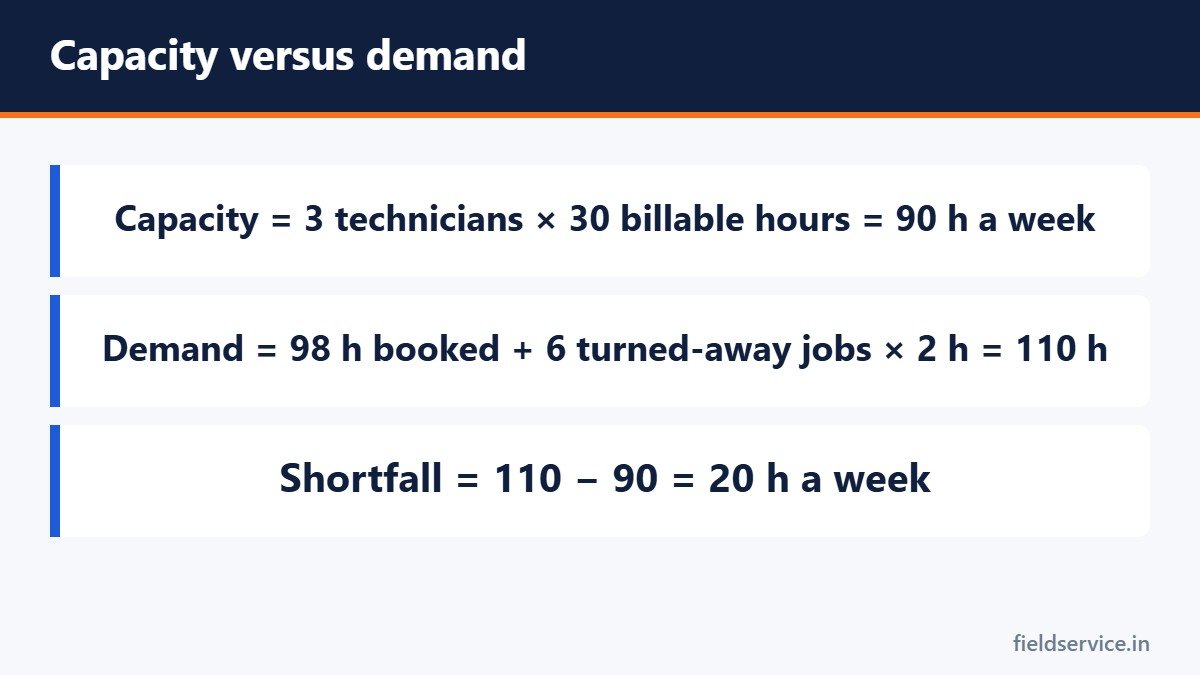
Count the full cost of a new technician
The wage is only the start. A new technician also brings payroll taxes, insurance and benefits, plus a vehicle, tools, a phone, uniforms, software licences and the time others spend training them. Our guide to loaded labor cost shows how to add these up. In the example below we use a loaded cost of $1,650 a week.
Do the math
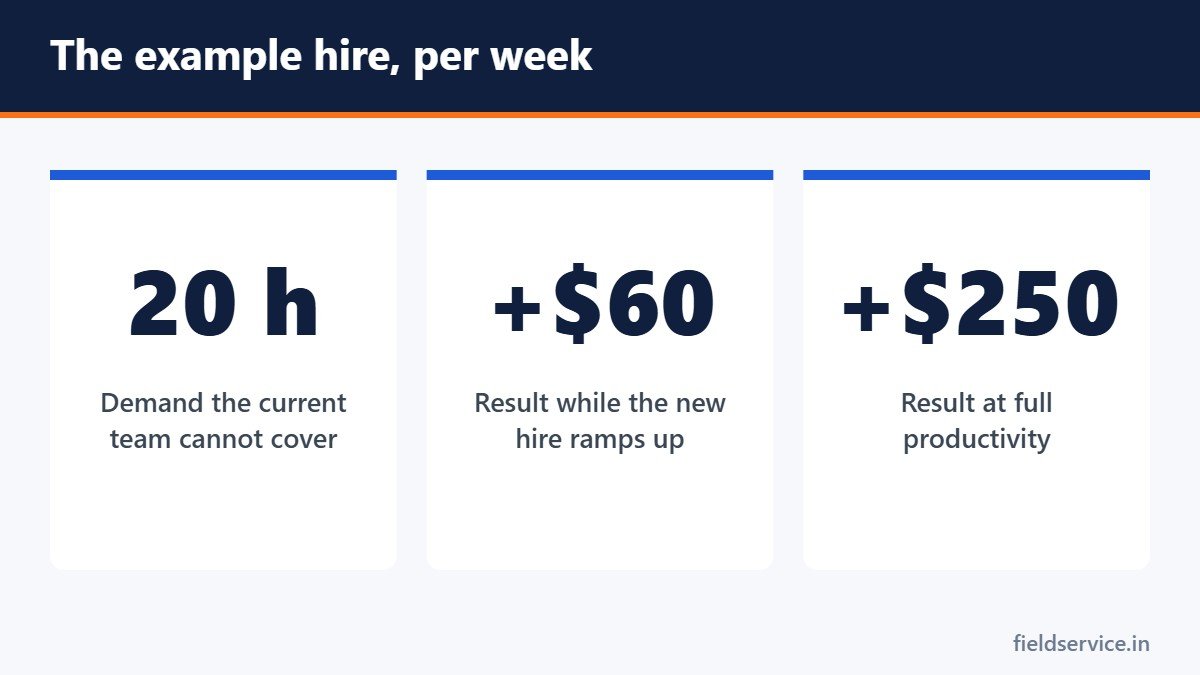
If the business earns $95 of gross profit per billable hour, a new technician who covers the 20-hour shortfall at full productivity adds 20 × $95 = $1,900 of gross profit a week, against a cost of $1,650. The business gains about $250 a week.
New technicians are rarely fully productive at first. If the new hire works at 60 percent of a full technician for the first months, they can cover 18 of the 20 hours, earning 18 × $95 = $1,710. That is still $60 a week ahead. With a lower gross profit per hour, the same hire would lose money during the ramp-up, which is a cash-flow question as much as a profit one.
Run your own numbers in the when to hire a technician calculator.
Alternatives to a full-time hire
| Option | Works best when |
|---|---|
| Planned overtime | The shortfall is small or short-lived |
| Seasonal or part-time help | Demand peaks only in summer and winter |
| A subcontractor | You need specialist skills or occasional extra hands |
| Better scheduling and routing | Drive time and gaps are eating capacity |
| Raising prices | Demand is high and you cannot hire fast enough |
Raising prices is often overlooked. If demand is well above capacity, your prices may be too low. See how to raise prices.
Plan the ramp-up
- Decide in advance what the new technician should be able to do alone by 30, 60 and 90 days.
- Pair them with an experienced technician at first, and account for the time that costs.
- Start them on maintenance and simpler repairs.
- Hold short weekly check-ins.
Our guide to onboarding a new technician has a full plan.
Related guides
- Revenue per technician
- Seasonal planning for service businesses
- Field technician interview preparation
Three Excel workbooks that take you from what a technician costs to what to charge, then show whether each job made money.
Not sure yet? Try two forms free or see all packs.
Frequently asked questions
How do I know if my business needs another technician?
When steady demand, including work you are turning away, consistently exceeds the billable hours your team can deliver, and the gross profit from the extra work would cover a new technician’s full cost.
How much does it cost to add a technician?
Much more than the wage. Add payroll taxes, insurance, benefits, a vehicle, tools, phone, uniforms, software and training time to find the loaded cost.
How long until a new technician is profitable?
It depends on their experience, the work and how well they are trained. Plan for a period of reduced productivity and check that your cash can carry it.
What if demand is only high in peak season?
Consider overtime, seasonal help or a subcontractor for the peaks instead of a permanent hire, and use slower months for maintenance work.
Figures in this article are an example. Use your own demand and cost data.