


On a hot afternoon, a failed run capacitor is one of the most likely reasons an air conditioner has stopped cooling. The part is inexpensive and quick to replace, which makes it tempting to swap one in without testing. Testing takes a few minutes, confirms the diagnosis and tells you whether something else caused the failure.
What a run capacitor does
A run capacitor stores and releases electrical energy to create the phase shift that a single-phase motor needs in order to start and run efficiently. In a residential outdoor unit, a dual run capacitor serves both the compressor and the condenser fan motor. It has three terminals: C (common), HERM (the compressor) and FAN.
Symptoms of a failed capacitor
- The outdoor unit hums but the fan or the compressor does not start
- The fan starts only when given a push
- The compressor trips on its overload
- The motor draws higher amps than normal
- The top of the capacitor is bulged, or there is oil leaking from it
Safety first
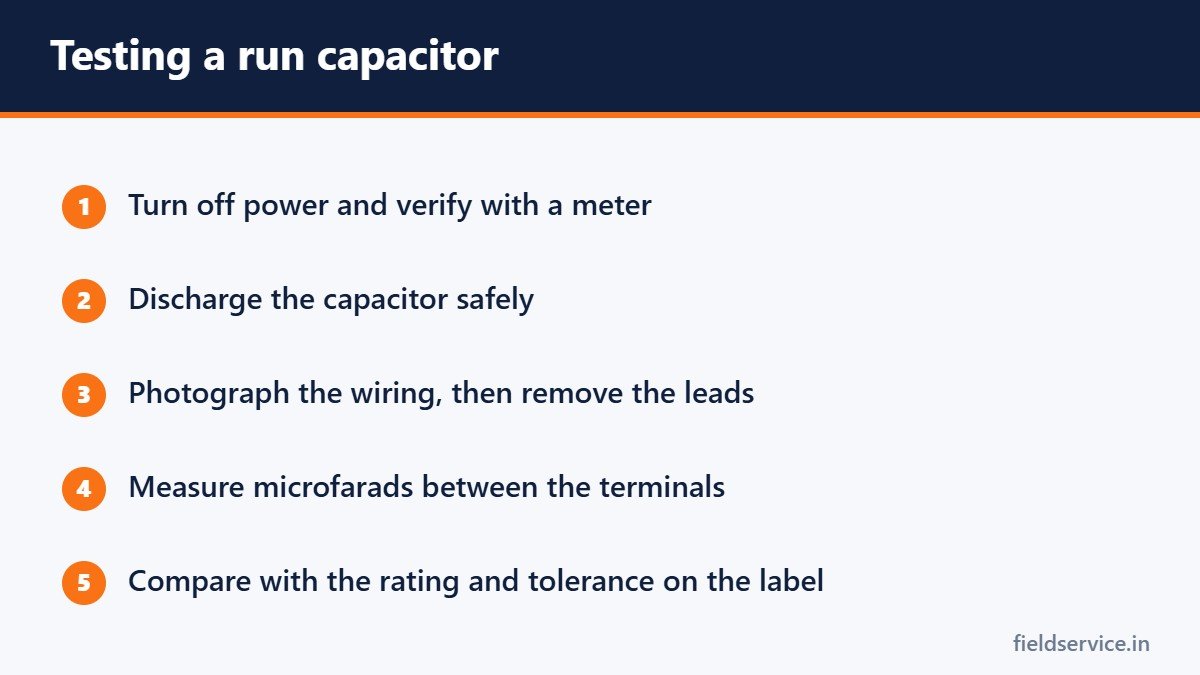
- Turn off power at the disconnect and confirm with your meter that it is off.
- Discharge the capacitor before touching the terminals. A capacitor can hold a charge after power is removed. Use a discharge tool or a suitably rated resistor across the terminals. Do not short it with a screwdriver.
- Wear safety glasses and insulated gloves.
Testing with a meter
- Take a photo of the wiring so you can reconnect it correctly.
- Remove the wires from the capacitor terminals.
- Set your meter to the capacitance function, marked µF or MFD.
- On a dual capacitor, measure from C to HERM and then from C to FAN.
- Compare each reading with the rating printed on the label.
Reading the label and the tolerance
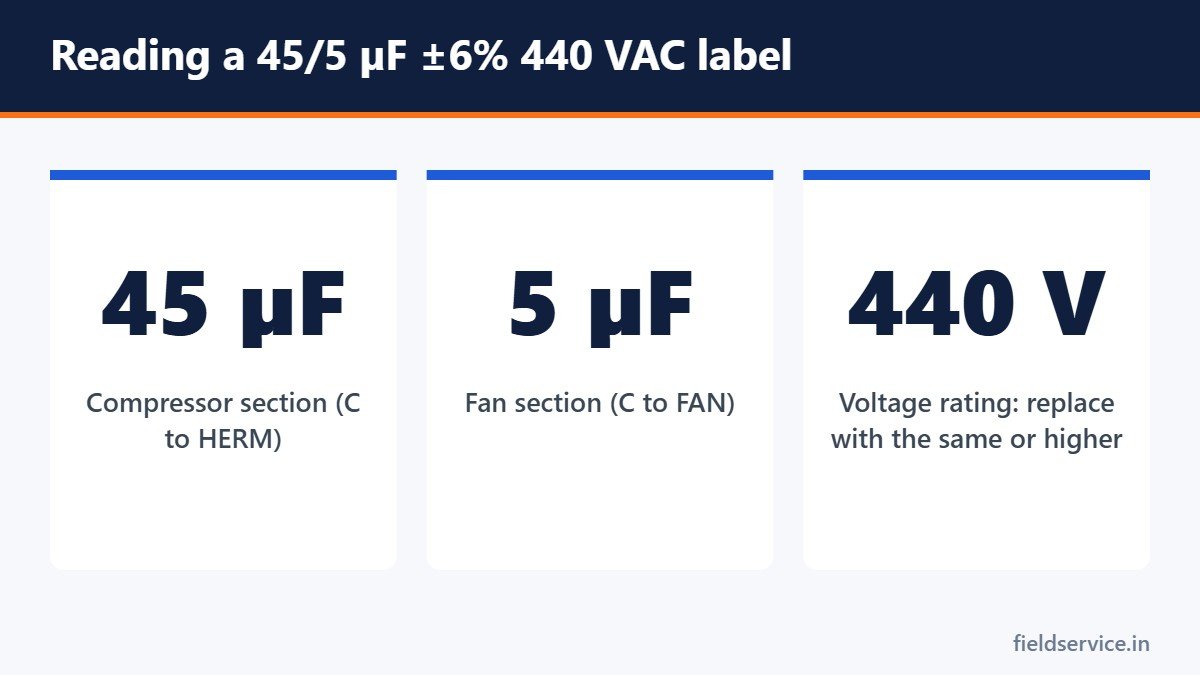
A label such as “45/5 µF ±6% 440 VAC” means 45 microfarads for the compressor, 5 microfarads for the fan, a tolerance of 6 percent either way, and a voltage rating of 440 volts AC.
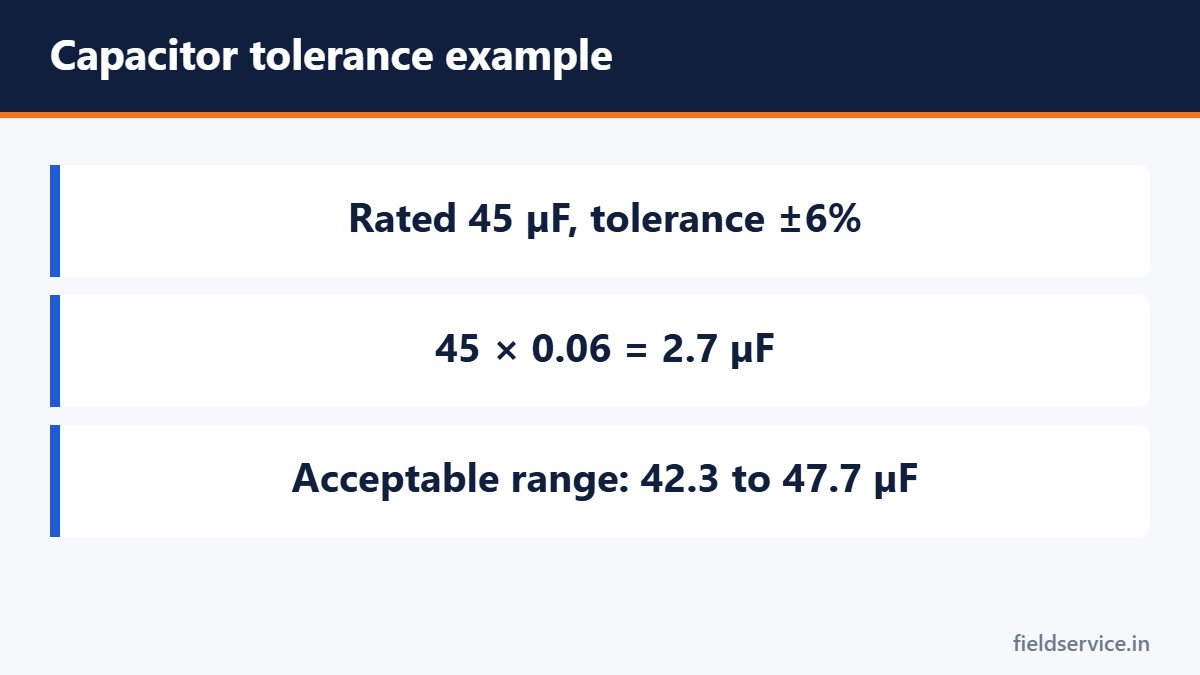
For the 45 µF section, 6 percent is 2.7 µF, so the acceptable range is 42.3 to 47.7 µF. A reading of 38 µF is out of tolerance, and the capacitor should be replaced even if the unit still runs.
Testing under load
Experienced technicians often check a capacitor while the system is running, which shows how it performs at operating temperature. This means measuring on live equipment, so it should only be done by trained technicians who follow their employer’s safety procedures.
- With the system running, measure the amps on the wire between the capacitor and the motor’s start winding.
- Measure the voltage across the two capacitor terminals for that section.
- On a 60 Hz supply: microfarads = amps × 2,652 ÷ volts.
Example: 4.2 amps and 350 volts gives 4.2 × 2,652 ÷ 350 = 31.8 µF. Against a 35 µF rating with a 6 percent tolerance, the minimum is 32.9 µF, so this capacitor is weak.
Choosing a replacement
- Match the microfarad rating. Use the value specified for the equipment.
- Use the same or a higher voltage rating. A 440-volt capacitor can replace a 370-volt one. A 370-volt capacitor must not replace a 440-volt one.
- Match the type and fit. Dual or single, round or oval, and sized to sit in the bracket.
Find out why it failed
Capacitors wear out with heat and age. They also fail early because of high voltage, a motor drawing too much current or a condenser coil so dirty that the unit runs hot. Before you leave, check the motor amps against the nameplate, look at the contactor contacts and check the coil. Replacing a capacitor without looking for a cause is a common source of callbacks.
Record the readings
Write the measured values and the rated values on the ticket. They show the customer why the part was replaced and give the next technician a reference. See how to document a service call.
For the meter basics, see how to use a multimeter. This article is an educational overview. Follow the equipment manufacturer’s instructions and your employer’s safety procedures.
Related guides
- Furnace Tune-Up Checklist: What a Technician Should Check
- GFCI vs. AFCI: What Is the Difference?
- Static Pressure in HVAC Systems: What It Is and How to Measure It
Six everyday forms in Word and PDF, plus Excel workbooks that total mileage reimbursement and overtime pay.
Not sure yet? Try two forms free or see all packs.