


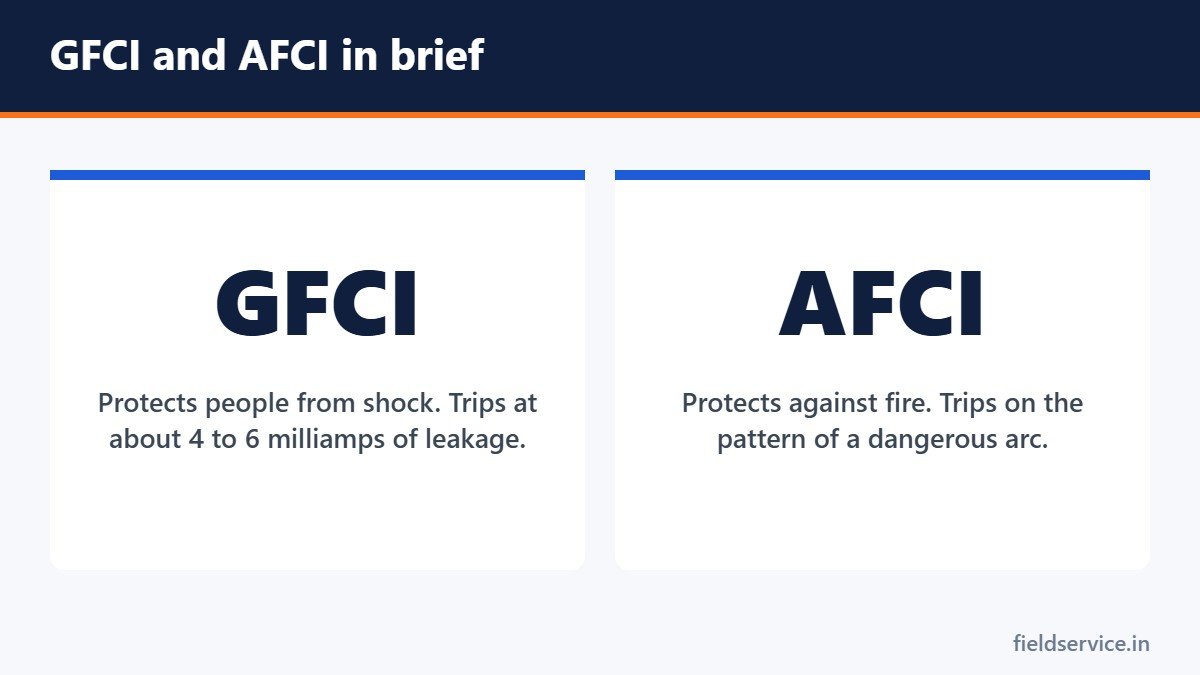
Two kinds of protective device are found in modern electrical panels and receptacles, and they are often confused. A GFCI protects people from electric shock. An AFCI protects a building from fires started by electrical arcing. They detect different faults, they are required in different places, and one cannot stand in for the other.
| Feature | GFCI | AFCI |
|---|---|---|
| Stands for | Ground-fault circuit interrupter | Arc-fault circuit interrupter |
| Protects against | Electric shock | Electrical fires |
| Detects | Current leaking to ground | Dangerous arcing in wiring |
| Typically used in | Wet and damp locations | Living areas and bedrooms |
How a GFCI works
A GFCI compares the current flowing out on the hot conductor with the current returning on the neutral. In a healthy circuit the two are equal. If some current is taking another path to ground, possibly through a person, the two no longer match. The GFCI trips when the difference reaches roughly 4 to 6 milliamps, and it does so in a fraction of a second. That is fast enough and sensitive enough to prevent most fatal shocks.
How an AFCI works
An arc is electricity jumping across a gap. A switch produces a small, harmless arc every time it opens. A damaged cord, a loose connection or a nail through a cable can produce a sustained arc that generates enough heat to start a fire. An AFCI uses electronics to monitor the current waveform, recognizes the pattern of a hazardous arc and trips the circuit. It is designed to tell these apart from the normal arcing of switches and motors.
Where each is required
The National Electrical Code (NEC) sets the requirements, and each state or locality adopts its own edition, sometimes with amendments. In general:
- GFCI protection is required where water and electricity are close together: bathrooms, kitchens, garages, outdoor receptacles, crawl spaces, unfinished basements and laundry areas. Recent code editions have extended it to more locations and to some equipment.
- AFCI protection is required on circuits serving most living areas of a home, including bedrooms, living rooms, hallways and similar rooms.
Always check the code edition in force where you are working, and confirm with the local authority if you are unsure.
Forms they come in
- Receptacles. A GFCI receptacle protects itself and can protect outlets wired downstream of it.
- Circuit breakers. GFCI and AFCI breakers protect the whole circuit from the panel.
- Dual-function breakers combine AFCI and GFCI protection in one device, for places where both are required.
Testing
Both types have a test button. Manufacturers generally recommend testing monthly. Press TEST and the device should trip and cut power. Reset it afterward. A device that does not trip, or that will not reset, should be replaced.
Troubleshooting a device that keeps tripping
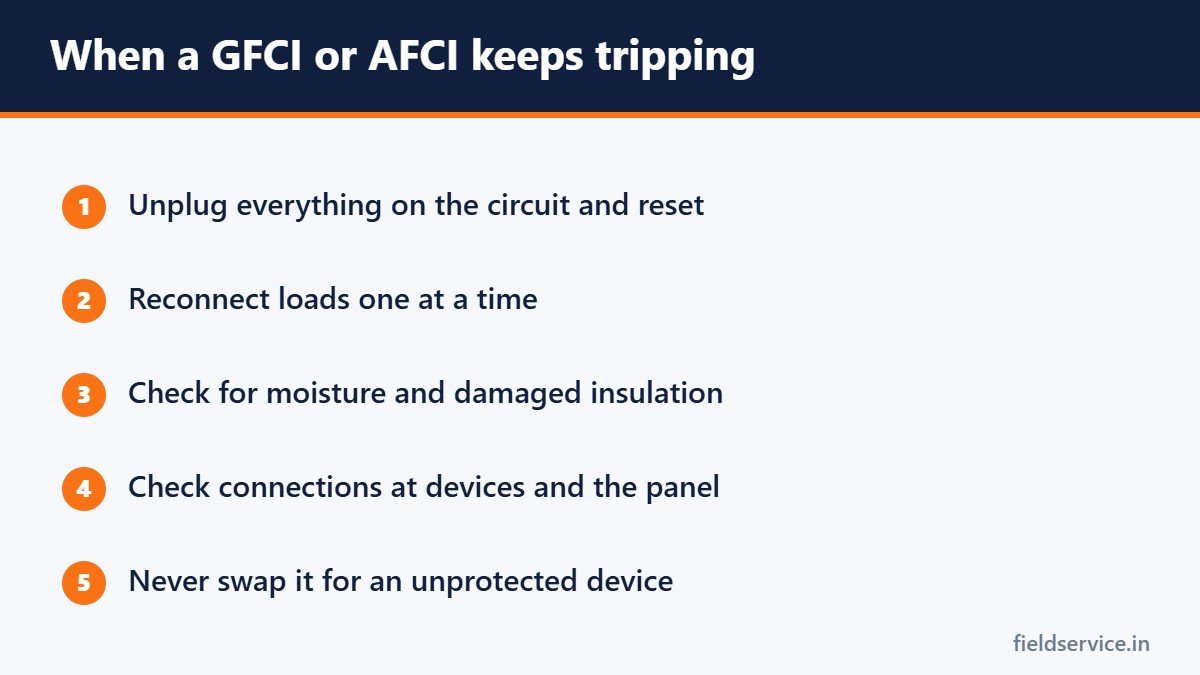
- A GFCI that trips repeatedly often points to moisture in a box or fixture, damaged insulation, or a faulty appliance. Unplug everything on the circuit, reset, and reconnect items one at a time.
- An AFCI that trips repeatedly can indicate a loose connection, damaged cable or a failing cord. A shared neutral between circuits can also cause it.
- Some older appliances and motors can cause unwanted trips. Rule out a wiring fault first before blaming the appliance.
Do not replace a tripping protective device with a standard one to make the problem go away. It is tripping for a reason, and removing the protection leaves the hazard in place.
What technicians in other trades should know
HVAC and appliance technicians meet these devices regularly, for example on a condensate pump receptacle or an outdoor service receptacle. If equipment trips a GFCI, measure for leakage to ground before assuming the device is faulty. A multimeter and an understanding of Ohm’s law are the starting point.
This article is a general overview. Electrical work must follow the code adopted in your area and should be done by a qualified, licensed person.
Related guides
- Furnace Tune-Up Checklist: What a Technician Should Check
- How to Test a Run Capacitor
- Static Pressure in HVAC Systems: What It Is and How to Measure It
Six everyday forms in Word and PDF, plus Excel workbooks that total mileage reimbursement and overtime pay.
Not sure yet? Try two forms free or see all packs.