


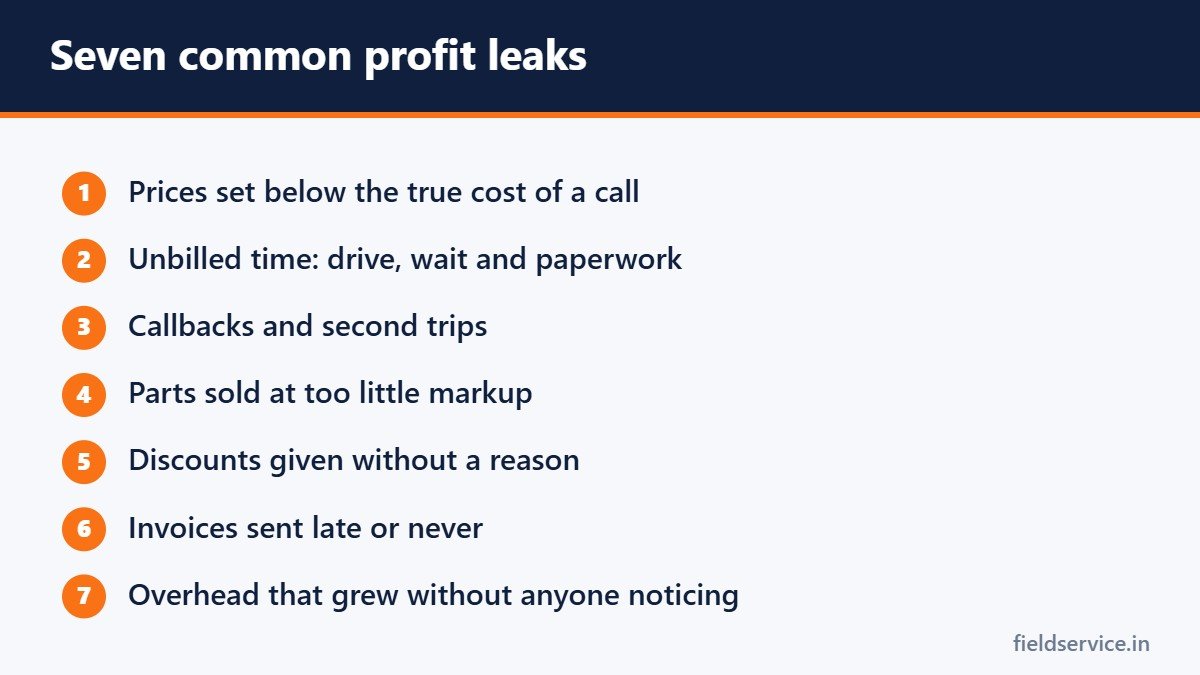
The phones ring, the trucks are out every day and the schedule is booked a week ahead. Then the year-end numbers arrive and the business made far less than anyone expected. This is one of the most common stories in the trades, and it rarely has a single cause. Profit leaks out in small amounts, on job after job, through costs nobody priced in and time nobody billed. Here are seven of the most common leaks and how to find them.
1. Prices below the true cost
Many prices are copied from competitors or set years ago and raised only occasionally. Meanwhile wages, insurance, fuel and software keep rising. Work out what a call actually costs with the true cost of a service call calculator and compare it with what you charge. Our guide on calculating the true cost of a service call explains each part.
2. Unbilled time
Technicians are paid for every hour on the clock, but only some of those hours are billed. Drive time, waiting for access, supply house runs, and paperwork all cost money. The share of paid hours that are billed, called billable utilization, is one of the most important numbers in a service business. Measure it with the billable utilization calculator.
3. Callbacks and second trips
Every return visit for the same problem costs labor, drive time and vehicle cost, usually with nothing billed. Second trips for parts that were not on the truck cost the same. See the cost of callbacks and first-time fix rate.
4. Parts margin
Selling parts at cost plus a small markup leaves little to cover the time spent ordering, picking up, stocking and warrantying them. A sliding markup scale, with higher markups on low-cost parts, is common in the trades. See markup vs margin and the parts markup calculator.
5. Discounts without a reason
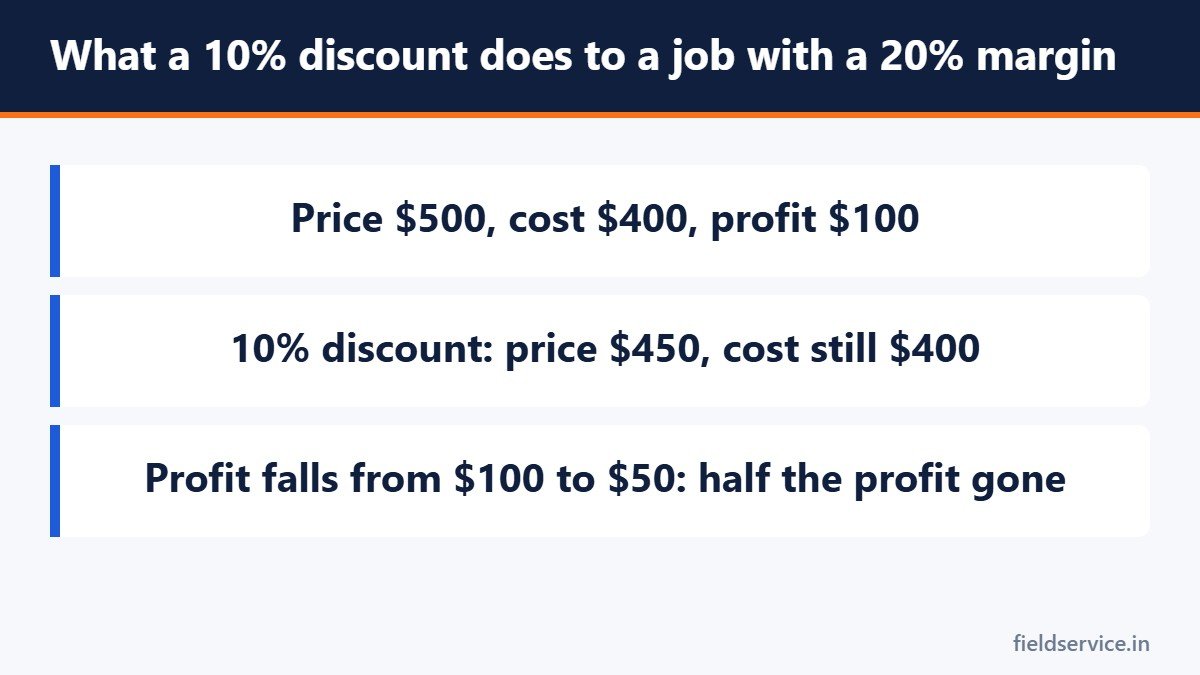
A discount for a long-standing maintenance customer is a business decision. A discount because the customer hesitated is a habit. Every dollar of discount comes straight out of profit, not out of revenue. On a job with a 20 percent net margin, a 10 percent discount halves the profit.
6. Late and missing invoices
Work that is never invoiced is pure loss, and work invoiced weeks later is paid weeks later, or not at all. Invoice on site where you can, and review open jobs every week. See how to write a service invoice.
7. Overhead creep
Overhead grows quietly: another software subscription, a bigger office, an extra vehicle that is rarely used. Each addition feels small. Review every recurring cost at least once a year and ask whether it still earns its place. See service business overhead.
How to find your leaks
You do not need an accountant to start. Pick ten recent jobs of different types and calculate the real profit on each, including drive time and a share of overhead. The job profitability calculator does the arithmetic.
| What to look at | What it tells you |
|---|---|
| Net margin by job type | Which kinds of work actually make money |
| Net margin by technician | Where training or coaching would help most |
| Callback rate | How much rework is costing you |
| Billable utilization | How much paid time is never billed |
| Days from job to invoice | How fast work turns into cash |
Patterns appear quickly. Often a small number of job types or customers earn little or nothing, and the fix is a price change, a minimum charge or a decision to stop offering that work.
Fix the biggest leak first
Do not try to fix everything at once. Choose the one leak that costs the most and that you can actually change this month. For most businesses, that is pricing or unbilled time. Then measure again in 90 days. Our guide to field service KPIs lists the numbers worth tracking monthly.
Related guides
- How to raise prices in a service business
- How to calculate job profitability
- Good, better, best repair options
Three Excel workbooks that take you from what a technician costs to what to charge, then show whether each job made money.
Not sure yet? Try two forms free or see all packs.
Frequently asked questions
Why does my service business make little profit when we are busy?
Usually because of several small leaks together: prices below true cost, unbilled time, callbacks, low parts margins, discounts, late invoices and rising overhead. Being busy only helps if each job is profitable.
What is the quickest way to find profit leaks?
Calculate the real profit on ten recent jobs, including drive time and overhead, and compare job types. The weakest ones usually stand out.
How much does a discount really cost?
More than it looks. On a job with a 20 percent net margin, a 10 percent discount removes half of the profit, because the costs of the job do not change.
How often should I review profitability?
Review key numbers monthly and do a full review of prices and overhead at least once a year.
This article is general information and is not accounting advice.