


A technician drives 25 minutes to a booked call, knocks, waits, calls the customer and gets voicemail. The slot is gone, and so is most of an hour. No-shows and late cancellations are a quiet drain on every service business, and most owners never add up what they cost. A clear cancellation policy, backed by a few simple habits, removes most of them. This guide explains how to write one that is fair to customers and to you.
What a no-show really costs
A missed appointment costs the drive there, the wait, and the time it takes to get to the next job, with nothing billed. It also costs the paying job that could have filled the slot. Take a small shop that loses three appointments a week, each wasting about an hour and a quarter of technician time, at a billable rate of $120 an hour.
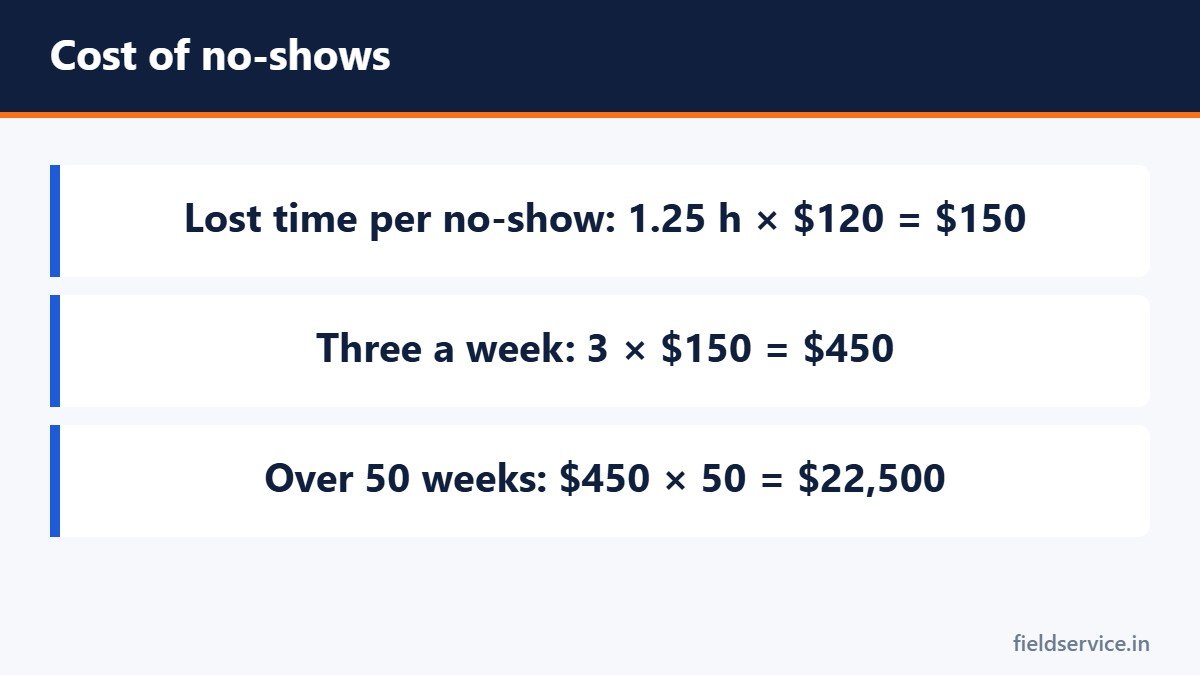

Use your own rate and numbers. The travel time cost calculator and the technician utilization calculator will help, and technician utilization explained shows why lost hours matter so much.
Prevent them before you penalize them
Most no-shows are not deliberate. People forget, get called into work, or were never sure when you were coming. Prevention works better than fees.

- Confirm immediately. Send the date, arrival window, address, what the visit covers and any fee, by text or email, as soon as the job is booked.
- Remind the day before. Ask the customer to reply to confirm. An unconfirmed appointment is a warning sign worth a phone call.
- Send an on-my-way message. It gives the customer time to get home and tells you early if nobody will be there.
- Shorten the window. Customers are far more likely to be home for a two-hour window than an all-day one. See arrival windows and scheduling.
- Make cancelling easy. A customer who can cancel with one text will tell you. A customer who has to sit on hold will simply not answer the door.
Text reminders need the customer’s consent. Our guide on texting customers covers the basics.
What a cancellation policy should say
- Notice period: how much notice you need to cancel or reschedule without charge. Twenty-four hours is common for routine calls.
- Late cancellation: what happens when notice is shorter than that.
- No-show: what happens when the technician arrives and cannot get access. State how long the technician will wait and how they will try to reach the customer.
- Your side: what you will do if you are late or have to reschedule. A policy that only binds the customer feels unfair, and customers notice.
- Exceptions: emergencies, illness and severe weather.
- Deposits: for larger jobs or special-order parts, whether a deposit is taken and when it is refundable.
Sample wording
“We reserve a technician and a time slot for your appointment. If you need to cancel or reschedule, please let us know at least 24 hours ahead and there will be no charge. For cancellations with less notice, or if our technician arrives within the scheduled window and cannot get access, a fee of $__ applies. If we are running late we will contact you, and if we must reschedule we will offer you the next available appointment.”
Treat this as a starting point and have it reviewed for your state.
Should you charge a fee?
| Approach | Advantages | Drawbacks |
|---|---|---|
| No fee, reminders only | No friction; simple | No recovery of lost time |
| Fee for late cancellation or no-show | Recovers some cost; discourages repeat offenders | Hard to collect; can cost goodwill |
| Diagnostic or trip fee paid at booking | Customer has committed; easy to apply | Some customers will not book |
| Deposit on larger jobs | Protects special-order parts and blocked days | Needs clear refund terms |
Many companies waive the fee the first time and apply it to repeat no-shows. A fee you never intend to charge is still useful as a signal that the appointment has value. See trip charges explained for how a fee collected at booking fits into your pricing.
Rules to know before you charge
- Disclose it first. A cancellation fee is only enforceable if the customer agreed to it before booking. Put it in the confirmation message, on your website and on estimates.
- Card charges. If you keep a card on file and charge it for a no-show, the customer must have agreed to that in advance. Card networks expect clear disclosure, and undisclosed charges are likely to be reversed.
- The FTC Cooling-Off Rule. Under federal law, a buyer generally has three business days to cancel a sale of $25 or more that is made at the buyer’s home, and the seller must give written notice of that right. The rule generally does not cover a visit the customer asked for in order to have something repaired or maintained, or a sale needed to meet an emergency. Extra goods or services sold during that visit, beyond the repair that was requested, can still be covered.
- State law. Many states have their own home solicitation and home improvement contract laws, with cancellation rights, deposit limits and required contract wording.
Ask an attorney who knows your state’s contractor rules to review your policy and your contract forms.
Handle exceptions like a person
Apply the policy with judgment. A long-standing customer with a family emergency should not get a fee notice. A customer who has missed three appointments should pay in advance for the fourth. Train office staff to explain the policy calmly and to offer a new slot first; see how to handle a customer complaint.
When you are the one who is late
Customers judge your policy by how you keep your own appointments. Track your on-time arrival rate, call ahead when you are running behind, and consider a small credit when you miss a window. Good scheduling makes both problems smaller; see how dispatch affects technician productivity.
Measure it
- Count no-shows and late cancellations each week.
- Record the reason where you can find it out.
- Note which booking sources and time slots produce the most.
- Check whether confirmed appointments are missed less often than unconfirmed ones.
Related guides
Sources
- Federal Trade Commission: Buyer’s remorse and the FTC Cooling-Off Rule
- Code of Federal Regulations: 16 CFR Part 429, Cooling-off period for sales made at homes
Estimate, invoice and work order templates in Word and PDF, plus Excel workbooks for job scheduling and maintenance agreement renewals.
Not sure yet? Try two forms free or see all packs.
Frequently asked questions
What is a reasonable cancellation notice period for a service call?
Twenty-four hours is the most common notice period for routine residential service calls. Larger jobs that block out a full day or need special-order parts often have longer periods.
Can I charge a customer for a no-show?
Generally only if the customer agreed to the fee before the appointment was booked. The fee should be clearly disclosed in writing, and state law may limit what you can charge.
How can I reduce no-shows without charging fees?
Confirm the booking in writing, send a reminder the day before, send an on-my-way message, offer narrower arrival windows and make it easy to reschedule.
What is the FTC Cooling-Off Rule?
It is a federal rule that generally gives buyers three business days to cancel a sale of $25 or more made at their home, and requires the seller to give notice of that right. Visits the customer requested for repair or maintenance are generally excluded, though extra items sold during the visit can be covered. State laws may add further rights.
Should I take a deposit for service work?
Deposits are common for larger jobs and special-order parts. State the amount and the refund terms in writing, and check your state’s rules on contractor deposits.
This article is general information and is not legal advice. Consumer protection and contractor laws vary by state.