


Tools are one of the biggest costs of working in the trades. A new technician can spend a few thousand dollars on hand tools and meters, and specialty instruments cost far more. So who should pay: the technician or the employer? There is custom, there is law, and there is tax, and they do not always point the same way. This guide explains how a tool allowance works and what the rules say.
What is customary in the trades
Practice varies by trade and by company, but a common split looks like this:
| Usually the technician | Usually the employer |
|---|---|
| Basic hand tools: screwdrivers, pliers, wrenches, nut drivers | Recovery machines, vacuum pumps and refrigerant scales |
| A personal multimeter and basic testers | Combustion analyzers and other calibrated instruments |
| Tool bags and personal storage | Large or specialty power tools, drain machines, threaders |
| Work boots, in many companies | Ladders, safety equipment and most PPE |
| Consumables, the vehicle and its fuel |
Good employers put the split in writing, with a list of the tools a technician is expected to own at each level. See apprentice, journeyman and master levels for how expectations grow with experience.
What federal law says
The federal Fair Labor Standards Act (FLSA) does not forbid an employer from requiring employees to provide their own tools. It does set a limit. According to the U.S. Department of Labor, if an employer requires an employee to buy tools needed for the job, the cost may not reduce the employee’s pay below the minimum wage or cut into overtime pay in any workweek.
This applies whether the employer deducts the cost from a paycheck or simply requires the employee to pay out of pocket.
A worked example
A helper earns $15 an hour and works 40 hours, for gross pay of $600. The federal minimum wage is $7.25 an hour, so the minimum for the week is $290. If the employer requires the helper to buy a $400 tool set that week:
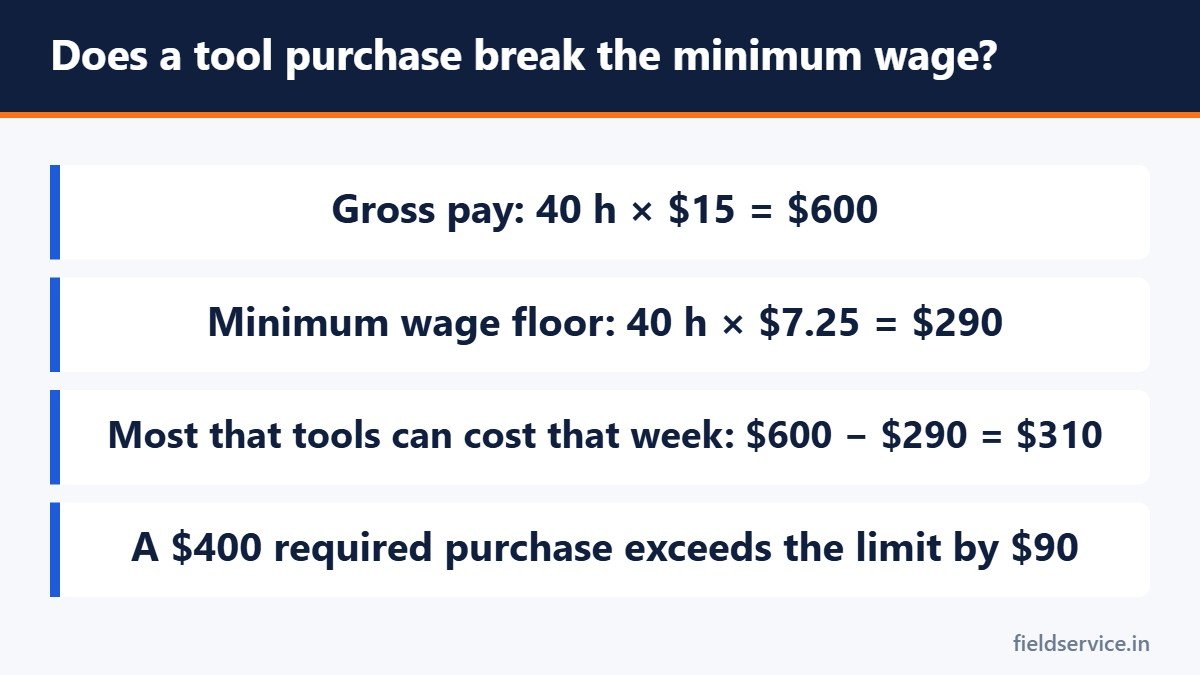
Spreading the cost over several pay periods is the usual way employers stay within the limit. Many states have higher minimum wages, which raises the floor.
State laws can go further
Some states are stricter than federal law. California, for example, generally requires employers to provide the tools and equipment needed for the job, with an exception that lets employees who earn at least twice the state minimum wage be required to supply the hand tools customarily used in their trade. Other states require employers to reimburse necessary work expenses. Check your own state’s rules.
Safety equipment is different
OSHA requires employers to pay for most required personal protective equipment. There are exceptions for some everyday items, such as ordinary safety-toe footwear and prescription safety glasses that can be worn off the job. See PPE for field technicians.
How a tool allowance works
A tool allowance is money an employer provides toward the cost of a technician’s own tools. Common forms are:
- A fixed amount: for example, a set sum each month or year.
- Reimbursement: the technician buys approved tools, submits receipts and is paid back up to a limit.
- A tool account: the employer holds an account with a supplier and the technician orders against a yearly budget.
- A purchase program: the employer buys the tools and the technician repays the cost over time, sometimes with the balance forgiven after a period of service.
Read the terms of any purchase program. Ask who owns the tools if you leave, and whether an unpaid balance can be taken from your final paycheck. Final-pay deductions are restricted by federal and state law.
How tool money is taxed
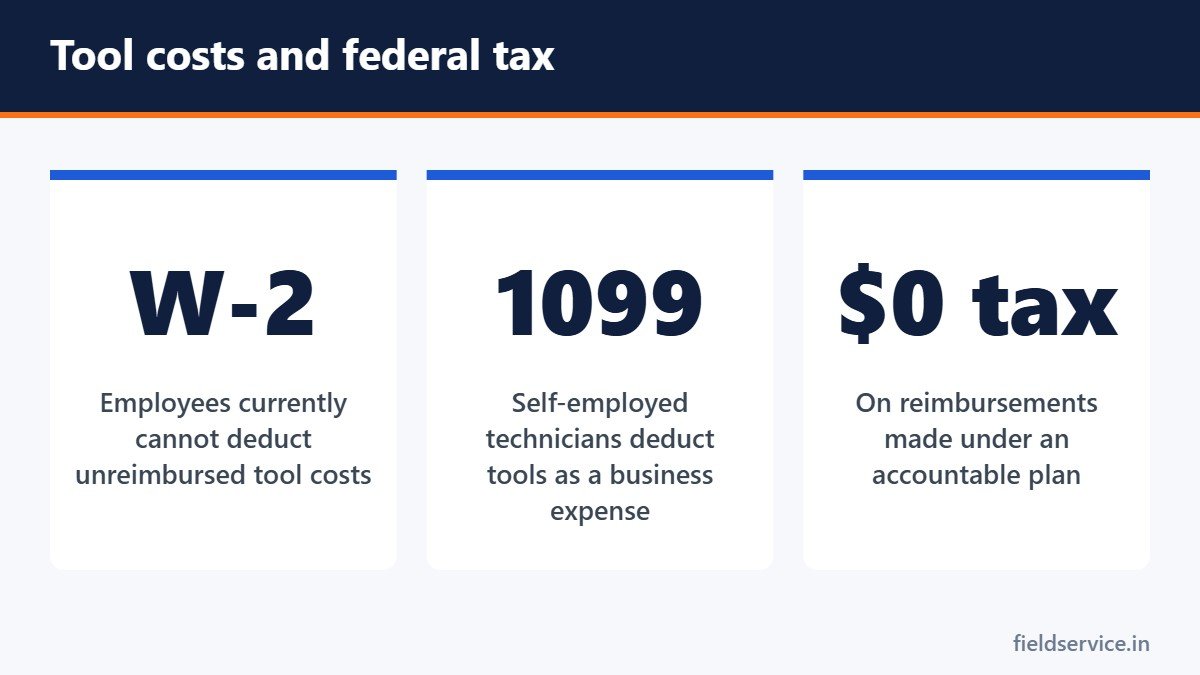
- Employees: under current federal tax law, W-2 employees cannot deduct unreimbursed work expenses such as tools on their federal return. A few states still allow a deduction on the state return.
- Flat allowances: a tool allowance paid without any requirement to show receipts is generally treated as taxable wages.
- Accountable plans: if the employer reimburses actual tool costs under an accountable plan, the reimbursement is not taxable. In broad terms, the expense must have a business purpose, the employee must substantiate it with receipts within a reasonable time, and any excess must be returned.
- Self-employed technicians: independent contractors generally deduct tools as a business expense. See W-2 vs 1099 technicians.
Because the tax treatment of an allowance changes what it is worth, a reimbursement of $1,200 under an accountable plan is worth more to you than a taxable $1,200 allowance. Your pay stub will show which you are receiving; see how to read your pay stub.
Questions to ask before you take a job
- Which tools am I expected to own on day one, and which does the company supply?
- Is there a tool allowance or reimbursement, and how is it paid?
- Who replaces a tool that is broken, lost or stolen from the truck?
- Is my tool box covered by the company’s insurance while it is in the company vehicle?
- If I buy tools through the company, what happens to the balance if I leave?
Tool support is part of total pay, alongside wages, bonuses and benefits. Weigh it when you compare offers or ask for a raise. Whatever the arrangement, keep an inventory with photos, serial numbers and receipts. It is the only way to prove a loss.
Related guides
Sources
- U.S. Department of Labor: Fact Sheet #16, Deductions From Wages for Uniforms and Other Facilities Under the FLSA
- Internal Revenue Service: Publication 463, Travel, Gift, and Car Expenses (accountable plans)
- OSHA: Personal protective equipment, including payment for PPE
Six everyday forms in Word and PDF, plus Excel workbooks that total mileage reimbursement and overtime pay.
Not sure yet? Try two forms free or see all packs.
Frequently asked questions
Can an employer require technicians to buy their own tools?
Under federal law, yes, as long as the cost does not reduce pay below the minimum wage or cut into overtime pay in any workweek. Some states have stricter rules.
Is a tool allowance taxable?
A flat allowance paid without receipts is generally taxable as wages. Reimbursements of actual tool costs under an accountable plan are not taxable.
Can I deduct my tools on my taxes?
W-2 employees currently cannot deduct unreimbursed tool costs on a federal return. Self-employed technicians can generally deduct tools as a business expense.
Who pays if my tools are stolen from the company truck?
It depends on company policy and insurance. Many commercial auto policies do not cover employees’ personal tools, so ask before a loss happens and keep an inventory with receipts.
Does my employer have to pay for safety gear?
OSHA requires employers to pay for most required personal protective equipment, with limited exceptions such as ordinary safety-toe boots that can be worn off the job.
This article is general information and is not legal or tax advice. State laws differ, and tax rules change. Ask a qualified adviser about your situation.