


Parts on a service truck are money on wheels. Too few, and technicians make supply runs and second trips. Too many, and thousands of dollars sit in bins, get damaged, go missing or become obsolete. Most small service businesses manage truck stock by habit: each technician carries whatever they like and restocks when something runs out. A simple minimum and maximum system does the job better and takes little time to run.
What poor truck stock costs
- Supply runs. Each one takes most of an hour of paid time. See how to reduce windshield time.
- Second visits. A missing part is the most common reason a job is not finished the first time. See first-time fix rate.
- Lost sales. A customer who has to wait three days for a part may call someone else.
- Cash tied up. Stock nobody uses is money that cannot be spent on anything else.
- Shrinkage. Parts that are not tracked disappear without anyone noticing.
Decide what to stock
Use your own records. Look at the parts used over the last six to twelve months, and sort them by how often each one was needed.
- Used every week: stock on every truck.
- Used every month: stock on every truck if the part is small and inexpensive. Otherwise keep it at the shop.
- Used a few times a year: keep at the shop or order when needed.
- Caused a second trip in the last quarter: consider adding it, whatever its usage.
The stock list will differ by trade, by season and sometimes by technician, if people specialize. Our service vehicle stocking guide covers the general categories.
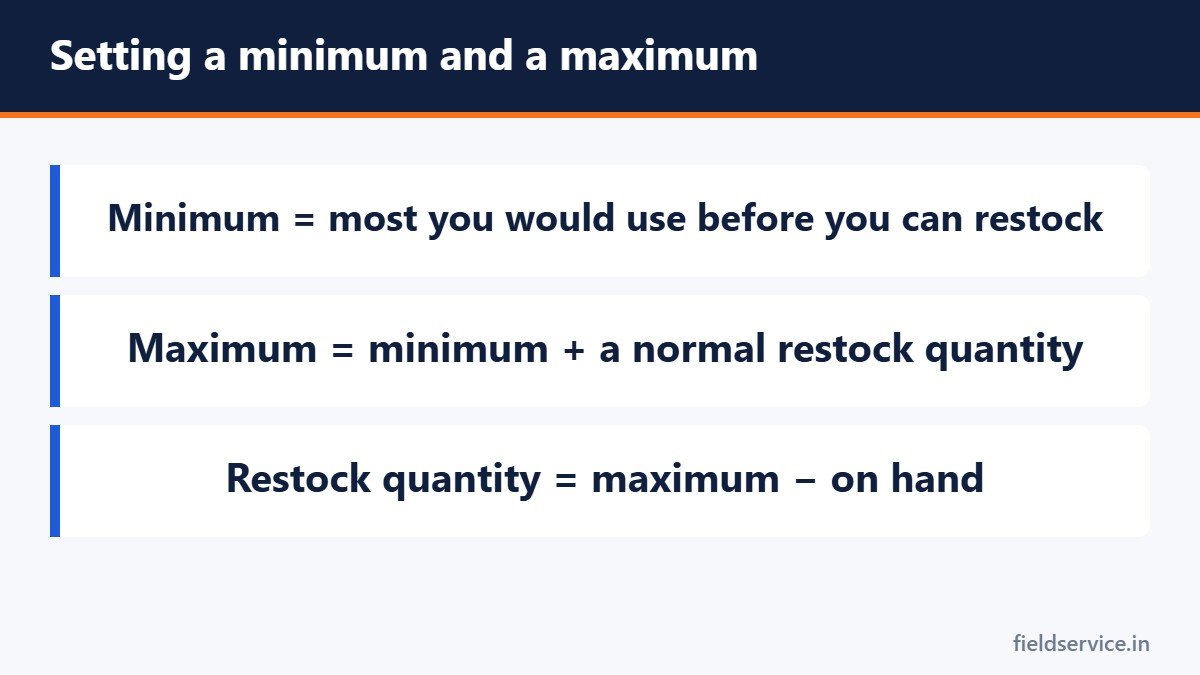
How minimum and maximum levels work
- The minimum is the quantity below which the part must be restocked. Set it at the most you are likely to use before the next restock. If a truck is restocked weekly and has never used more than three of a part in a week, a minimum of three is sensible.
- The maximum is the most the truck should carry. Set it high enough that restocking is not constant and low enough to fit the bin and limit the money tied up.
- When the quantity on hand falls to the minimum or below, restock to the maximum.
Example: a capacitor has a minimum of 2 and a maximum of 5. The count shows 1 on hand. Restock quantity is 5 − 1 = 4.
Restock from the ticket
The simplest reliable method is to replace what was used. Every part used on a job is recorded on the ticket. At the end of the day, or first thing the next morning, the truck is restocked from the day’s tickets. Restocking from memory does not work. Nobody remembers the third fitting used on the second job of yesterday.
Options for how restocking happens:
- The technician collects parts from the shop each morning from a printed list.
- A parts person stages a bin for each truck overnight.
- A supplier restocks the trucks directly on a schedule. Some distributors offer this.
Organize the truck to match
- Give every stocked part a labeled bin, with the part number and the minimum and maximum on the label.
- Keep the layout the same on every truck, so that anyone can find a part and anyone can restock.
- Put fast-moving parts where they are easiest to reach.
- Keep a printed stock list in the vehicle.
Our service vehicle stock checklist on the templates page has columns for bin, minimum, maximum, on hand and restock quantity.
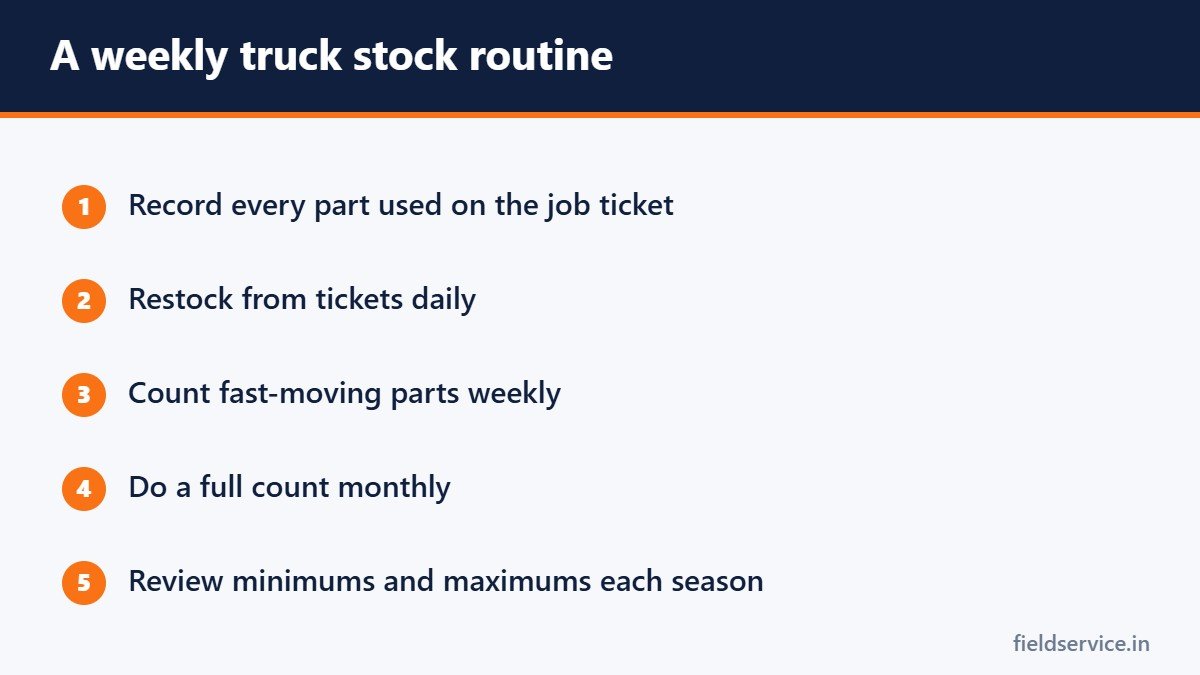
Count regularly
- Weekly: a quick check of the fastest-moving items.
- Monthly: a full count of the truck against the stock list.
- Seasonally: a review of the list itself.
Compare each count with what the records say should be there. Small differences are normal. A large or repeated difference means parts are being used without being recorded, which also means they are not being billed.
Seasonal changes
What fails in January is not what fails in July. Before each season, raise the levels of the parts that season uses and lower or remove the ones it does not. Parts taken off the trucks go back to the shop, not into a corner of the van.
Parts used and not billed
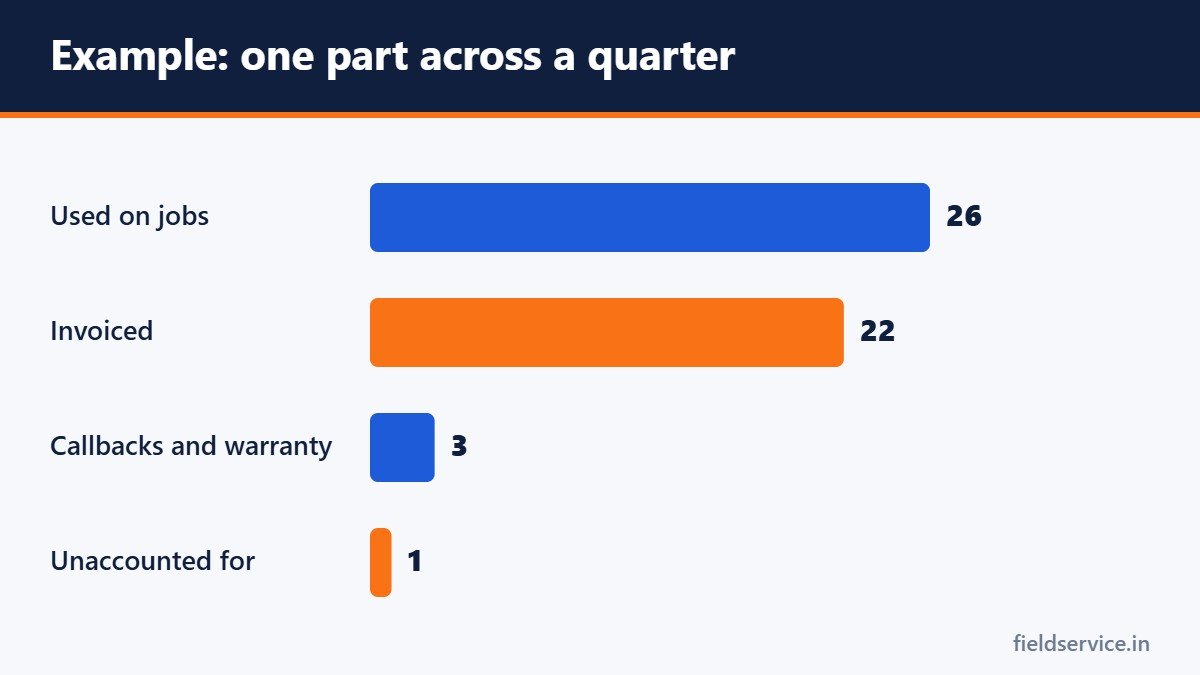
Every count that comes up short represents parts that left the truck without reaching an invoice. Sometimes the part was used on a callback or a warranty job. Often it was simply forgotten. Recording parts on the ticket at the time, before leaving the job, fixes most of it. See how to document a service call.
How much stock is too much?
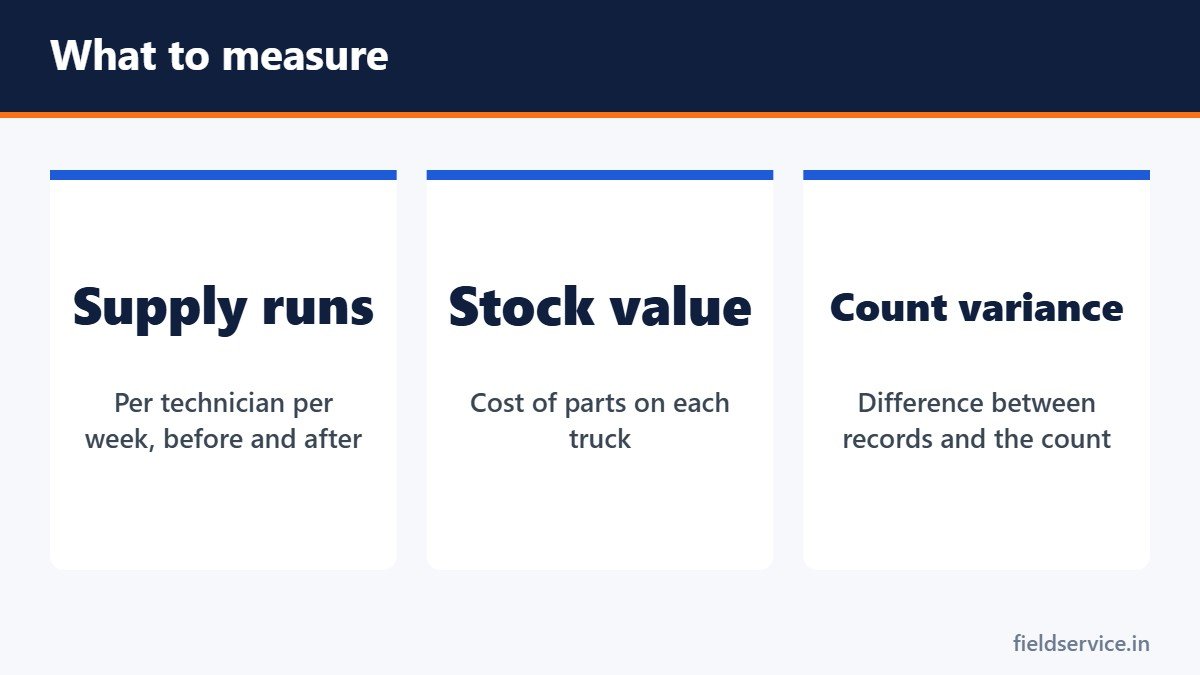
Add up the cost of everything on one truck. Owners are often surprised by the total. Then look at how much of it has not moved in six months. That portion can usually be returned to the supplier, moved to the shop or sold off. A truck does not need to carry a part for every possible job. It needs to carry the parts for the jobs it actually runs.
Tools and software
A two-truck business can run this on a printed list and a clipboard. As the fleet grows, field service software with inventory by truck will track usage from job records and produce restock lists automatically. The discipline of recording parts on the ticket matters more than the tool.
Getting technicians on board
- Explain the reason: fewer parts runs and fewer evenings spent at the supply house.
- Ask technicians what they are always short of and what they never use.
- Make restocking as easy as possible.
- Review the list with them each season.
Getting started
- Pull six months of parts usage.
- Build a stock list for one truck, with a minimum and maximum for each part.
- Label the bins.
- Restock from tickets for a month.
- Count, compare and adjust the levels.
- Roll the same layout out to the other trucks.
Related guides
- Maintenance Agreements: How They Work and How to Price Them
- Warranty Work: How to Track It and Stop It Draining Profit
- How to Onboard a New Technician: A 90-Day Plan
Six everyday forms in Word and PDF, plus Excel workbooks that total mileage reimbursement and overtime pay.
Not sure yet? Try two forms free or see all packs.
Frequently asked questions
What is a min/max inventory system?
Each stocked part has a minimum quantity, below which it is restocked, and a maximum quantity, which is the most the truck should carry. When the count falls to the minimum, the part is restocked to the maximum.
How do I decide which parts to keep on a service truck?
Use your own usage records. Stock the parts used weekly on every truck, keep rarely used and expensive parts at the shop, and add any part that has caused repeated second trips.
How often should truck inventory be counted?
A quick check of fast-moving parts each week and a full count each month works for most small businesses, with a review of the stock list each season.
Why does my truck stock never match the records?
Usually because parts are used without being recorded on the job ticket. Recording parts at the job, before leaving, fixes most of the difference and makes sure they are billed.