


A technician who goes out alone usually sets the first labor rate by feel. The old employer charged $125 an hour, so $90 seems like a fair price that will win work. A year later the new owner is busier than ever and earning less than the old wage. The rate was never connected to what the business costs to run. Setting it properly needs four numbers and about half an hour.
Why the old wage is the wrong starting point
As an employee, your wage was only part of what you cost. Your employer also paid payroll taxes, insurance, the truck, the fuel, the tools, the office and every hour you were not on a job. As an owner, all of that is yours. Our article on hourly pay vs. billable rate shows the gap from the employer’s side.
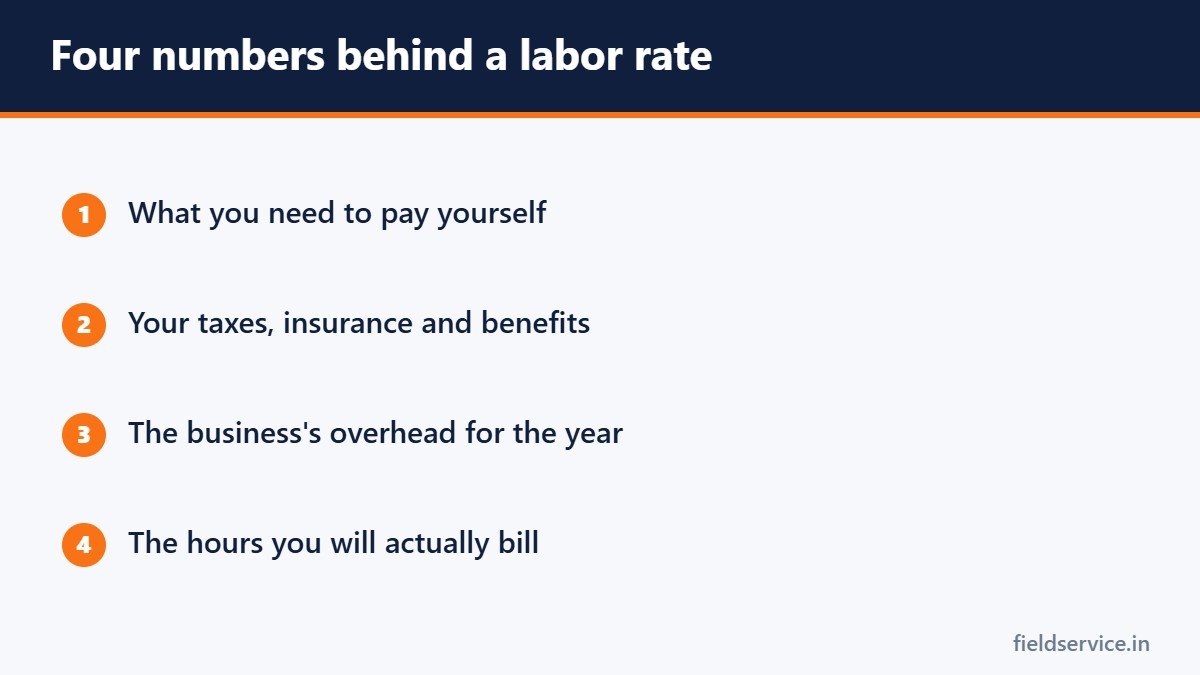
Step 1: what you need to earn
Decide on an annual salary for yourself as the technician. Use what a good employer would pay someone with your skills. In this example, $75,000.
Step 2: your own taxes and benefits
You now pay both halves of Social Security and Medicare, and your own health insurance and retirement savings. See W-2 vs. 1099. In this example, allow $15,000 a year.
Step 3: overhead
List every cost of running the business for a year. Example figures:
| Item | Annual cost |
|---|---|
| Vehicle: payment or depreciation, fuel, maintenance | $9,000 |
| Insurance: liability and commercial auto | $6,000 |
| Tools, software, phone, licenses, marketing, accounting | $14,000 |
| Total overhead | $29,000 |
Your own figures will differ. Do not leave out the small recurring items, because together they are large. See service business overhead.
Step 4: billable hours
This is the number new owners get most wrong. You will not bill 40 hours a week. As an owner-operator you also drive, quote, order parts, answer the phone, invoice and do the books.
A realistic assumption for a one-person business is about 25 billable hours a week, over 48 working weeks once holidays, illness and slow weeks are allowed for.
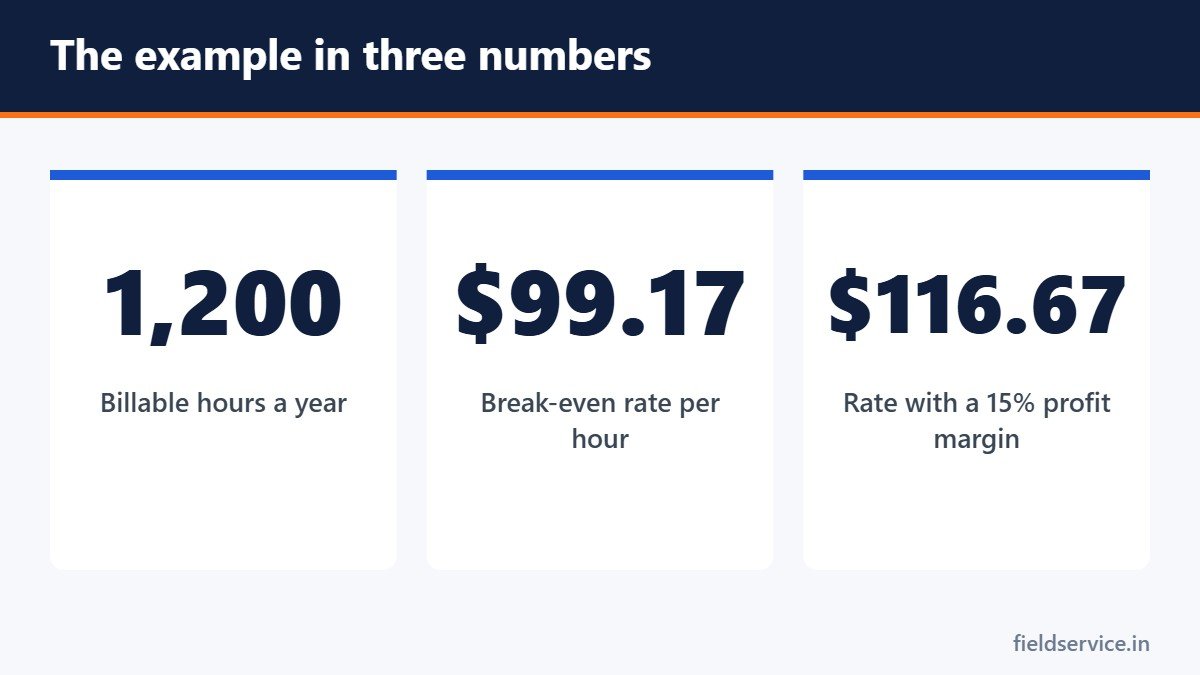
25 × 48 = 1,200 billable hours a year
Step 5: break-even rate
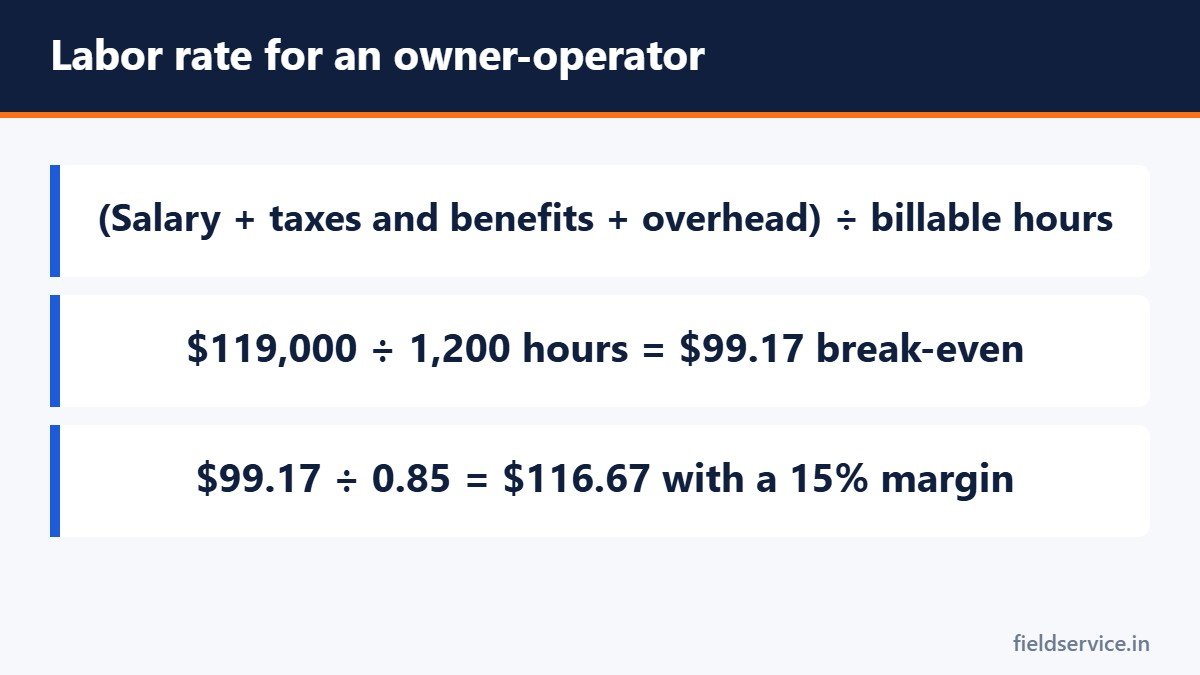
Add the first three numbers and divide by the fourth.
- Salary: $75,000
- Taxes and benefits: $15,000
- Overhead: $29,000
- Total: $119,000
$119,000 ÷ 1,200 = $99.17 an hour
At this rate the business pays you your salary and covers its costs, with nothing left over.
Step 6: add profit
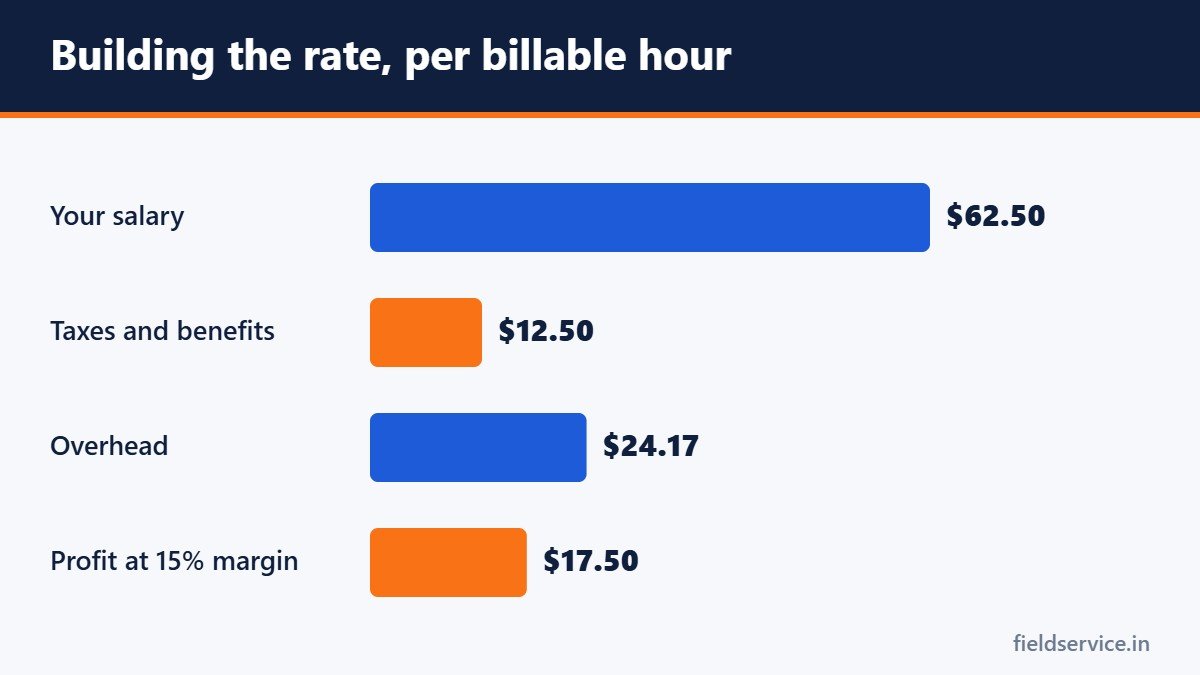
A business needs profit as well as a salary for its owner. Profit pays for a replacement truck, a slow winter, a bad debt and growth. For a 15 percent margin, divide by 0.85:
$99.17 ÷ 0.85 = $116.67 an hour
Round to a figure you are comfortable quoting, such as $115 or $120.
What happens at $90 an hour
At $90, the same 1,200 hours bring in $108,000. The costs are $119,000. The shortfall of $11,000 comes out of your salary, so you are earning $64,000 for doing two jobs, with nothing put aside for the truck. That is how busy owner-operators end up worse off than they were as employees.
If the market will not pay your rate
Compare your number with what established companies in your area charge. If yours is in the same range, charge it. New owners nearly always underestimate what customers will pay for a reliable, licensed technician who turns up. If your number is well above the local market, do not simply cut it. Look at the inputs:
- Billable hours. Can you bill 28 hours a week through tighter routing and less time on admin? At 1,344 hours, break-even falls to $88.54.
- Overhead. Is there a cost that is not earning its keep?
- Job mix. Are there higher-value jobs you could take on?
The rate comes out of the arithmetic. Changing it without changing the inputs just moves the loss onto your own pay.
Parts are separate
The labor rate covers your time. Parts and materials are priced on top, with their own margin, which also contributes to overhead and profit. See markup vs. margin and the parts markup calculator.
Hourly or flat rate?
Once you know your hourly rate, you can either bill by the hour or build flat-rate prices from it: the rate multiplied by the average time each task takes, plus the part. Many residential customers prefer a fixed price. See flat rate vs. time and materials.
Service call and minimum charges
The labor rate alone does not cover the trip. Set a service call fee or a minimum charge that pays for the drive and the first part of the visit. See trip charges and the service call minimum price calculator.
Review it every year
Insurance, fuel and parts prices rise, and your billable hours will change as the business settles. Recalculate annually and adjust. Small yearly changes are easier on customers than a large one. See how to raise prices.
Common mistakes
- Starting from the old wage or a competitor’s price
- Assuming 40 billable hours a week
- Leaving out your own taxes and health insurance
- Forgetting vehicle replacement
- Including no profit, so that any surprise becomes a loss
- Lowering the rate at the first objection
For the rest of the start-up checklist, see going out on your own, and for the monthly revenue target, see the break-even point.
Related guides
- IRS Mileage Rate 2026: What Field Technicians Need to Know After the July Increase
- Loaded Labor Cost: What a Technician Really Costs Per Hour
- How Overtime Pay Works for Field Technicians
Three Excel workbooks that take you from what a technician costs to what to charge, then show whether each job made money.
Not sure yet? Try two forms free or see all packs.
Frequently asked questions
How do I calculate my hourly labor rate as a self-employed technician?
Add the salary you need, your own taxes and benefits and your annual overhead, then divide by the hours you will realistically bill in a year. Divide the result by one minus your target profit margin.
How many billable hours can an owner-operator expect?
Around 25 hours a week is a realistic starting assumption for a one-person service business, because driving, quoting, ordering parts, invoicing and bookkeeping take the rest of the time.
Should I charge less than established companies when I start?
Not automatically. Price from your own costs. A rate below your break-even means every hour you work loses money, however busy you are.
Is the labor rate the same as the service call fee?
No. The labor rate covers your time on the job. A service call fee or minimum charge covers the cost of the trip and the first part of the visit.
This article is general information and is not financial or tax advice.