


Every service business gets complaints. A repair did not hold, a technician was late, the bill was higher than the customer expected. What separates good companies from poor ones is not the number of complaints but what happens in the first day after one arrives. A complaint handled quickly and fairly often leaves the customer more loyal than before. One that is ignored or argued with becomes a bad review, a chargeback or a lost account.
Why complaints are useful
Most unhappy customers do not complain. They simply call someone else next time. The few who tell you are giving you a chance to fix the problem and to find out about something that is probably affecting other customers too.
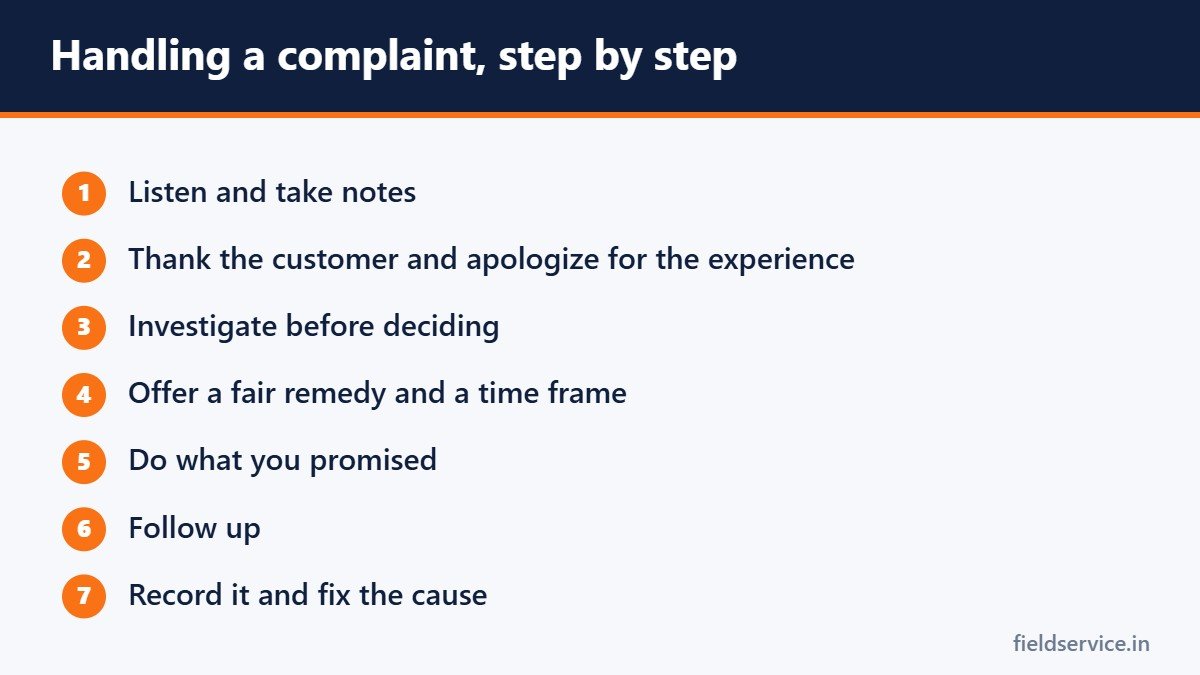
Step 1: Listen
Let the customer explain the whole thing without interruption. Take notes. Ask questions only to make sure you understand what happened and when. Do not defend, explain or correct at this stage.
Step 2: Acknowledge
Thank them for telling you and apologize for the experience. “I am sorry this happened, and thank you for letting us know” is true whether or not the company turns out to be at fault. It is not an admission of liability. It tells the customer you are taking them seriously.
Step 3: Investigate
Tell the customer you will look into it and when you will call back. Then do it:
- Read the job record, the notes and the photos.
- Talk to the technician, and listen to their account without assuming blame.
- Check what was quoted, what was approved and what was done.
- If the complaint is about workmanship, send someone to look, ideally a different technician or a supervisor.
This is where good records pay for themselves. See how to document a service call.
Step 4: Decide on a remedy
Match the remedy to the problem:
- The repair failed. Return and correct it at no charge. Treat it as a priority call.
- The technician was late or the service was poor. Apologize, explain what you are changing, and consider a goodwill credit.
- The bill was a surprise. Go through what was quoted and approved. If the price was not communicated clearly, a partial credit is usually fair.
- Damage was caused. Arrange the repair or involve your insurer, and keep the customer informed.
- The company did nothing wrong. Explain what you found, calmly and with evidence. Sometimes a small goodwill gesture is still worth making.
Decide who in the company is allowed to approve what. If technicians and office staff can resolve small matters on the spot, up to a set amount, most complaints end in one conversation.
Step 5: Do what you promised
Call back when you said you would, even if you have no answer yet. Carry out the remedy quickly. A second failure to deliver is worse than the original problem.
Step 6: Follow up
A few days after the remedy, call to check that the customer is satisfied. Very few companies do this, and customers remember it.
Step 7: Record and learn
Log every complaint with the date, the job, the cause and the outcome. Review the log each month. Complaints usually cluster around a few causes:
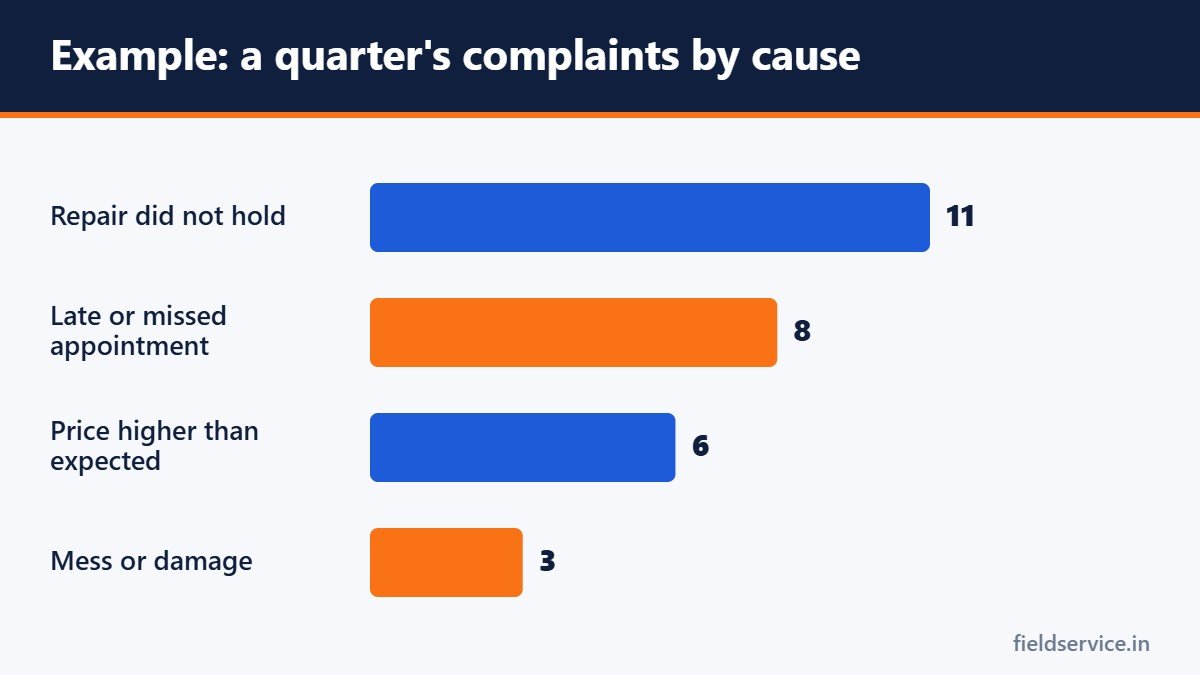
In that example, the largest group points to callbacks, and the second to scheduling. See the real cost of a callback and on-time arrival rate. Our callback tracking log on the templates page can be adapted for complaints.
What not to do
- Do not argue or try to prove the customer wrong in the first conversation.
- Do not blame the technician in front of the customer.
- Do not go silent while you investigate.
- Do not offer a refund on condition that the customer removes a review.
- Do not make promises the business cannot keep.
- Do not treat every complaint as an attempt to get something for free.
Complaints made in public
When the complaint arrives as an online review, reply briefly and politely in public, then take the detail to a phone call. Everyone who reads the review will read your reply. See how to get more customer reviews for how to respond.
When the customer is being unreasonable
A small number of complaints are not made in good faith, or the customer demands far more than the problem justifies. Stay polite, set out the facts and what you are prepared to do, and put it in writing. You are not obliged to meet every demand, and you may decide not to work for that customer again. If the customer has been abusive to staff, say so plainly. See dealing with difficult customers.
Payment disputes
If a customer disputes a card payment with their bank, you will be asked for evidence. A signed estimate, a sign-off form, an itemized invoice and photos are what settle these. See taking payments in the field.
Build it into the business
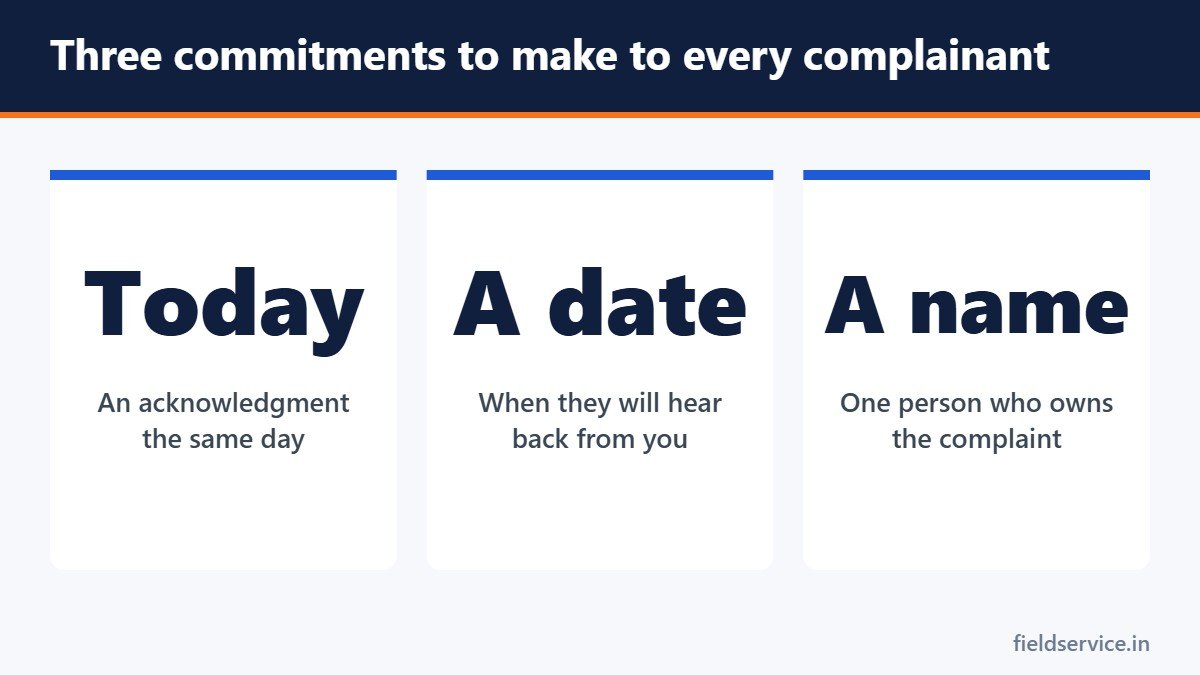
- Name one person responsible for complaints.
- Set a rule that every complaint is acknowledged the same day.
- Give staff authority to resolve small issues without asking.
- Keep a simple log.
- Review it monthly and choose one cause to fix.
- Tell the team what was learned, without naming and shaming.
Related guides
- How to Explain a Repair to a Customer
- In the Customer’s Home: Etiquette Every Field Technician Should Follow
- Truck Inventory Management: Setting Minimums and Maximums That Work
Six everyday forms in Word and PDF, plus Excel workbooks that total mileage reimbursement and overtime pay.
Not sure yet? Try two forms free or see all packs.
Frequently asked questions
What is the first thing to do when a customer complains?
Listen to the whole complaint without interrupting, take notes, thank the customer for telling you and say when you will get back to them.
Does apologizing admit fault?
Saying you are sorry the customer had a poor experience is an acknowledgment, not an admission of liability. It shows you are taking the complaint seriously while you find out what happened.
Should we give a refund for every complaint?
No. Match the remedy to the problem. A failed repair should be corrected at no charge. Other complaints may call for an explanation, a partial credit or a goodwill gesture.
How quickly should a complaint be answered?
Acknowledge it the same day and give the customer a specific time by which they will hear back, even if the investigation takes longer.