


When a furnace stops on a cold night, most people search for a local company and look at two things: the star rating and how many reviews stand behind it. A business with a few dozen recent, detailed reviews gets the call ahead of one with four reviews from three years ago, whatever the quality of the work. Reviews are earned on the job, but most satisfied customers never write one unless somebody asks.
Why reviews matter
- They are the first impression for people who have never heard of you.
- Recent reviews show that the business is active and consistent.
- Detailed reviews answer questions a customer would otherwise call to ask.
- They give you feedback you would not hear any other way.
Earn it first
No request will produce good reviews from poor service. The visits that generate them have things in common: the technician arrived when promised, explained the problem clearly, gave the price before starting and left the place clean. Our guides on explaining a repair and on-time arrival cover the habits behind them.
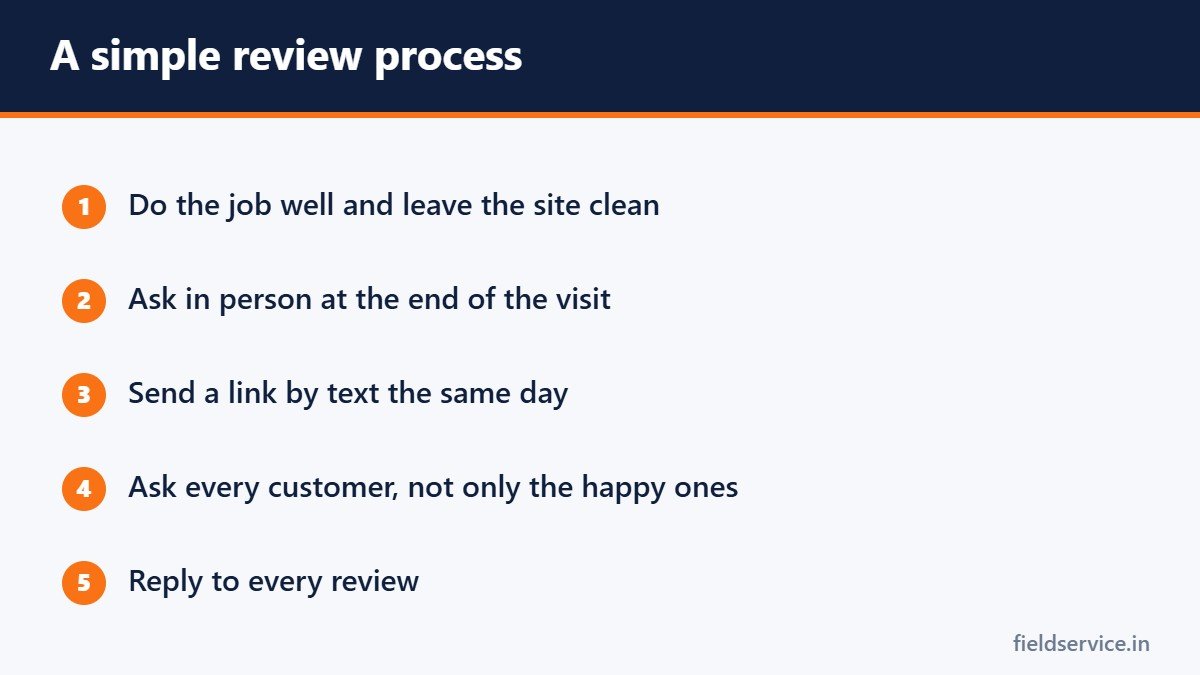
When and how to ask
Ask in person
The best moment is at the end of a visit, when the system is running and the customer has just said thank you. A request from the technician who did the work is far more effective than an email from the office. Something like: “If you were happy with the visit, a review would really help us. We will text you a link.”
Send a link the same day
Make it one tap. A text with a direct link to your review page, sent within a few hours, gets a much better response than a message several days later. Text messages need the customer’s consent. See texting customers.
One reminder at most
A single follow-up a few days later is reasonable. More than that feels like pestering.
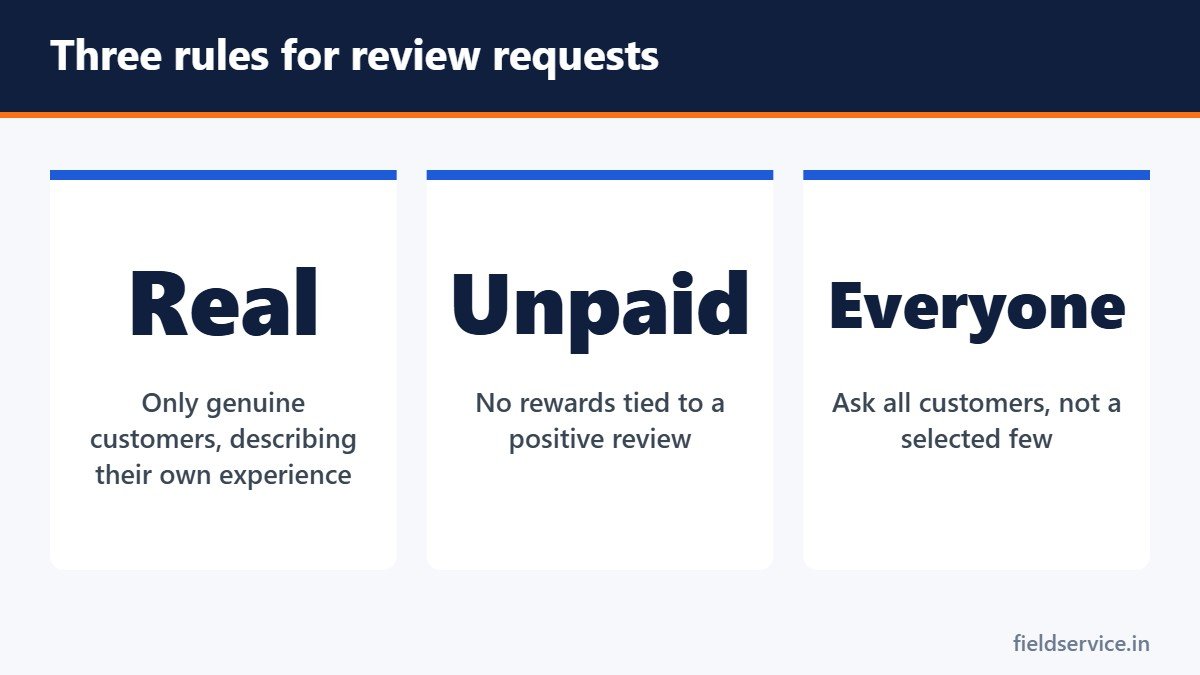
What the rules prohibit
Reviews are covered by Federal Trade Commission rules and by each platform’s own policies. This is a general summary.
- Fake reviews. The FTC’s rule on consumer reviews and testimonials, which took effect in October 2024, prohibits fake reviews, including reviews from people who were never customers and reviews generated by AI and presented as real experiences.
- Paying for a particular sentiment. The rule prohibits offering compensation or other incentives in exchange for a review that expresses a particular view, positive or negative.
- Undisclosed insider reviews. Reviews by owners, managers and employees, or their relatives, without disclosing the connection.
- Suppressing negative reviews. Using threats or intimidation to prevent or remove them.
Platforms add their own restrictions. Google’s policies, for example, prohibit offering incentives for reviews and discourage selectively asking only customers you expect to be positive, a practice often called review gating. Check the current policy of each platform you use.
Rewarding technicians
Paying a technician a bonus when a customer mentions them by name in a review is a common practice. It is an incentive to the employee, not to the reviewer, and that distinction matters. Make sure it does not lead technicians to pressure customers or to write reviews themselves. See spiffs and bonuses for technicians.
Responding to reviews
Positive reviews
Thank the customer briefly and mention something specific, such as the technician’s name or the job. A reply shows other readers that someone is paying attention.
Negative reviews
- Wait until you are calm. Replies written in anger make things worse.
- Look up the job and find out what happened.
- Reply publicly, briefly and politely. Acknowledge the problem and say you would like to put it right.
- Move the detail to a phone call or email.
- Do not argue, do not reveal the customer’s personal details and do not blame the customer.
- If you resolve it, the customer may choose to update the review. Do not make a refund or repair conditional on them doing so.
Your reply is read by every future customer who looks at that review. A calm, helpful response to a complaint often does more for your reputation than another five-star rating. See how to handle a customer complaint.
Fake or unfair reviews
If a review is from someone who was never a customer, or it breaks the platform’s rules, report it through the platform’s own process. You can also post a short, factual reply saying that you have no record of the job and inviting the person to contact you.
Learn from them
Read reviews as data. If three customers in a month mention late arrivals, you have a scheduling problem. If several praise the same technician for clear explanations, find out what that technician does and teach it to the others. Share good reviews with the team, by name.
Common mistakes
- Asking only the customers you are sure were pleased
- Offering a discount or gift card for a five-star review
- Having staff or family post reviews
- Handing the customer a tablet and watching while they write
- Asking for many reviews in one burst after months of none
- Leaving negative reviews unanswered
Track it
Each month, note the number of new reviews, your average rating and the share of jobs that led to a review. Fifty jobs and five reviews is a 10 percent rate. A steady flow of a few reviews every week looks more credible, and is more useful, than a sudden batch.
Six everyday forms in Word and PDF, plus Excel workbooks that total mileage reimbursement and overtime pay.
Not sure yet? Try two forms free or see all packs.
Frequently asked questions
Can I offer customers a discount for leaving a review?
Offering an incentive in exchange for a review that expresses a particular sentiment is prohibited by the FTC’s rule on consumer reviews. Many platforms, including Google, prohibit incentives for reviews altogether. The safe approach is to offer nothing.
When is the best time to ask for a review?
At the end of the visit, in person, when the work is complete and the customer is satisfied, followed by a text with a direct link the same day.
Should I respond to negative reviews?
Yes. A brief, polite public reply that acknowledges the issue and offers to resolve it shows future customers how you handle problems.
Can my employees leave reviews for the business?
Reviews from employees, owners or their relatives that do not disclose the relationship are prohibited under the FTC rule and violate most platform policies.
This article is general information and is not legal advice. Check the current FTC rules and each platform’s policies.
Related guides
- Skills That Make a Field Technician More Valuable
- In the Customer’s Home: Etiquette Every Field Technician Should Follow
- Truck Inventory Management: Setting Minimums and Maximums That Work