


Getting a technician and a stocked truck to a customer’s door costs money before any work starts. A trip charge, also called a service call fee or a dispatch fee, is how many service businesses recover that cost. Customers sometimes object to it, and owners sometimes set it by copying a competitor. Both problems go away once you know what the charge is made of.
What a trip charge covers
- The technician’s paid time while driving
- Fuel
- Vehicle costs such as insurance, maintenance and depreciation
- A share of the cost of scheduling and dispatching the call
Trip charge, diagnostic fee and minimum charge
These terms get mixed up. A trip charge pays for travel. A diagnostic fee pays for the time and skill needed to find the fault. A minimum charge is the least you will bill for any visit. Many companies fold travel and diagnosis into one flat service call fee. Whichever structure you use, be clear with customers about what the fee includes.
How to calculate the cost of a trip
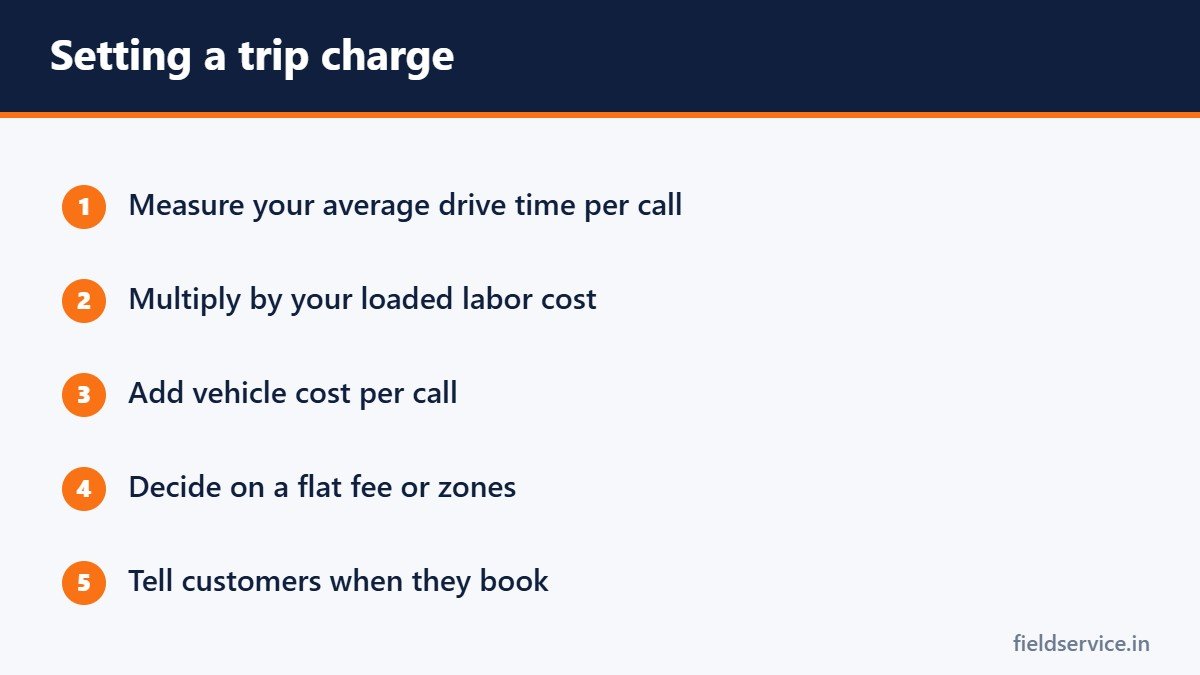
Start with the average round-trip drive time per call and your loaded labor cost. If you have not worked that out, see loaded labor cost.
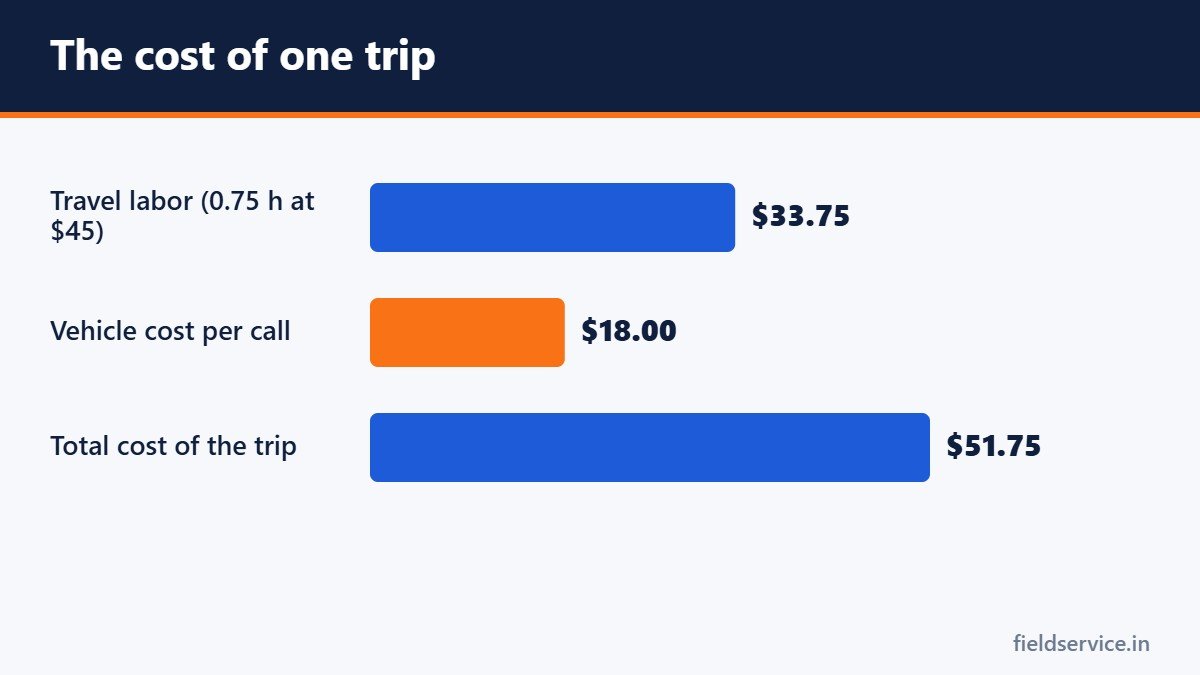
- Average travel time per call: 45 minutes, or 0.75 hours
- Loaded labor cost: $45 an hour
- Travel labor: 0.75 × $45 = $33.75
- Vehicle cost per call: $18
Cost of the trip: $33.75 + $18 = $51.75.
That is your cost. Charging less means every call starts at a loss that the repair has to make up. The travel time cost calculator and the fuel cost calculator will give you your own figures.
Flat fee or zones?
A single flat trip charge is simple and suits a compact service area. If you cover a wide region, a flat fee means nearby customers subsidize distant ones. Zone pricing sets a higher charge for areas beyond a set distance or drive time. Keep it to two or three zones so that it stays easy to quote over the phone.
Should you waive it when the customer approves the repair?
Many companies credit the fee toward the repair if the customer goes ahead. It makes the fee easier to accept. If you do this, the cost of the trip still has to be recovered, so it must be built into your repair prices. Otherwise you are giving away $50 on every job.
How to explain it to customers
- State the fee when the appointment is booked, before the truck rolls.
- Say what it covers: a trained technician and a stocked vehicle sent to their door.
- Explain whether it is credited toward the repair.
- Put it in writing in the booking confirmation.
Customers accept a fee they were told about. They resent one that first appears on the invoice.
Common mistakes
- Copying a competitor’s fee without knowing your own cost
- Waiving the fee without recovering it elsewhere
- Leaving it unchanged for years while fuel, wages and insurance rise
- Charging the same amount for a call an hour away
- Not mentioning it until the invoice
How it fits into your pricing
The trip charge is one part of the price of a call. For the full calculation, including time on site, overhead and profit, see how to price a service call and the service call minimum price calculator. Review the numbers at least once a year.
Related guides
- How to Set Your Labor Rate as a One-Truck Service Business
- W-2 Employee or 1099 Contractor: What Technicians Should Know
- How to Calculate Job Profitability in a Service Business
Three Excel workbooks that take you from what a technician costs to what to charge, then show whether each job made money.
Not sure yet? Try two forms free or see all packs.