


HVAC work mixes units from several fields. Capacity is given in BTU per hour and tons, electric heat in kilowatts, motors in horsepower, gas pressure in inches of water column, refrigerant pressure in pounds per square inch and vacuum in microns. Moving between them is part of the job, on the nameplate, on the gauges and in conversation with customers. This page collects the conversions and formulas that come up most often.
Heat and capacity
| Conversion | Value |
|---|---|
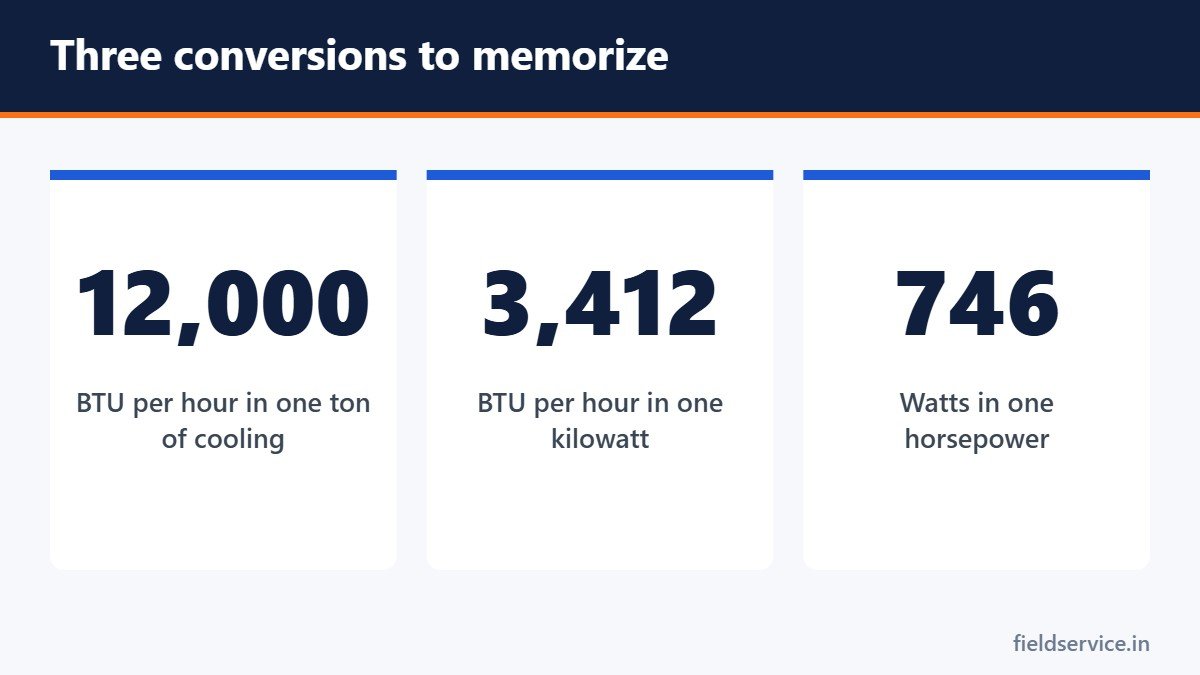
| 1 ton of cooling | 12,000 BTU per hour |
| 1 kilowatt | 3,412 BTU per hour |
| 1 horsepower | 746 watts |
| 1 therm of natural gas | 100,000 BTU |
| 1 cubic foot of natural gas | About 1,000 BTU (varies with the gas supply) |
| 1 gallon of propane | About 91,500 BTU |
| 1 watt | 3.412 BTU per hour |
Examples:
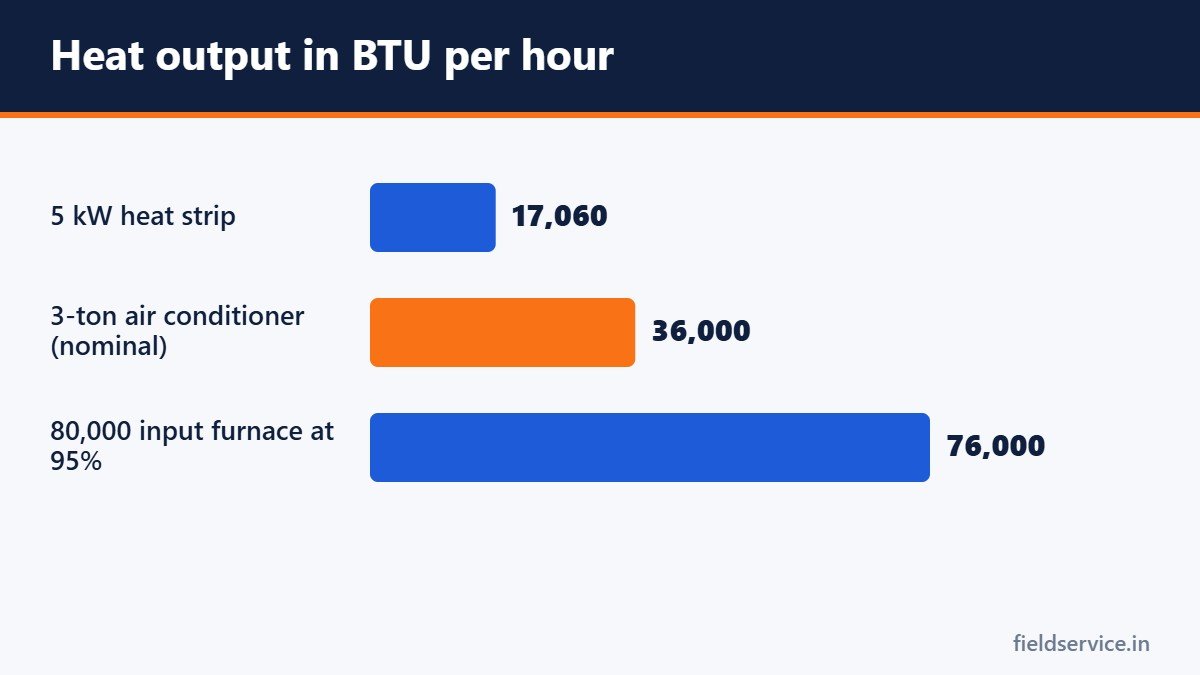
- A 3-ton air conditioner has a nominal capacity of 3 × 12,000 = 36,000 BTU per hour.
- A 5-kilowatt electric heat strip produces 5 × 3,412 = 17,060 BTU per hour.
- A 42,000 BTU per hour unit is 42,000 ÷ 12,000 = 3.5 tons.
The ton comes from the heat absorbed by melting one ton of ice over 24 hours.
Furnace input and output
A furnace nameplate gives input in BTU per hour. Output is input multiplied by efficiency.
Example: an 80,000 BTU per hour input furnace at 95 percent efficiency delivers 80,000 × 0.95 = 76,000 BTU per hour. The same input at 80 percent delivers 64,000.
Temperature
- °F = (°C × 9 ÷ 5) + 32
- °C = (°F − 32) × 5 ÷ 9
A temperature difference converts differently from a temperature reading: a difference of 1°C equals a difference of 1.8°F, with no 32 added. A 10°C temperature rise is an 18°F rise.
Pressure
| Conversion | Value |
|---|---|
| 1 psi | 27.7 inches of water column |
| 1 psi | 2.31 feet of water (head) |
| 1 psi | 2.04 inches of mercury |
| 1 inch of mercury | 25,400 microns |
| Standard atmospheric pressure | 14.7 psi, or 29.92 inches of mercury |
| psia | psig + 14.7 at sea level |
Examples:
- Natural gas manifold pressure of 3.5 inches of water column is 3.5 ÷ 27.7 = 0.13 psi.
- A pump producing 10 psi can lift water about 10 × 2.31 = 23 feet.
Microns measure deep vacuum during evacuation. The lower the number, the deeper the vacuum. Follow the equipment manufacturer’s evacuation target.
Airflow
The sensible heat formula connects airflow, temperature change and heat:
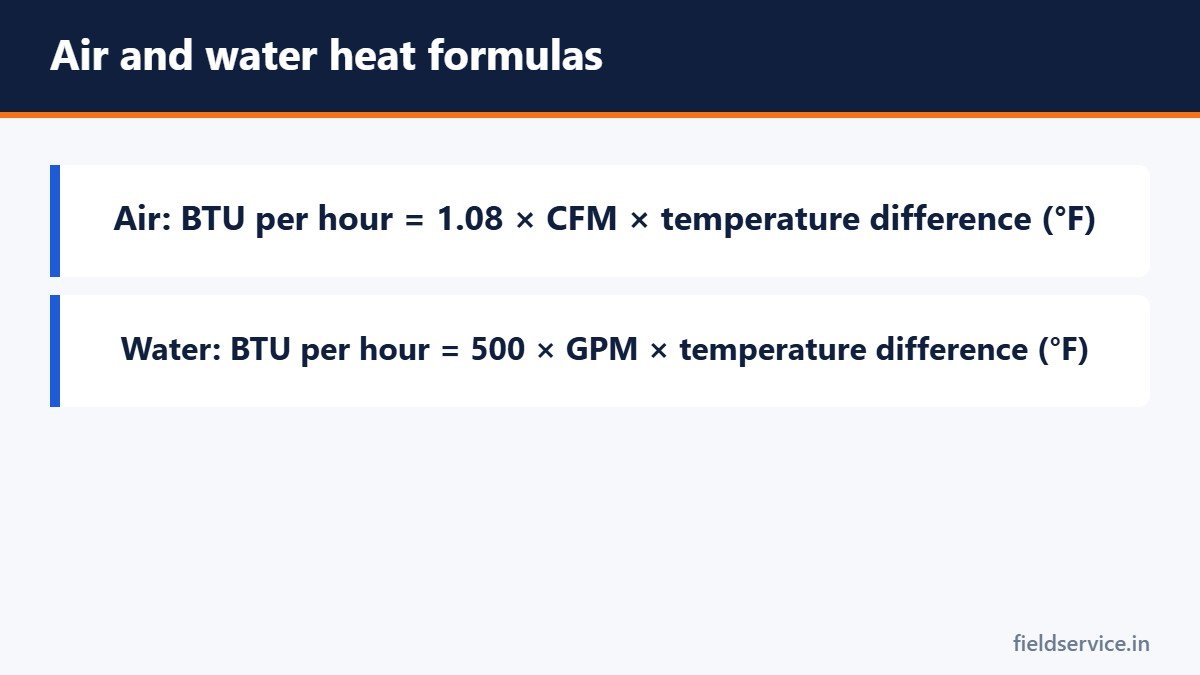
Rearranged, CFM = BTU per hour ÷ (1.08 × temperature difference). The factor 1.08 applies to air at standard conditions and changes at high altitude.
Example: a furnace delivering 76,000 BTU per hour with a 50°F temperature rise is moving 76,000 ÷ (1.08 × 50) = about 1,407 cubic feet per minute.
A common rule of thumb for cooling is about 400 CFM per ton, with the actual target depending on the equipment and the climate. A 3-ton system would be around 1,200 CFM. See temperature split and static pressure.
Water
- 1 gallon of water weighs about 8.34 pounds.
- It takes 1 BTU to raise 1 pound of water by 1°F.
- BTU per hour = 500 × gallons per minute × temperature difference in °F.
Example: a hydronic loop flowing 4 gallons per minute with a 20°F drop is delivering 500 × 4 × 20 = 40,000 BTU per hour. The factor 500 applies to plain water and changes for glycol mixtures.
Electrical
- Watts = volts × amps, for resistive loads such as heating elements
- Amps = watts ÷ volts
- Kilowatts = watts ÷ 1,000
- Kilowatt-hours = kilowatts × hours of use
Example: a 10-kilowatt heat strip on a 240-volt supply draws 10,000 ÷ 240 = 41.7 amps. For motors and compressors, power factor and efficiency come into it, so use the nameplate amps. See Ohm’s law for technicians.
Operating cost
Customers often ask what something costs to run.
- Cost = kilowatts × hours × price per kilowatt-hour
Example: a 10-kilowatt auxiliary heat strip running for 5 hours at 15 cents per kilowatt-hour costs 10 × 5 × $0.15 = $7.50. That is why emergency heat on a heat pump is expensive. See heat pump basics.
Efficiency ratings
- AFUE is the share of a furnace’s fuel energy delivered as heat over a season, as a percentage.
- SEER2 and EER2 are cooling output in BTU divided by electrical input in watt-hours.
- HSPF2 is seasonal heating output in BTU divided by watt-hours for a heat pump.
- COP is output divided by input in the same units. To convert EER to COP, divide by 3.412.
Length, area and volume
- 1 inch = 25.4 millimeters
- 1 foot = 0.3048 meters
- 1 cubic foot = 7.48 gallons
- Area of a round duct = 3.1416 × radius × radius
- Duct velocity in feet per minute = CFM ÷ duct area in square feet
Example: 800 CFM through a duct with an area of 1 square foot moves at 800 feet per minute.
Weight of refrigerant
- 1 pound = 16 ounces
- 1 kilogram = 2.205 pounds
Charge quantities on nameplates may be given in pounds and ounces or in kilograms. Convert carefully and weigh the charge in.
Tips for avoiding errors
- Write the units next to every number. Most mistakes are unit mistakes.
- Check whether a pressure is gauge or absolute.
- Check whether a temperature is a reading or a difference.
- Ask whether the answer is reasonable. A residential furnace does not move 14,000 CFM.
- Rules of thumb are a first check. The manufacturer’s data is the final word.
Record the readings and the results on the ticket. See how to document a service call.
Related guides
- 7 Field Service KPIs Every Small Service Business Should Track
- In the Customer’s Home: Etiquette Every Field Technician Should Follow
- Furnace Tune-Up Checklist: What a Technician Should Check
Six everyday forms in Word and PDF, plus Excel workbooks that total mileage reimbursement and overtime pay.
Not sure yet? Try two forms free or see all packs.
Frequently asked questions
How many BTU are in a ton of cooling?
One ton of cooling is 12,000 BTU per hour. A 3-ton system has a nominal capacity of 36,000 BTU per hour.
How do I convert kilowatts to BTU?
Multiply kilowatts by 3,412 to get BTU per hour. A 5-kilowatt heater produces about 17,060 BTU per hour.
How many inches of water column are in one psi?
About 27.7 inches of water column equal one pound per square inch.
What is the formula for airflow from temperature rise?
CFM equals heat output in BTU per hour divided by 1.08 times the temperature rise in degrees Fahrenheit. The factor 1.08 applies to air at standard conditions.
This reference is an educational overview. Use the equipment manufacturer’s data for design and service decisions.