

Furnaces do not care about holidays. Neither do frozen pipes, failed water heaters or a commercial refrigeration unit full of food. For many trades, late November through early January brings both peak emergency demand and the time of year technicians most want off. Without a plan, the same few people end up covering every holiday, customers wait, and resentment builds. With a plan, the business keeps serving customers and the team knows where it stands.
Start with expected demand
Look back at last year’s calls for the same weeks. Which days were busiest? How many calls were true emergencies, and how many could have waited a day? In heating trades, cold snaps drive demand more than the calendar does, so plan for a range rather than a single number. See seasonal planning.
Decide what you will cover
| Coverage level | What it means |
|---|---|
| Full service | Normal hours on non-holiday weekdays |
| Emergency only | No heat, no water, active leaks, safety hazards and commercial refrigeration |
| Closed | Phones answered by voicemail or a service with clear instructions |
Write down what counts as an emergency so the person answering the phone can decide quickly. Our guide to emergency and after-hours service calls has a starting list.
Build a fair rotation
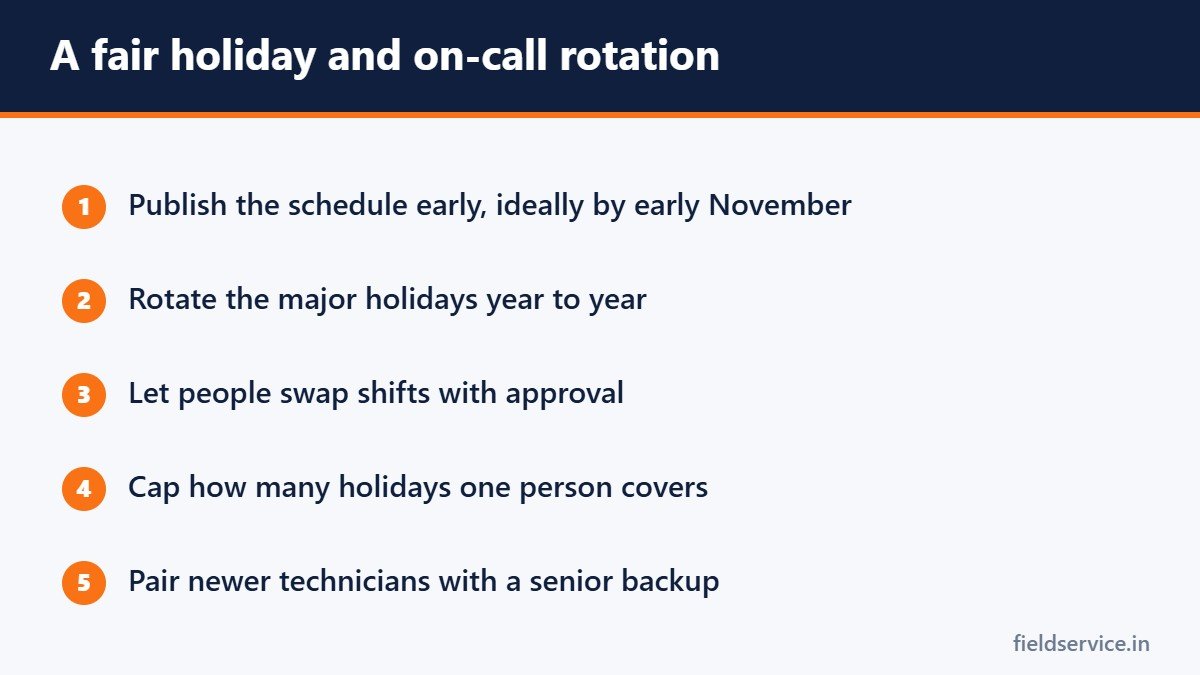
Record who covered which holiday each year. Fairness is easier to prove with a list than from memory, and it is what keeps good technicians from quitting in January.
On-call pay
How on-call time is paid depends on how restricted the technician is while waiting. Under federal law, time spent waiting on call can count as hours worked if the employee is so restricted that they cannot use the time for their own purposes. Time actually responding to calls, including travel to the call, is generally work time. Many businesses also pay a flat on-call stipend and a minimum call-out payment. See on-call pay for technicians and overtime pay, and check your state’s rules.
Price emergency and holiday work properly
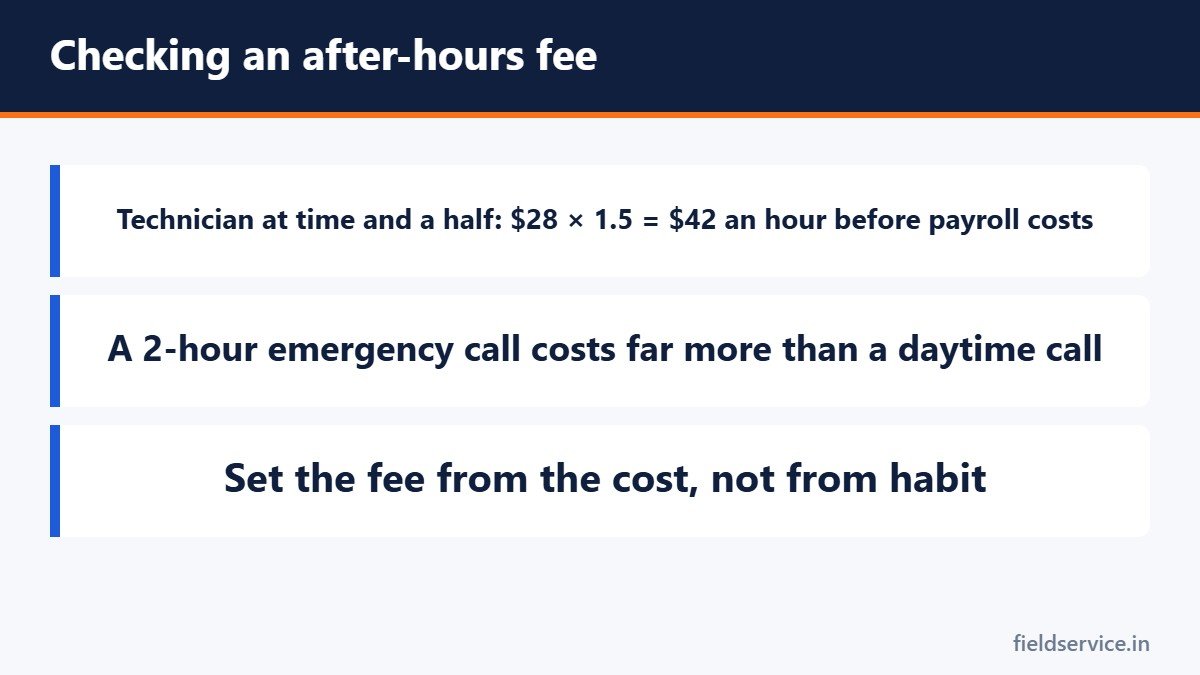
After-hours and holiday calls cost more to deliver: premium pay, disrupted schedules and tired technicians. Many businesses charge a higher service fee or a premium labor rate for them. Make the price clear on the phone before dispatching, so there are no surprises at the door. Use the true cost of a service call calculator with premium pay rates to check that your after-hours fee covers the real cost.
Prepare before the holidays
- Stock trucks with the parts most likely to fail in cold weather: igniters, flame sensors, pressure switches, capacitors, inducer motors, thermocouples and common water heater parts. See truck inventory management.
- Check supply house holiday hours and plan around them.
- Service the trucks: tires, batteries and winter kits. See daily vehicle inspection checklist.
- Test the after-hours phone routing.
- Brief everyone on cold-weather safety. See cold stress on winter calls.
Tell customers early
- Post holiday hours on your website, your voicemail and your Google Business Profile.
- Email maintenance customers with the schedule and a reminder to book any non-urgent work early.
- Explain emergency fees clearly.
After the holidays
Review how many calls came in, how quickly they were answered, and how the team felt about the rotation. Adjust next year’s plan while it is fresh. Thank the people who covered.
Related guides
Sources
Six everyday forms in Word and PDF, plus Excel workbooks that total mileage reimbursement and overtime pay.
Not sure yet? Try two forms free or see all packs.
Frequently asked questions
How should a small service business handle holiday coverage?
Decide which days you will offer full service, emergency-only service or none, define what counts as an emergency, and publish a fair rotation early so technicians can plan.
Do on-call technicians have to be paid for waiting time?
Under federal law it depends on how restricted they are. If they cannot use the time for their own purposes, the waiting time may count as hours worked. Time spent responding to calls generally counts. State rules may add requirements.
Should I charge more for holiday service calls?
Many businesses do, because premium pay and disruption raise the cost. Tell the customer the price before dispatching.
What parts should technicians carry for winter emergencies?
Common failure parts for the heating equipment you service, such as igniters, flame sensors, pressure switches, capacitors and water heater parts, plus supplies for temporary repairs.
This article is general information and not legal advice. Wage rules vary by state.