


A customer letting a technician into their home is extending a good deal of trust. They do not know you. They are letting you walk through their rooms, open their utility closet and perhaps work while they are out. Most customers cannot judge the technical quality of a repair, so they judge what they can see: whether you were polite, whether you were careful and whether you left a mess. The habits below cost nothing and are a large part of what people mean when they call a technician professional.
Before you knock
- Send or confirm the on-the-way message so that the customer expects you.
- Park on the street or where the customer directs, not across the driveway or on the lawn. Check for oil drips before parking on a driveway.
- Read the job notes, so that you do not ask the customer to repeat what they told the office.
- Check your appearance: a clean uniform and a visible ID badge.
- Put out a cigarette or vape well before you arrive, and do not smoke on the property.
At the door
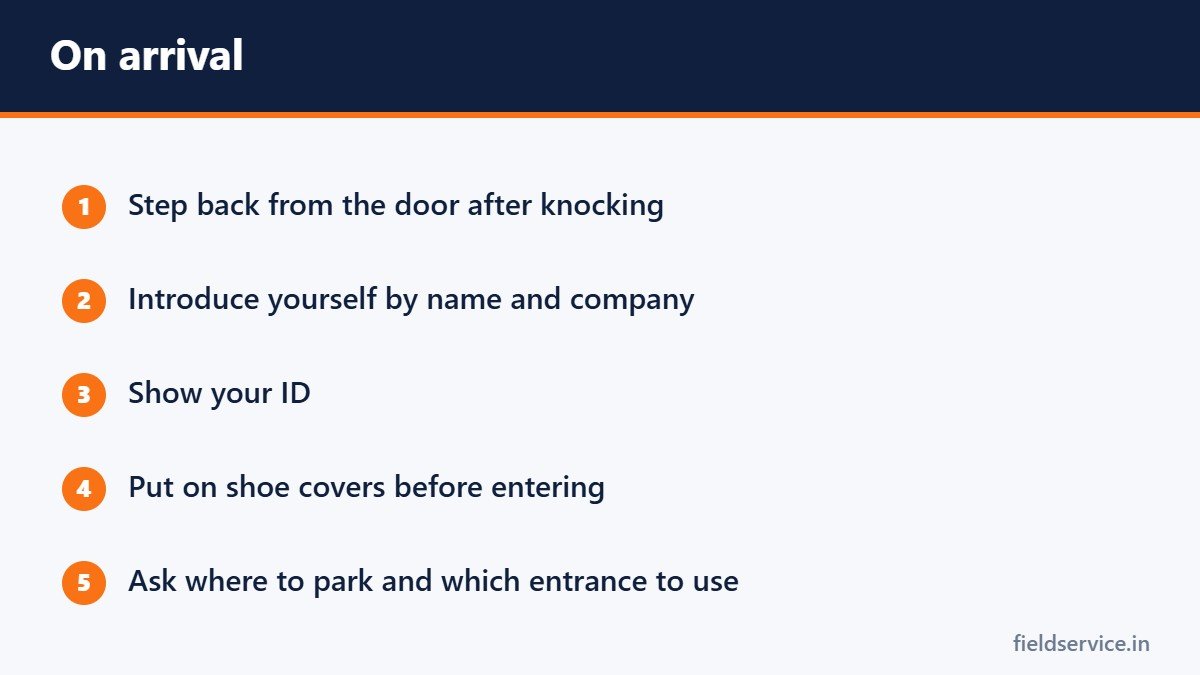
- Knock or ring once and step back.
- Introduce yourself by name and company and show your ID.
- Say why you are there: “I am here about the water heater.”
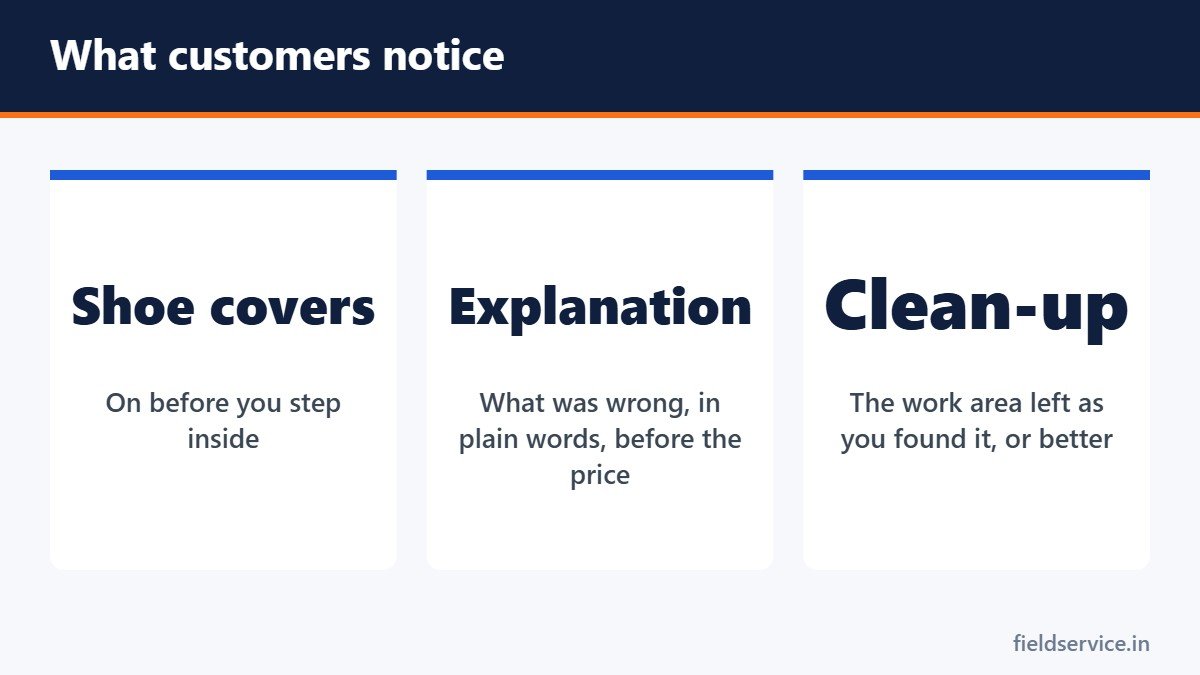
- Put on shoe covers before you step inside, every time, whatever the weather.
- Ask whether there are pets or anything you should know.
If a child answers and no adult appears to be home, do not go in. Call the office. Follow your company’s policy.
Listen first
Ask the customer to describe the problem and show you where it is. Let them finish. A minute of listening tells you things the work order did not, and it shows that you are taking the problem seriously.
Protect the home
- Lay drop cloths or floor protection on your route and in the work area.
- Use a mat or a tray under tools and parts.
- Move furniture and belongings only with permission, and put them back.
- Carry tools and equipment carefully. Door frames and walls are easy to scuff.
- Watch ladders and long items indoors.
- Keep doors closed if there are pets or small children, and close gates behind you.
Respect the space
- Go only where the job takes you. If you need access to another room, ask.
- Do not open cupboards or closets you have no reason to open.
- Ask before using the bathroom, and leave it clean.
- Do not sit on the furniture.
- Do not eat or drink in the home, apart from water you brought.
- Do not comment on the customer’s belongings, housekeeping or lifestyle.
Phones, music and language
- Keep personal calls for the truck. If you must take a work call, step outside.
- No music or videos.
- No swearing, including to yourself when something goes wrong.
- Do not complain about your employer, your schedule, other customers or other companies.
- Avoid politics, religion and other topics that divide people.
Privacy
You will see and hear things in people’s homes. Keep them to yourself. Photograph the equipment and the work area only, and never post a customer’s home online without written permission. See using photos and video on service calls.
Explain and get approval
Tell the customer what you found, what the options are and what each costs, before doing any work. Use plain language and show them the problem if you can. See how to explain a repair to a customer.
While you work
- Tell the customer if you need to turn off the water, power or gas, and for how long.
- Tell them if there will be noise or a smell.
- If you need to go out to the truck, say so.
- If the job is taking longer than you said, give an update.
- If you damage something, say so at once and tell your office. Customers forgive an accident that is owned up to. They do not forgive finding it later.
If the customer is not home
- Follow the access instructions exactly.
- Lock up as you found it.
- Leave a note or send a message saying what was done.
- Take photos before and after.
- Do not let anyone else in.
Clean up
- Remove all packaging, old parts and debris. Ask whether the customer wants to see the old part first.
- Wipe down the equipment and the area around it.
- Vacuum or sweep the work area.
- Check your route out for marks or debris.
- Take your drop cloths and tools. Count your tools.
Leaving the area cleaner than you found it is the habit customers mention most in reviews.
Before you leave
- Show the customer the completed work and that it is operating.
- Explain anything they need to do, such as changing a filter.
- Go through the invoice and take payment.
- Ask whether they have any questions.
- Thank them.
Our job completion checklist on the templates page covers the last steps.
Things that should never happen
- Entering without permission
- Smoking or vaping on the property
- Using the customer’s tools, towels or supplies without asking
- Accepting or asking for payment to a personal account
- Making personal remarks, or any comment about a customer’s appearance
- Arguing
- Leaving a job unsafe or half-finished without explaining
Difficult situations
- Pets. Ask for dogs to be secured before you enter. Do not feed or handle pets.
- Children. Be friendly and keep them away from tools and the work area. Do not be alone with a child.
- Unsanitary or unsafe conditions. If the home is unsafe to work in, step outside and call your supervisor.
- An upset customer. See dealing with difficult customers.
For owners
- Supply shoe covers, drop cloths, a small vacuum and clean uniforms.
- Write down your standards and go through them with every new hire. See how to onboard a new technician.
- Ride along occasionally and watch the customer-facing part of the call.
- Share reviews that mention courtesy and cleanliness with the whole team. See how to get more customer reviews.
Related guides
- 7 Field Service KPIs Every Small Service Business Should Track
- HVAC Unit Conversions Every Technician Should Know
- How to Document a Service Call: A Checklist for Technicians
Six everyday forms in Word and PDF, plus Excel workbooks that total mileage reimbursement and overtime pay.
Not sure yet? Try two forms free or see all packs.
Frequently asked questions
Should technicians always wear shoe covers?
Yes. Putting on shoe covers before entering a home, every time, protects floors and shows respect for the customer’s home.
What should a technician do if they damage something in a customer’s home?
Tell the customer immediately and report it to the office. Being open about an accident keeps the customer’s trust.
Can a technician enter a home if only a child is present?
No. Do not enter. Call the office and follow your company’s policy.
Is it acceptable to use the customer’s bathroom?
Ask first, and leave it clean. Where possible, plan stops between jobs.