


When a service business prices a job, the labor and the parts are easy to see. The rent, the dispatcher’s wages, the insurance and the software subscription are not, yet every job has to pay a share of them. Those costs are overhead. Owners who leave overhead out of their prices, or guess at it, are the ones who stay busy and wonder where the money went. Calculating it properly takes an hour with your profit and loss statement.
What overhead is
Overhead is every cost of being in business that you cannot tie to a specific job. It is sometimes called indirect cost or fixed cost, though not all of it is truly fixed. Direct costs are the opposite: technician labor on the job, parts and materials, permits and subcontractors for that job.
What belongs in overhead
- People who do not bill. Office staff, dispatchers, managers, a parts runner, and the owner’s own pay for running the business.
- Unbilled technician time. Training, meetings, shop time and idle hours. Some businesses count this in labor cost instead. Count it once.
- Premises. Rent or mortgage, utilities, maintenance.
- Vehicles. Payments or depreciation, insurance, maintenance, registration. Some owners treat fuel as a direct cost.
- Insurance. General liability, property and other business policies.
- Marketing. Advertising, website, lead services.
- Technology. Field service software, phones, tablets, internet.
- Professional fees. Accountant, lawyer, payroll service.
- Licenses, bonds and memberships.
- Tools and equipment that are not bought for one job.
- Uniforms, office supplies, bank charges and card fees.
- Loan interest.
Step 1: total your overhead
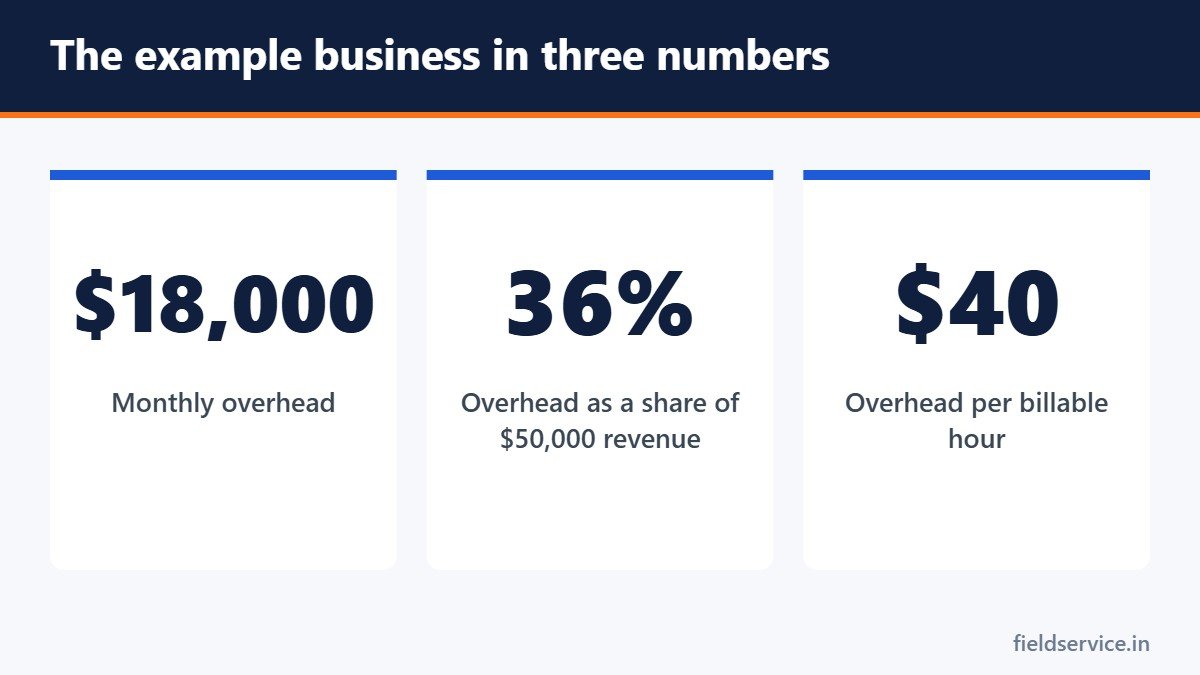
Take the last twelve months from your profit and loss statement and add up every cost that is not a direct job cost. Use a full year so that seasonal and annual bills are included. Divide by twelve for a monthly figure. In this article’s example, monthly overhead is $18,000.
Step 2: overhead as a share of revenue
Divide overhead by revenue for the same period. If monthly revenue averages $50,000, overhead is 36 percent of revenue. Your gross margin has to be higher than this percentage for the business to make a profit. With a 45 percent gross margin and 36 percent overhead, net profit is 9 percent.
Step 3: overhead per billable hour
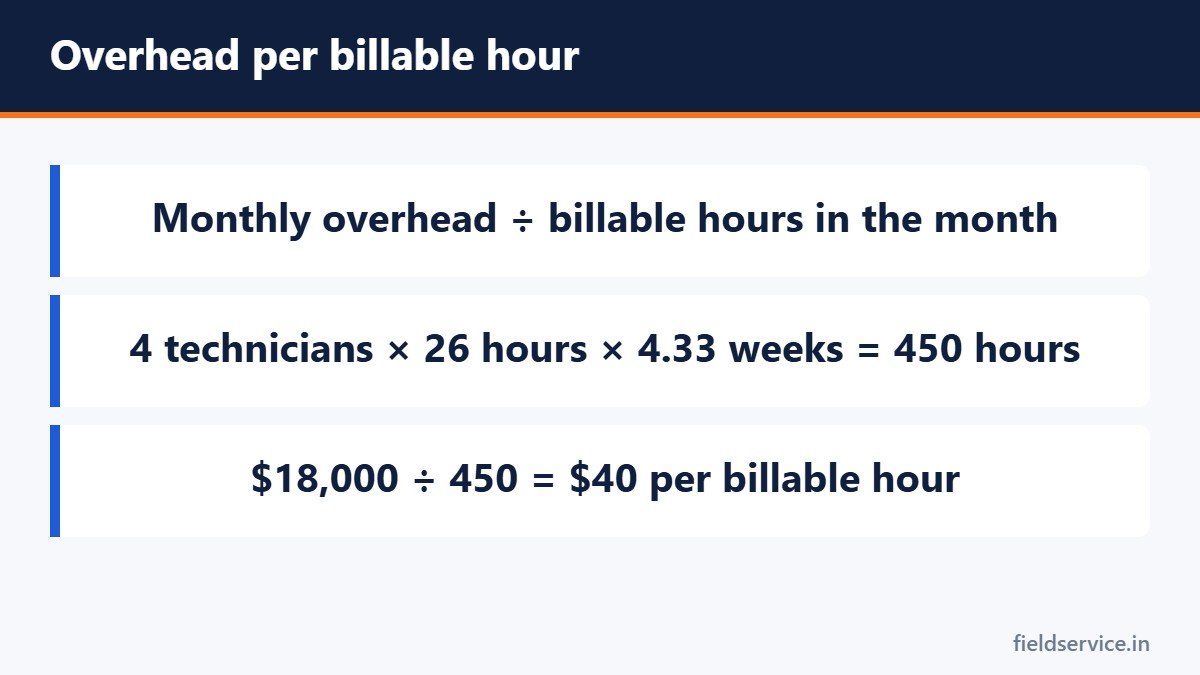
For pricing, the most useful figure is overhead per billable hour. Divide monthly overhead by the hours your technicians actually bill in a month.
Example: four technicians each bill 26 hours a week. Over an average month of 4.33 weeks, that is about 450 billable hours.
$18,000 ÷ 450 = $40 per billable hour
Every hour you bill has to carry $40 of overhead before it earns anything. That figure goes straight into your labor rate. See hourly pay vs. billable rate.
Step 4: overhead per call
Some businesses prefer a per-call figure. Divide monthly overhead by the number of calls completed. With 300 calls a month, overhead is $60 per call. Use it in the service call minimum price calculator.
Why billable hours matter so much
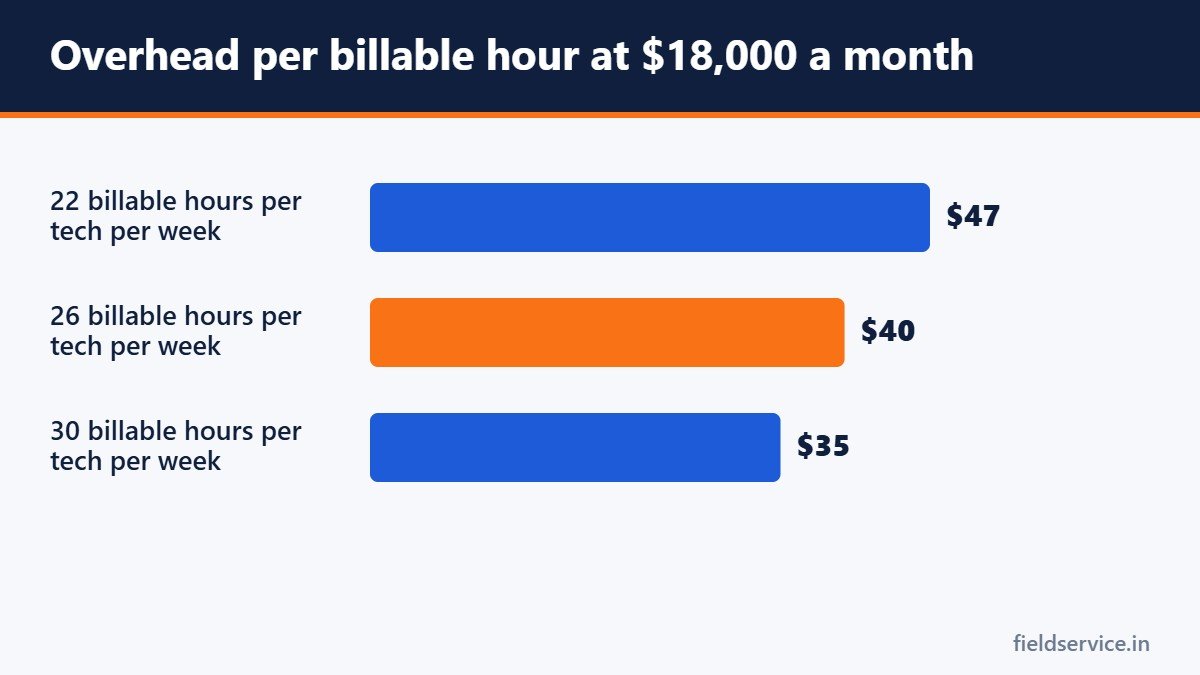
Overhead per hour is as much about hours as about costs. In the example, if each technician billed 30 hours a week in place of 26, the monthly total would be about 520 hours and overhead would fall to roughly $35 an hour, with no cost cut at all. This is one of the reasons technician utilization has such an effect on profit.
Use the number
- Pricing. Build your labor rate and flat-rate prices from loaded labor cost plus overhead per hour plus profit. See loaded labor cost and how to price a service call.
- Job costing. Allocate overhead to each job by its labor hours to find net profit. See how to calculate job profitability.
- Break-even. Overhead divided by gross margin gives the revenue you need each month. See the break-even point.
- Decisions. Before adding a cost, work out how much extra revenue it requires.
Controlling overhead
The aim is not the lowest possible overhead. A dispatcher who keeps four trucks full pays for themselves several times over. The aim is to make sure each overhead cost earns its place.
- Review subscriptions and software. Cancel what is not used.
- Shop insurance each year with a broker who knows your trade.
- Measure marketing by result. Know what each source of leads costs per booked job.
- Maintain vehicles on schedule. Breakdowns cost more than maintenance.
- Match office staffing to call volume.
- Question recurring charges that have crept up.
Often the more effective lever is the other side of the equation: more billable hours and better margin on the same overhead.
Common mistakes
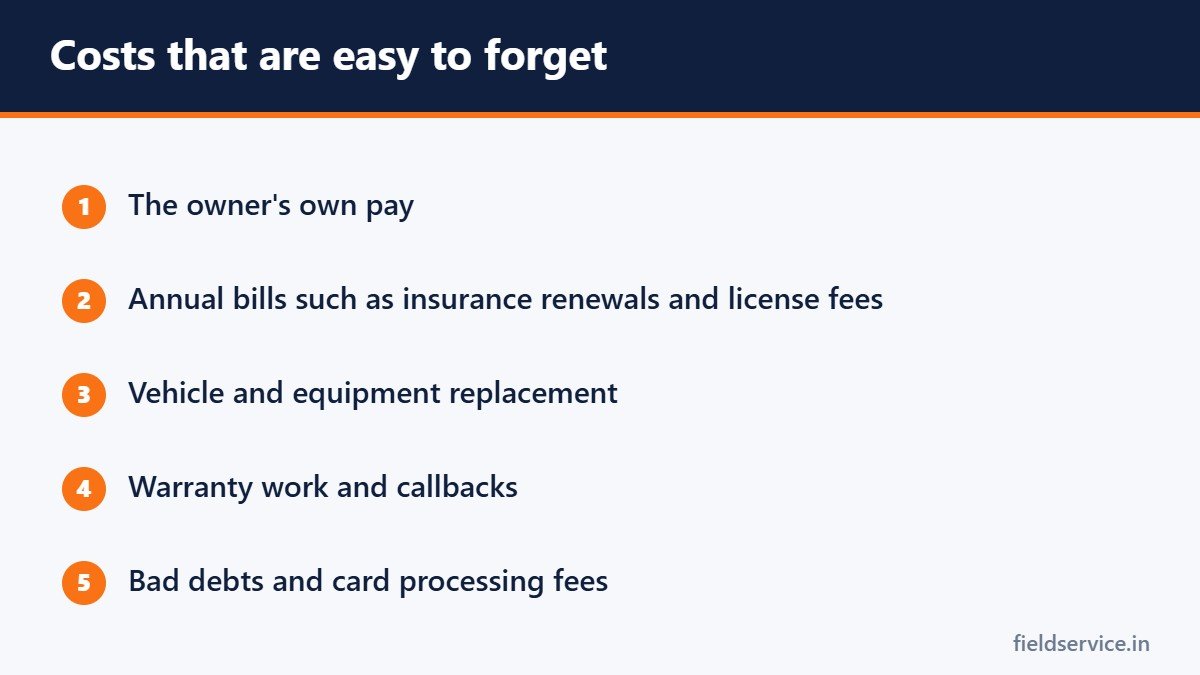
- Leaving out the owner’s pay. If you run the business, that work has a cost. A business that only looks profitable because the owner is not paid is not profitable.
- Counting a cost twice, for example putting vehicle costs in both overhead and the per-call figure.
- Using one good month. Use twelve months.
- Forgetting replacement. Trucks and equipment wear out. Set aside for it.
- Dividing by the hours you pay for, when the figure that matters is the hours you bill.
- Never updating it. Overhead rises every year.
Set up your books to show it
If your profit and loss statement mixes job costs and overhead, ask your accountant or bookkeeper to separate them: revenue, then direct costs, then gross profit, then overhead, then net profit. With that layout you can read your gross margin and your overhead percentage straight off the page every month.
A yearly routine
- Total the last twelve months of overhead.
- Calculate overhead as a share of revenue, per billable hour and per call.
- Compare with last year.
- Update your labor rate and price book.
- Choose one cost to reduce and one that is worth increasing.
Related guides
- How to Write a Service Estimate Customers Understand and Accept
- MERV Ratings Explained: Choosing the Right Air Filter
- How to Set Your Labor Rate as a One-Truck Service Business
Three Excel workbooks that take you from what a technician costs to what to charge, then show whether each job made money.
Not sure yet? Try two forms free or see all packs.
Frequently asked questions
What is overhead in a service business?
Overhead is every cost of running the business that cannot be tied to a specific job, such as rent, office wages, insurance, vehicles, software and marketing.
How do I calculate overhead per billable hour?
Divide your monthly overhead by the number of hours your technicians bill in a month. For example, $18,000 divided by 450 billable hours is $40 per hour.
Should the owner’s salary be included in overhead?
Yes. A fair wage for the owner’s work in running the business is a real cost and should be included.
What is a typical overhead percentage for a service business?
It varies widely with the size and type of business. What matters is that your gross margin is higher than your overhead percentage, and that you know both figures for your own business.
This article is general information and is not accounting advice.