

Many small service businesses do not know how much they need to bill each month before they make any money. The owner works long hours, the trucks are busy, and whether the month was profitable only becomes clear when the accountant reports weeks later. The break-even point answers the question in advance. It is the level of revenue at which the business covers every cost and earns nothing. Each dollar above it contributes to profit. Each dollar below it is a loss.
Two kinds of cost
- Fixed costs stay much the same whether you run ten jobs or a hundred in a month. Rent, office wages, insurance, truck payments, software, phones and loan repayments are examples. Together they are your overhead.
- Variable costs rise and fall with the work. Technician labor on jobs, parts and materials, fuel, card processing fees and sales commission are examples.
Some costs are mixed. A technician’s wage is fixed in the sense that you pay it whether or not the phone rings, but it is usually treated as a job cost when calculating margin. Be consistent about where you put each cost.
Gross margin
Gross margin is the share of each dollar of revenue left after the variable costs of doing the work. If a month’s revenue is $50,000 and the direct costs of the jobs were $27,500, gross profit is $22,500 and gross margin is 45 percent. Our article on job profitability shows how to work it out job by job, and the job gross margin calculator does the arithmetic.
The formula
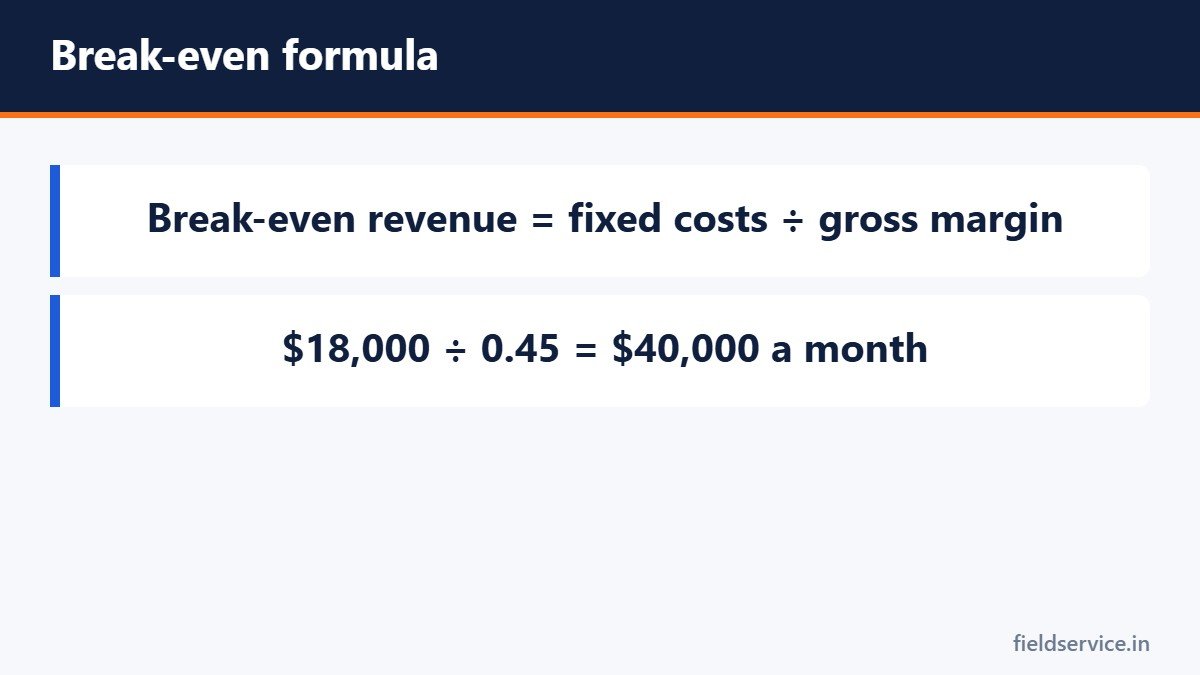
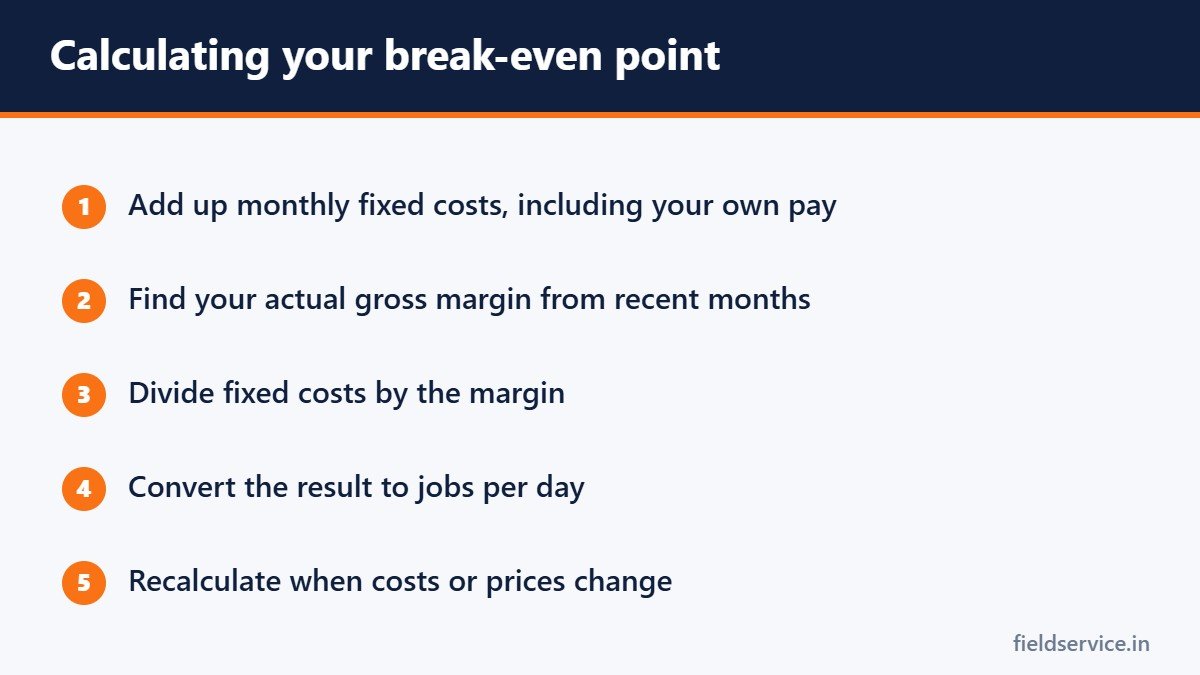
Divide your fixed costs for a period by your gross margin, expressed as a decimal.
Example: a business has monthly overhead of $18,000 and a gross margin of 45 percent.
$18,000 ÷ 0.45 = $40,000
The business must bill $40,000 a month to break even. At that level, the $18,000 of gross profit exactly pays the overhead.
Turn it into jobs and days
- With an average ticket of $300, $40,000 is about 134 jobs a month.
- Over 21 working days, that is roughly $1,905 a day, or a little over six jobs a day across the whole business.
A daily figure is easier to manage against than a monthly one. If the board shows four jobs booked for tomorrow and break-even is six, you know today that there is a problem.
Adding a profit target
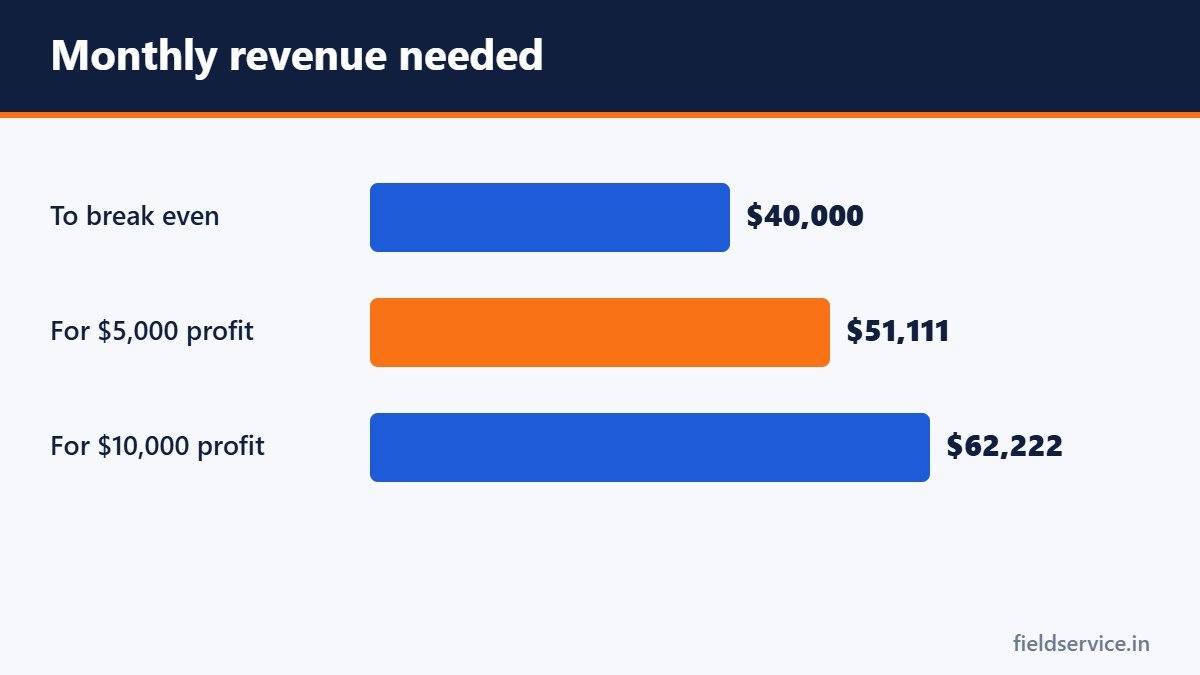
Breaking even is not the goal. To find the revenue needed for a given profit, add the profit to the fixed costs before dividing.
For a profit of $5,000 a month: ($18,000 + $5,000) ÷ 0.45 = $51,111.
What moves the break-even point
- Overhead goes up. A new truck payment or an extra office employee raises break-even. Adding $2,000 a month of overhead at a 45 percent margin requires $4,444 more revenue every month just to stay level.
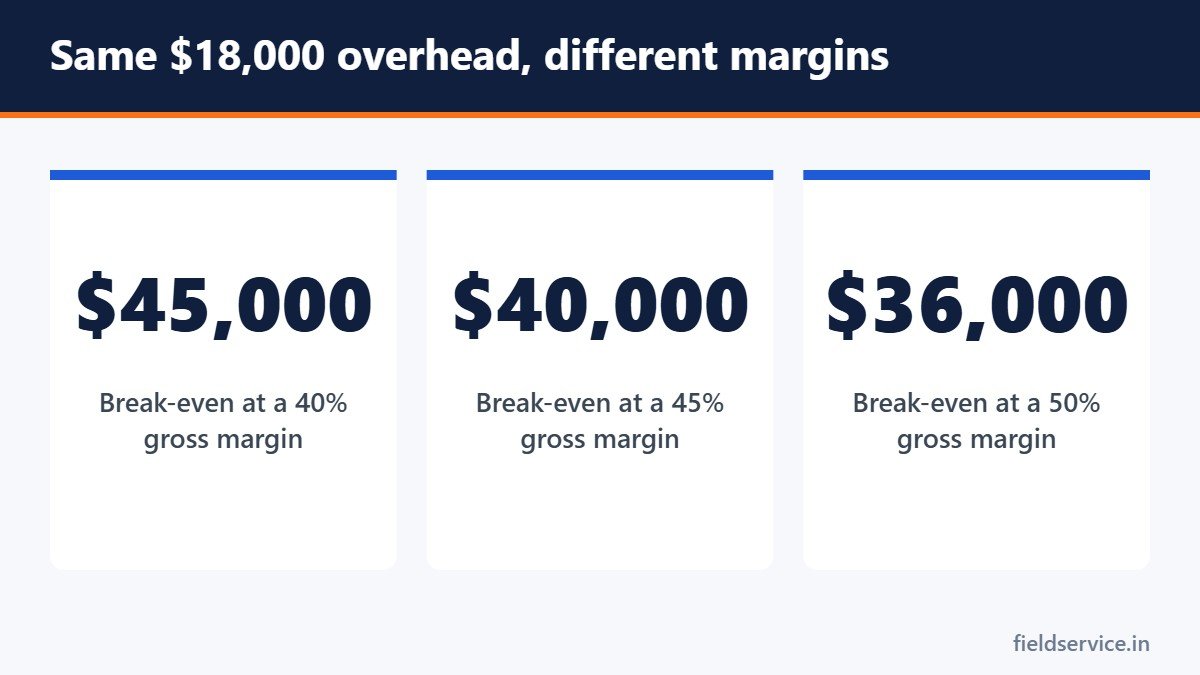
- Margin goes up. Better pricing, fewer callbacks or lower parts costs reduce break-even. At a 50 percent margin, the same $18,000 of overhead breaks even at $36,000.
- Margin goes down. Discounting is expensive. At a 40 percent margin, break-even rises to $45,000.
This is why a small price increase has such a large effect, and why discounts cost more than they seem to. Our article on markup vs. margin explains the arithmetic of margin.
Using it for decisions
Before hiring or buying
Work out how much the new cost adds to overhead and how much extra revenue is needed to cover it. Then ask honestly whether that revenue is available. See revenue per technician.
Setting prices
If break-even requires more jobs than your team can run, prices or margin are too low. See how to price a service call.
Planning for slow months
In seasonal trades, some months fall below break-even every year. Knowing by how much tells you how much cash to hold from the busy season. Maintenance agreements are one way to raise revenue in the quiet months.
Checking a month in progress
Halfway through the month, compare revenue to date with half the break-even figure. You will know while there is still time to act.
Common mistakes
- Leaving the owner’s own pay out of overhead. If you are not paying yourself a wage, the business is not really breaking even.
- Forgetting annual costs such as insurance renewals and license fees. Divide them by twelve and include them.
- Leaving out loan repayments and equipment replacement.
- Using a margin from your price book when the margin actually achieved, after discounts and callbacks, is lower.
- Calculating it once and never updating it.
Where to get the numbers
Your profit and loss statement for the last twelve months has what you need. Add up the overhead lines and divide by twelve for monthly fixed costs. Divide gross profit by revenue for the gross margin. If your books do not separate job costs from overhead, ask your accountant to set them up that way. It is the most useful change you can make to your reports. See service business overhead for what belongs in each group.
Related guides
- Voltage Drop Explained: Causes, Calculation and Limits
- IRS Mileage Rate 2026: What Field Technicians Need to Know After the July Increase
- How to Raise Prices in a Service Business Without Losing Customers
Three Excel workbooks that take you from what a technician costs to what to charge, then show whether each job made money.
Not sure yet? Try two forms free or see all packs.
Frequently asked questions
What is a break-even point?
It is the level of revenue at which a business covers all of its costs and makes neither a profit nor a loss.
How do I calculate break-even revenue?
Divide fixed costs for the period by gross margin expressed as a decimal. For example, $18,000 of monthly overhead divided by a 45 percent gross margin gives $40,000.
Should the owner’s salary be included in fixed costs?
Yes. If the owner works in the business, a fair wage for that work is a cost. Leaving it out makes the business look more profitable than it is.
How often should I recalculate break-even?
At least once a year, and whenever overhead, prices or margins change, such as when you add a vehicle or an employee.
This article is general information and is not accounting advice.