


Ask customers what annoys them most about home service companies and waiting comes near the top. They took time off work, the window was eight to twelve, and the technician arrived at one. The repair may have been perfect, but the review will mention the wait. On-time arrival rate tells you how often you keep the first promise you make to a customer.
How to calculate it
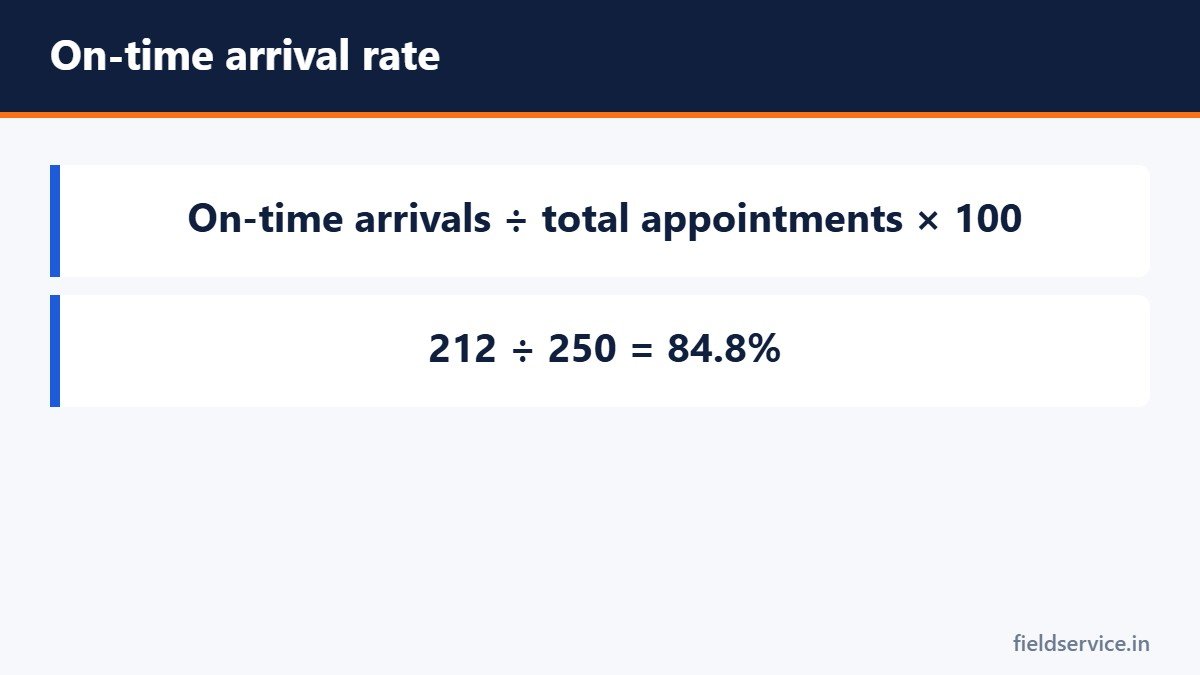
Divide the number of appointments where the technician arrived within the promised window by the total number of appointments, then multiply by 100. If 212 of 250 appointments in a month were on time, the rate is 84.8 percent.
Define “on time” before you measure
- Window or exact time? If you promise a two-hour window, arriving any time inside it is on time.
- What counts as arrival? Use the moment the technician marks arrival on the job, or the vehicle GPS reaches the address.
- Are early arrivals on time? Arriving before the window starts can be as inconvenient for the customer as arriving after it. Decide how you treat them.
- What about appointments you rescheduled? A visit moved by the company at the last minute is a broken promise and should be counted as one.
Write the definition down and keep it the same from month to month.
Why it matters
- Late arrivals are a leading cause of poor reviews and cancelled appointments.
- A late start pushes every later job, so one delay becomes several.
- Customers who have been kept waiting are harder to deal with and less likely to approve additional work.
- Technicians who are always behind rush, and rushed work comes back as callbacks.
Why technicians arrive late
- Job durations are underestimated. The schedule allows 60 minutes for work that usually takes 90.
- No allowance for driving. Travel time between jobs is left out or guessed.
- The first job starts late. A slow morning at the shop delays the whole day.
- Parts runs. An unplanned trip to the supply house takes most of an hour.
- Emergency calls are squeezed into a full schedule.
- Windows are too narrow for the way the business really runs.
Find the cause first
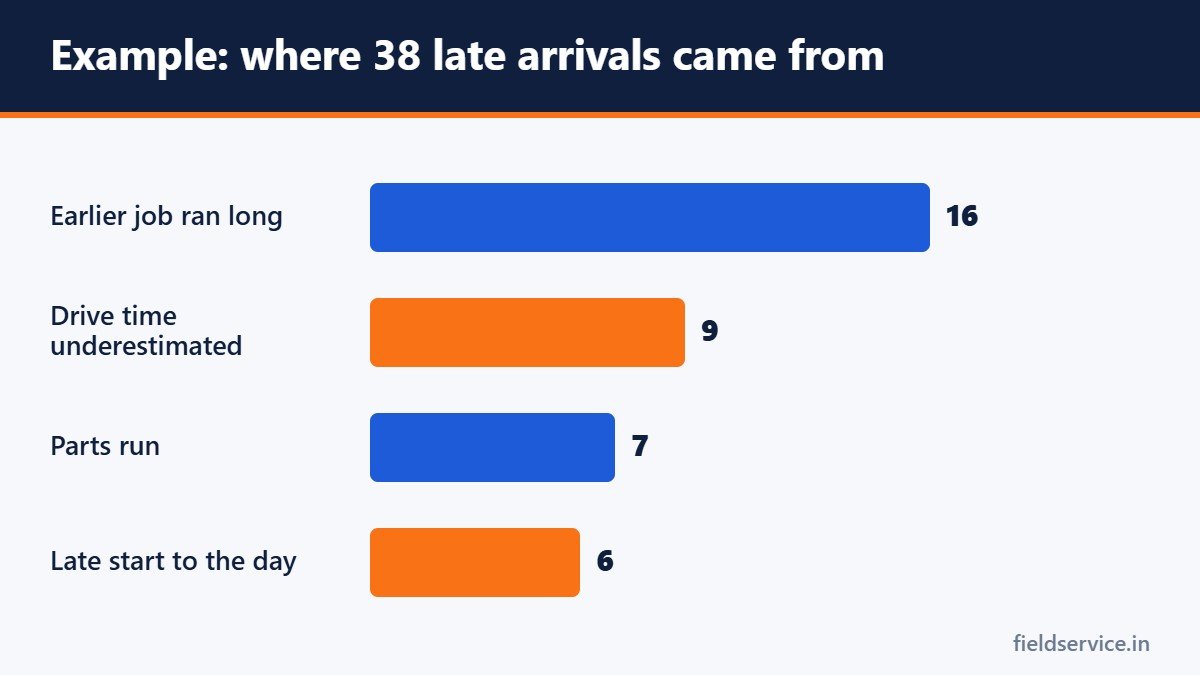
For a month, have dispatch record a reason for every late arrival. The split shows what to fix. In the example above, 16 of 38 late arrivals happened because an earlier job ran over. That points to job time estimates, not to driving.
How to improve it
Use real job durations
Look at how long each type of job has actually taken over the last few months and schedule from those figures.
Include drive time
Build realistic travel time into the schedule, with allowance for traffic at the time of day. See how to reduce windshield time.
Protect the first appointment
If the first job starts on time, the rest of the day has a chance. Restock trucks the evening before and keep morning meetings short.
Leave slack
A schedule booked to the minute fails at the first surprise. A buffer slot in the middle of the day absorbs overruns and emergencies.
Stock the trucks
Fewer parts runs mean fewer late arrivals. See what to keep in a service vehicle.
Offer windows you can keep
A two-hour window you meet nine times out of ten is better for customers than a one-hour window you often miss.
When you are going to be late
Some delays cannot be avoided. What matters then is how early the customer hears about it. A call or text before the window opens, with a new arrival time, is accepted by most people. Arriving late with no warning is not. Give technicians a quick way to tell dispatch that a job is running over, and make the customer call a standard step.
Track it with other numbers
A high on-time rate achieved by cutting jobs short is not an improvement. Watch it alongside first-time fix rate and callback rate. For the dispatch decisions behind all three, see how dispatch affects technician productivity.
Related guides
- Close Rate: How to Measure and Improve the Share of Quotes You Win
- Flat Rate vs. Time and Materials: Which Pricing Model Fits Your Service Business?
- Revenue per Technician: What It Shows and How to Use It
Six everyday forms in Word and PDF, plus Excel workbooks that total mileage reimbursement and overtime pay.
Not sure yet? Try two forms free or see all packs.
Frequently asked questions
What is a good on-time arrival rate?
There is no single standard, because it depends on how you define the arrival window. Measure your own rate for a few months, find the main causes of late arrivals and aim to improve on your own baseline.
Should early arrivals count as on time?
That is a choice for each business. If customers plan around the window, arriving before it opens can be a problem too. Many companies count only arrivals inside the window, or early arrivals the customer agreed to.
How do I track arrival times without software?
Have technicians write arrival and departure times on each ticket, or text dispatch on arrival. Vehicle GPS reports and scheduling software make it easier but are not required.
What should we do when a technician is running late?
Tell the customer before the window opens if possible, give a realistic new time and offer to reschedule if that suits them better.