


Maintenance agreements, also called service plans or memberships, are one of the best things a service business can sell. They bring steady revenue, fill the schedule in slow months, keep equipment running and keep customers loyal. They also have a trap: once sold, the price is fixed for a year, while the cost of every promised visit rises with wages and fuel. Priced carelessly, an agreement becomes a list of obligations that lose money. This guide shows how to price one from the ground up.
Step 1: Define exactly what the plan includes
You cannot price a plan until the promise is precise. Write down:
- How many visits per year, and in which seasons.
- What each visit covers: a checklist, not “a tune-up”.
- Which materials are included, such as filters or a standard amount of cleaning chemicals.
- Member benefits: repair discounts, priority scheduling, waived trip fees, extended labor warranties.
- What is excluded: repairs, parts, after-hours visits beyond a stated limit.
For HVAC plans, our furnace tune-up checklist is a good starting point for the visit itself.
Step 2: Cost one visit
Each visit costs labor including drive time, materials and a share of overhead. In this example a visit takes 1.5 hours including travel at a loaded labor cost of $40 an hour, uses $15 of materials and carries $30 of overhead.

Step 3: Add the cost of member benefits
Benefits are not free. A 15 percent repair discount costs you 15 percent of whatever repair work members buy. Estimate it from your own history: if a typical member spends about $170 a year on repairs, a 15 percent discount costs roughly $25 a year. Priority scheduling and waived trip fees also have a cost, mainly in schedule disruption, and you can add an allowance for them.
Step 4: Add your margin
With two visits a year, the annual cost is 2 × $105 + $25 = $235. To earn a 30 percent margin, divide by one minus the margin: $235 ÷ 0.70 = $335.71 a year, or about $27.98 a month.
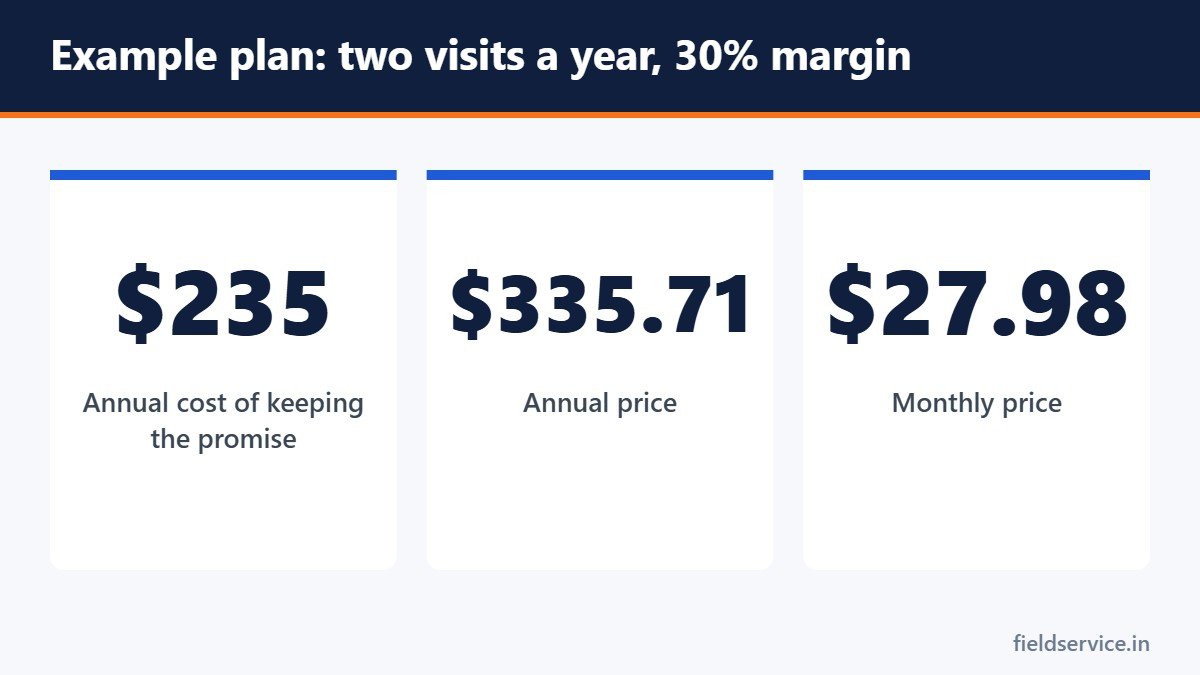
Note that dividing by 0.70 is different from adding 30 percent. Adding 30 percent to $235 gives $305.50, which is only a 23 percent margin. See markup vs margin.
Run your own plan in the maintenance agreement pricing calculator.
Monthly or annual billing?
| Billing | Advantages | Watch out for |
|---|---|---|
| Annual, paid up front | Cash arrives early; simple to manage | A larger price can be harder to sell |
| Monthly, automatic | Smaller payment feels easier; renewals can be automatic | Card failures and cancellations need follow-up |
| Both offered | Customers choose; you can price annual slightly lower | Two prices to keep consistent |
Whichever you choose, make renewal terms, cancellation rules and any automatic charges clear in writing. Consumer protection rules on automatic renewals vary by state, so check the rules that apply to you.
Common pricing mistakes
- Pricing to match a competitor without knowing your own visit cost.
- Forgetting drive time, which is often the biggest single cost of a visit.
- Offering generous repair discounts without estimating what they cost.
- Never raising the price for existing members.
- Promising “unlimited” anything.
Pricing with tiers
Many companies offer two or three levels of plan, for example a basic plan with visits only and a premium plan that adds larger discounts and priority service. Tiers work the same way as good, better, best repair options: each level must be costed separately and each must be honest value.
Measure the plan every year
- Actual cost per visit, from your job records.
- Renewal rate: the share of members who renew.
- Repair revenue from members compared with non-members.
- Visits completed on time versus pushed back.
If visits are regularly late or skipped, the plan is not delivering what was sold, and renewals will show it. See maintenance agreements for how to sell and run them, and the job profitability calculator to check individual visits.
Related guides
- Seasonal planning for service businesses
- The true cost of a service call
- How to get more customer reviews
Estimate, invoice and work order templates in Word and PDF, plus Excel workbooks for job scheduling and maintenance agreement renewals.
Not sure yet? Try two forms free or see all packs.
Frequently asked questions
How much should I charge for a maintenance agreement?
Enough to cover the full cost of every included visit, including drive time and overhead, plus the cost of member benefits and your target margin. Prices vary widely by trade, region and what the plan includes.
How do I calculate the cost of member discounts?
Estimate how much repair work a typical member buys in a year and multiply by the discount percentage. Use your own customer history where you can.
Is it better to bill maintenance plans monthly or annually?
Both work. Monthly billing makes the price feel smaller and can make renewal easier; annual billing brings cash in sooner. Many companies offer both.
Should I raise prices on existing plan members?
Yes, when your costs rise. Give clear notice at renewal and explain what the plan continues to include.
Figures in this article are an example. Use your own costs, and check consumer protection rules in your state for automatic renewals.