


Electricians are needed wherever something is built, upgraded or repaired, and the growth of electric vehicles, heat pumps, solar and data centers is adding to that demand. The trade pays well, does not require a college degree and has a clear, structured path from beginner to licensed professional. This guide covers how that path works.
What electricians do
Electricians install, maintain and repair electrical power, lighting, communications and control systems. Day to day that means reading blueprints and diagrams, running conduit and cable, installing panels, devices and fixtures, testing circuits and finding faults. The work is done to the electrical code adopted where you are working, which in most of the United States is based on the National Electrical Code.
The main branches are residential, commercial and industrial work. Related specialties include low-voltage and data cabling, solar, fire alarm and controls. Line work on utility power lines is a separate trade with its own training.
Pay and job outlook
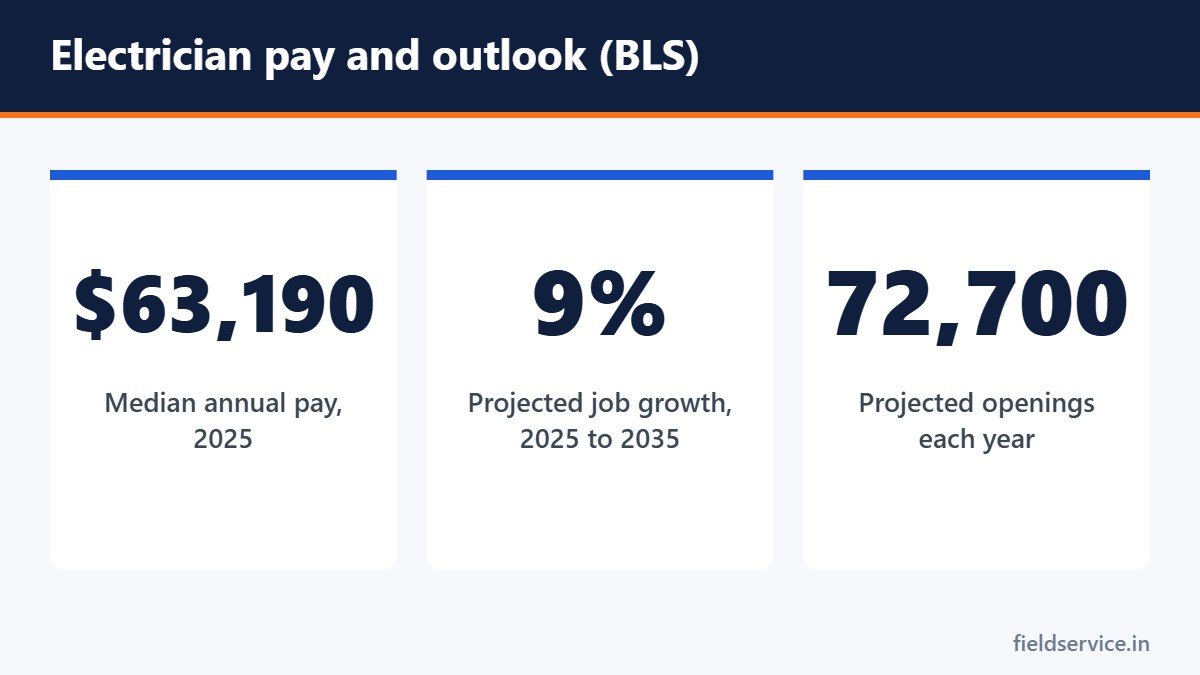
| Measure | Figure |
|---|---|
| Median pay, 2025 | $63,190 a year ($30.38 an hour) |
| Lowest 10 percent earned | Less than $42,640 |
| Highest 10 percent earned | More than $108,510 |
| Jobs, 2025 | 821,000 |
| Projected growth, 2025 to 2035 | 9 percent |
| Projected openings each year | About 72,700 |
These figures are from the U.S. Bureau of Labor Statistics, which describes the projected growth as much faster than the average for all occupations. Pay varies by region, sector and union membership, and overtime can add a good deal. The hourly to annual pay calculator shows what a rate adds up to.
The apprenticeship route
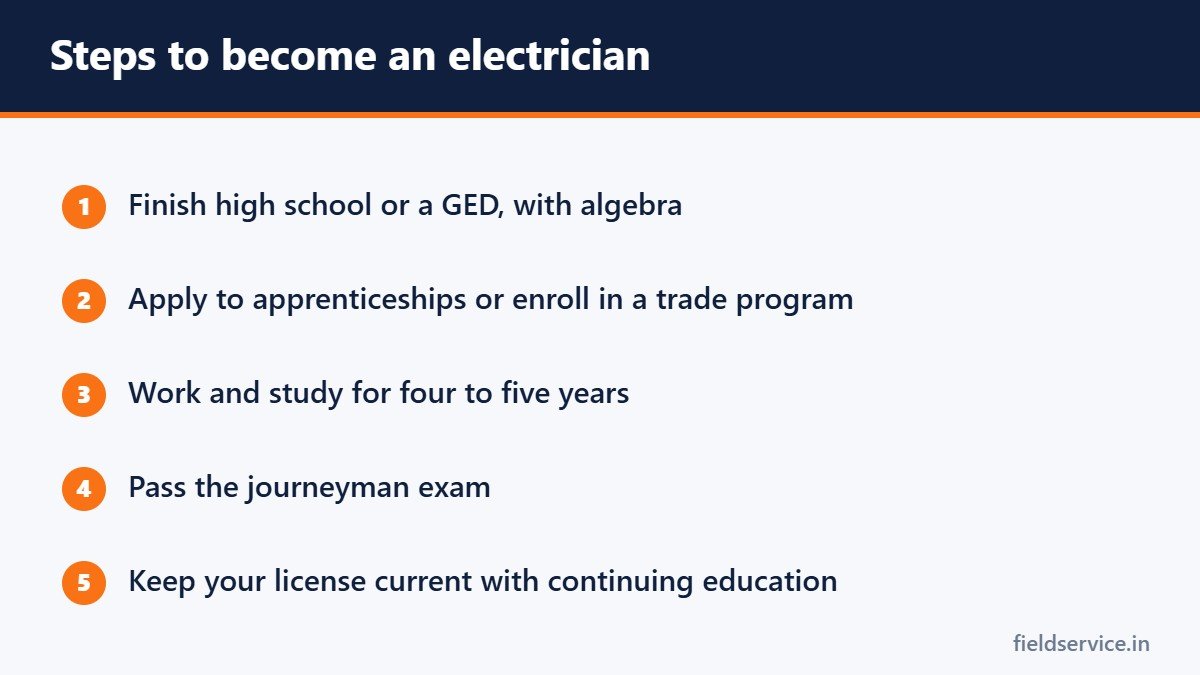
Most electricians learn through an apprenticeship that lasts four to five years. According to the BLS, apprentices typically complete about 2,000 hours of paid on-the-job training and some classroom instruction in each year of the program. You earn a wage from the start, and it rises as you progress.
Apprenticeships are sponsored by:
- Joint committees of unions and contractors
- Non-union contractor associations
- Individual electrical contractors
Typical entry requirements are a high school diploma or equivalent, a minimum age of 18, a passing score on an aptitude test covering reading and algebra, and a valid driver’s license. Many programs also require a drug test.
The trade school route
Technical schools and community colleges offer electrical programs that teach theory, code and basic wiring in a classroom and a lab. Some states and apprenticeship programs give credit for this training toward the required hours. School costs money and does not replace field experience, but it can help you get hired and start with a stronger grounding in theory.
Licensing
Most states require electricians to be licensed, and some leave licensing to cities and counties. Requirements differ, but the usual pattern is:
- Register as an apprentice or trainee where the state requires it.
- Complete the required hours of supervised work and classroom instruction.
- Pass a journeyman exam on electrical theory, the code and local rules.
- After further experience, qualify to sit a master or contractor exam.
Licenses do not always transfer between states. Our article on apprentice, journeyman and master levels explains the structure in more detail. Check with the licensing board in the state where you plan to work.
Skills that matter
- Math. Algebra and basic trigonometry are used for load calculations and conduit bending.
- Reading drawings and wiring diagrams.
- Troubleshooting. A working knowledge of Ohm’s law and confident use of a multimeter.
- Color vision. Wires are identified by color.
- Physical fitness. The work involves ladders, crawl spaces and long periods standing or kneeling.
- Attention to safety. Electricity does not allow for carelessness.
What the work is really like
New construction means working on unfinished sites in all weather. Service work means attics, crawl spaces and customers’ homes. Commercial and industrial jobs can involve night shifts and shutdowns. First-year apprentices do a lot of digging, drilling, pulling wire and carrying material. It gets more interesting as your skills grow.
Where the trade can lead
Experienced electricians move into roles such as foreman, estimator, project manager, inspector, instructor or contractor. Some specialize in controls, instrumentation or renewable energy. See field service career paths for the wider picture.
Six everyday forms in Word and PDF, plus Excel workbooks that total mileage reimbursement and overtime pay.
Not sure yet? Try two forms free or see all packs.
Frequently asked questions
How long does it take to become an electrician?
Most apprenticeships last four to five years. After that you can sit the journeyman exam in states that require one.
Do I need to go to trade school to become an electrician?
No. Many electricians learn entirely through an apprenticeship. A trade school program can help you get started and may count toward required hours in some states.
How much do electricians earn?
The U.S. Bureau of Labor Statistics reports a median of $63,190 a year in 2025. The lowest 10 percent earned less than $42,640 and the highest 10 percent earned more than $108,510.
Is an electrician license valid in every state?
No. Licensing is set by each state, and sometimes by cities or counties. Some states have reciprocity agreements, but many require you to apply or test again.
Related guides
- How to Become an HVAC Technician: Pay, Training and Certification
- How to Become a Plumber: Apprenticeship, Licensing and Pay
- HVAC vs. Electrician vs. Plumber: Comparing the Three Big Service Trades