

Customers ask about air filters more than almost any other part of their system, and the usual assumption is that the highest rating must be the best choice. Technicians know it is more complicated. A filter protects the equipment and cleans the air, and it also restricts airflow. The wrong filter in the wrong system causes real problems. Understanding MERV ratings lets you give a customer an answer that fits the equipment in front of you.
What MERV means
MERV stands for minimum efficiency reporting value. It comes from ASHRAE Standard 52.2, a test method that measures how well a filter captures particles in three size ranges, from 0.3 to 10 micrometers. The scale for these filters runs from 1 to 16. A higher number means the filter captures a larger share of particles, and in particular more of the small ones.
| MERV | Typical filter | What it captures well |
|---|---|---|
| 1 to 4 | Thin fiberglass panel | Large particles: lint, carpet fibers. Mainly protects the equipment. |
| 5 to 8 | Standard pleated | Mold spores, dust, pet dander, pollen |
| 9 to 12 | Better pleated or media filter | Finer dust and smaller particles |
| 13 to 16 | High-efficiency media filter | A large share of fine particles, including smoke and particles that carry bacteria and viruses |
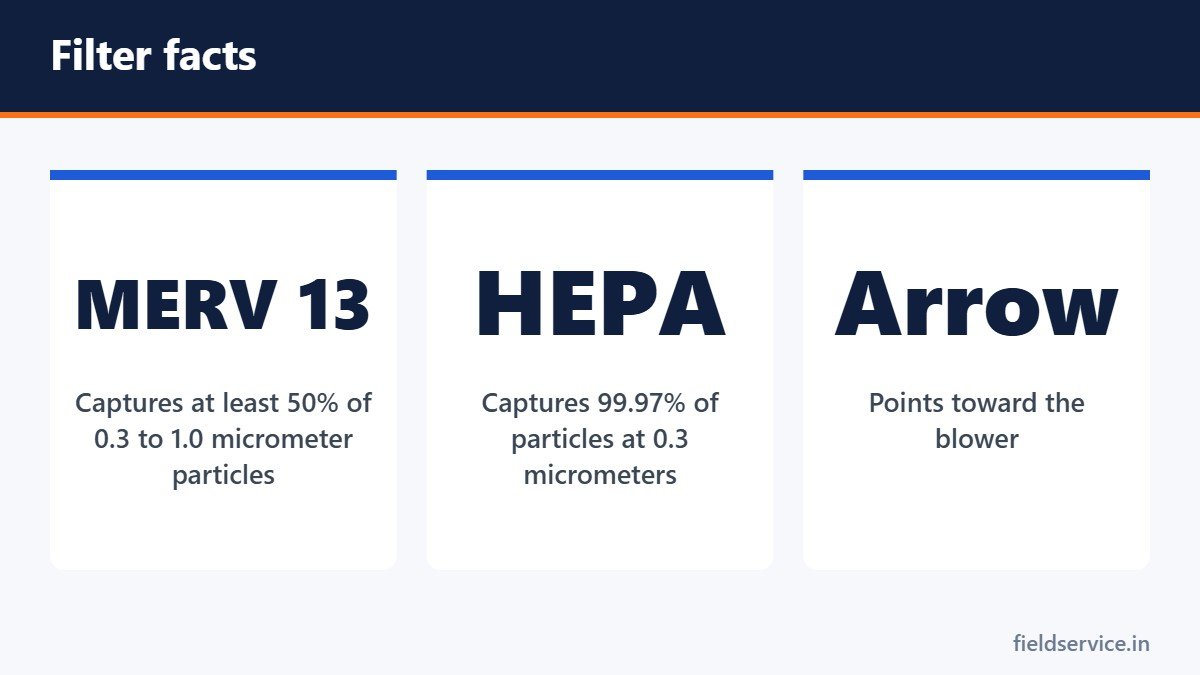
Under the standard, a MERV 13 filter must capture at least 50 percent of particles in the smallest range tested, 0.3 to 1.0 micrometers. A MERV 8 filter is not required to capture a set share of that smallest range at all.
MERV, MPR and FPR
Some retail filters carry other scales: MPR, used by one manufacturer, and FPR, used by one retailer. They are those companies’ own systems and do not convert exactly to MERV. When comparing, look for the MERV rating, which most packaging also shows.
HEPA is something else
A true HEPA filter captures 99.97 percent of particles at 0.3 micrometers, which is beyond the MERV 16 level. Standard residential furnaces and air handlers are not designed for the resistance of a HEPA filter. HEPA filtration in homes is normally provided by a separate bypass unit or a portable air cleaner.
The trade-off: resistance to airflow
Every filter resists the air passing through it, and that resistance is measured as pressure drop. As a general rule, a denser filter has a higher pressure drop, and the pressure drop rises as the filter loads with dust.
If the pressure drop is too high for the system, airflow falls. The effects are covered in our article on static pressure: a frozen coil in cooling, a tripped limit in heating, noise, poor comfort and a blower working harder than it should.
Filter area matters as much as MERV
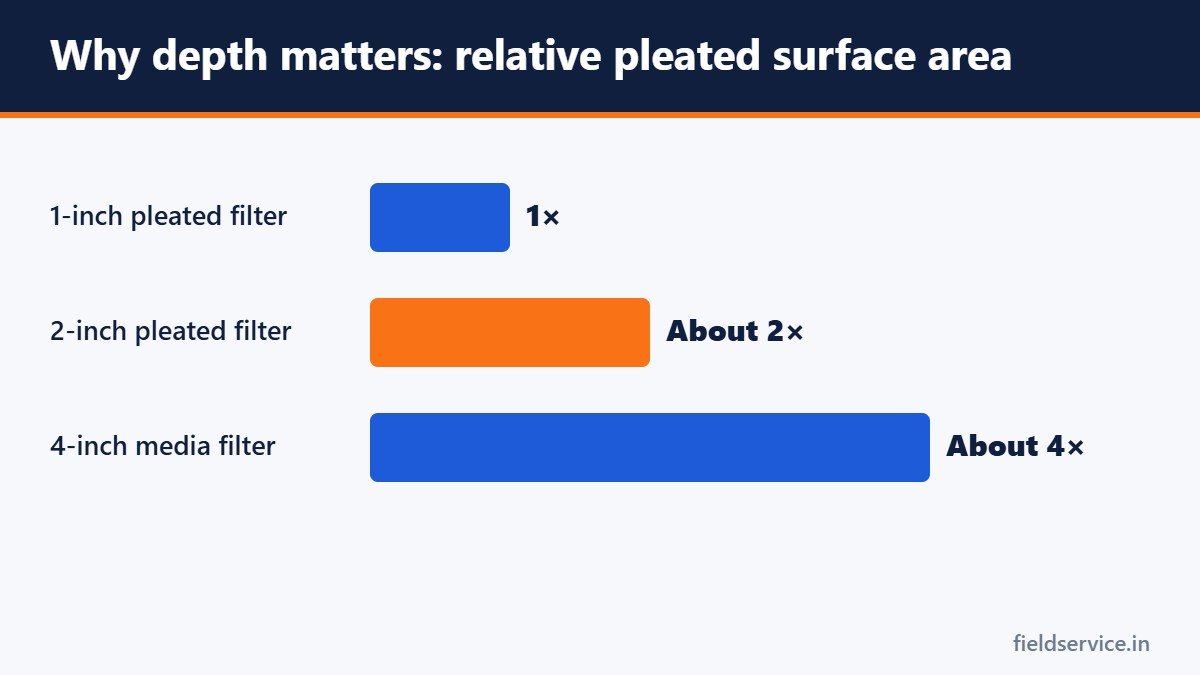
Pressure drop depends on the filter’s surface area as well as its rating. A one-inch MERV 13 filter has little surface and can be very restrictive. A four- or five-inch deep media filter of the same rating has several times the pleated area, so the air passes through more slowly and with much less resistance. This is why a high-efficiency filter usually needs a media cabinet and cannot simply be slid into a one-inch slot.
How to choose
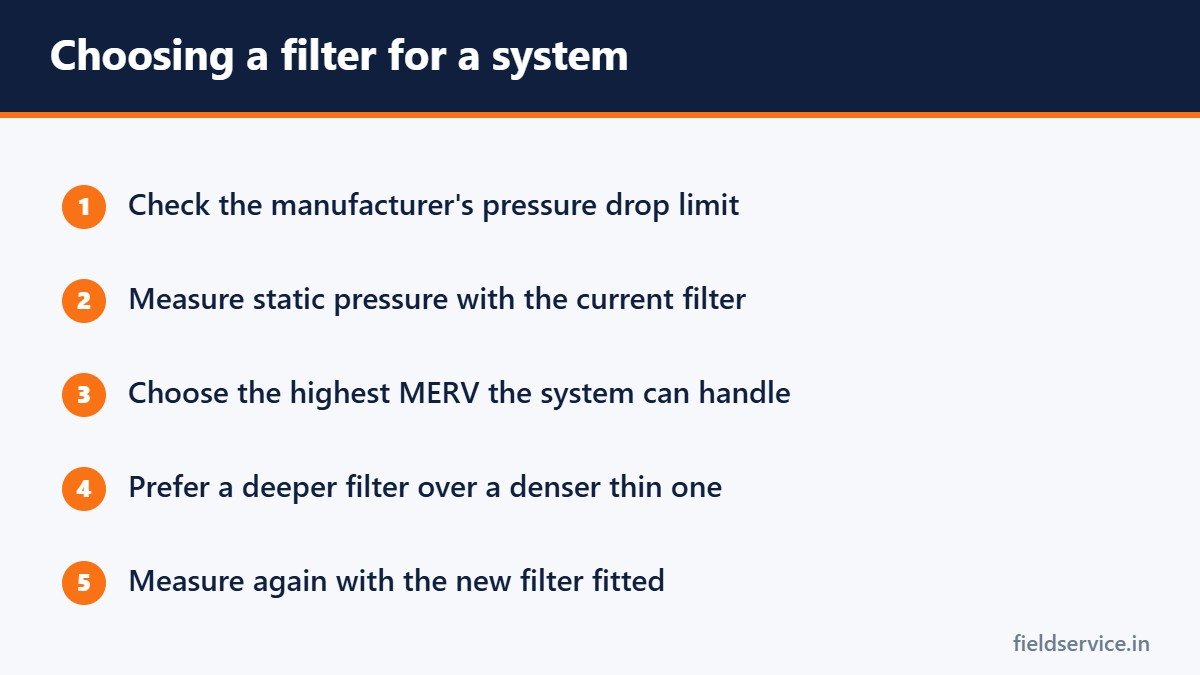
- Start with the equipment. Check the manufacturer’s instructions for the maximum filter pressure drop, and measure the system’s static pressure.
- For most homes, a MERV 8 to 11 pleated filter is a sound balance of filtration and airflow.
- For allergies, asthma, smoke or a wish for cleaner air, MERV 13 is a common target, provided the system can handle it. That usually means a deeper filter and adequate return duct area.
- For older systems with undersized returns, a lower rating may be the right answer until the ductwork is improved.
- Measure after the change. Take a static pressure reading with the new filter in place.
How often to change
There is no single interval. It depends on the filter, the home and how much the system runs.
- One-inch filters are commonly checked monthly and changed every one to three months.
- Deep media filters commonly last six months to a year.
- Pets, smokers, renovation work, wildfire smoke and constant fan operation all shorten the interval.
The reliable method is to look at the filter. If it is visibly loaded, change it. A pressure drop reading across the filter gives a more precise answer.
Fit and installation
- The filter must be the correct size. Air that goes around the filter is not filtered, and it carries dust onto the coil.
- Install it with the airflow arrow pointing toward the blower.
- Check that the filter rack or cabinet seals around the edges.
- Never run the system with no filter. The dust goes straight to the coil.
- Do not stack two filters in one slot.
What filters do and do not do
- They capture particles. They do not remove gases, odors or humidity. Activated carbon filters reduce some odors.
- They only work when air is moving. If the fan runs only during heating and cooling cycles, filtration stops in between.
- They protect the coil and the blower from dust. That was the original purpose of the furnace filter, and it still matters.
Talking to customers
When a customer asks for the best filter, ask what they are trying to achieve. If it is allergy relief or protection from smoke, explain that a higher rating helps, that their system may need a deeper filter cabinet to use it safely, and that you can measure to find out. If it is simply protecting the equipment, a standard pleated filter changed on time does the job. An honest answer here builds more trust than selling the most expensive option. See how to explain a repair to a customer.
On a maintenance visit
- Note the filter size, type and rating on the ticket.
- Check the condition and the fit.
- Measure the pressure drop across the filter if you carry a manometer.
- Look at the coil. A dirty coil suggests filter bypass or missing filters in the past.
A clogged filter also raises temperature split and can lead to a frozen coil and water problems. See condensate drain problems.
Related guides
- Thermostat Wiring Explained: What Each Terminal Does
- Wire Gauge and Ampacity Basics for Technicians
- HVAC Unit Conversions Every Technician Should Know
Six everyday forms in Word and PDF, plus Excel workbooks that total mileage reimbursement and overtime pay.
Not sure yet? Try two forms free or see all packs.
Frequently asked questions
What MERV rating is best for a home?
For most homes, MERV 8 to 11 balances filtration and airflow. MERV 13 gives better capture of fine particles but needs a system that can handle the added resistance, which usually means a deeper filter.
Can a high-MERV filter damage my HVAC system?
A filter with too much resistance for the system reduces airflow, which can cause a frozen coil, overheating in heating mode and extra strain on the blower. Check the manufacturer’s limits and measure static pressure.
Is MERV 13 the same as HEPA?
No. A HEPA filter captures 99.97 percent of particles at 0.3 micrometers, well beyond MERV 13. Standard residential equipment is not designed for HEPA filters.
How often should an air filter be changed?
It depends on the filter and the home. One-inch filters are commonly changed every one to three months and deep media filters every six to twelve months. Check the filter and change it when it is visibly loaded.
This article is an educational overview. Follow the equipment and filter manufacturers’ instructions.