


A customer sees $120 an hour on an invoice, knows the technician probably earns around $30, and assumes the company keeps the difference. Technicians sometimes think the same thing. The gap is real, but very little of it is profit. Working through where it goes is useful for owners setting a rate and for techs who want to understand their own value.
Step 1: the wage is not the cost
On top of the hourly wage, the employer pays payroll taxes, workers’ compensation insurance, health insurance, paid time off and any retirement contribution. In this example, assume those add 40 percent, which turns a $30 wage into a loaded cost of $42 an hour. Your own percentage will differ, so work it out from your payroll records.
Step 2: not every paid hour is billed
Out of a 40-hour week, a technician might bill 26 hours. The rest goes on driving, loading, meetings, callbacks and waiting. The week still costs 40 × $42 = $1,680, and that has to be recovered from 26 billable hours.
$1,680 ÷ 26 = $64.62 of labor cost for every hour billed.
Step 3: overhead
Rent, office staff, vehicles, insurance, software, marketing and tools are paid for by billable hours as well. Add up a month of overhead and divide by the billable hours for the month. In this example, assume it comes to $35 per billable hour.
$64.62 + $35 = $99.62. That is the break-even rate. At this price the company makes nothing.
Step 4: profit
For a 15 percent profit margin, divide by 0.85:
$99.62 ÷ 0.85 = about $117 an hour.
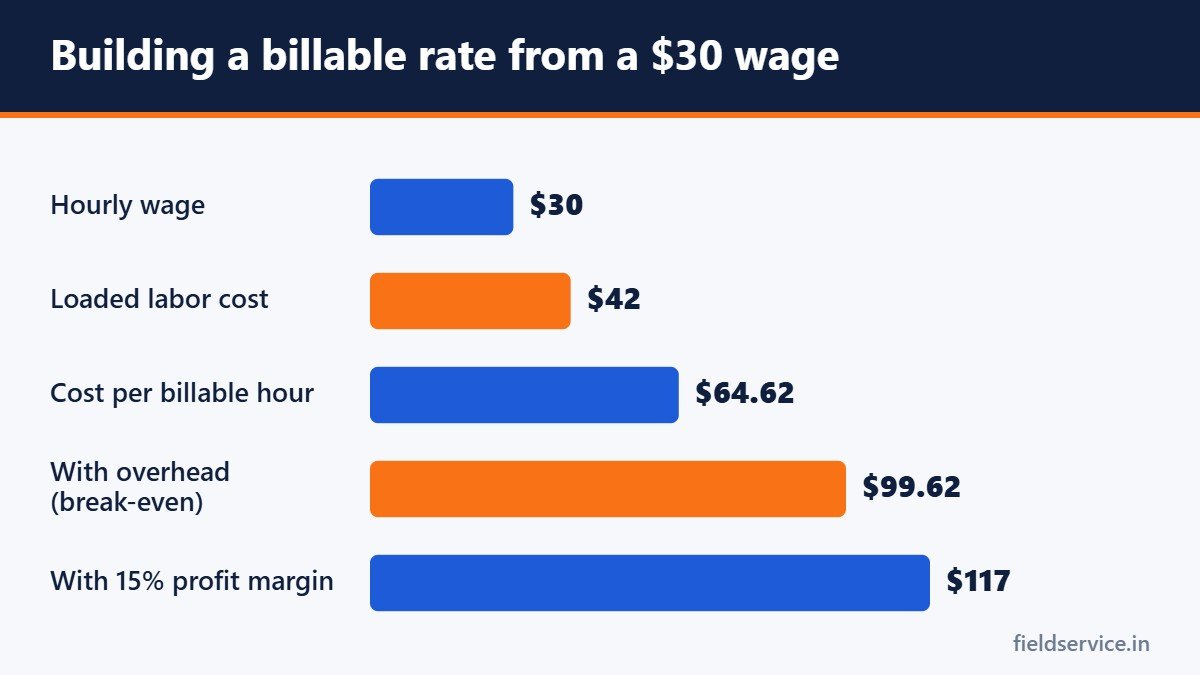
Of that $117, about $17.50 is profit. The rest pays the technician, the unbilled hours and the cost of running the business.
What moves the number most
Look at the steps again. The biggest jump is from loaded cost to cost per billable hour, and it is driven by utilization. If the same technician billed 30 hours a week, the labor cost per billable hour would fall from $64.62 to $56. That is why owners watch technician utilization so closely. The billable utilization calculator shows revenue per paid hour for your own figures.
What this means for technicians
- Your value to the business rises with every billable hour you add and every callback you avoid.
- When you ask for a raise, numbers such as your billable hours, average ticket and callback rate make a stronger case than time served.
- If you plan to go out on your own, do this calculation before you set a price. Charging slightly more than your old wage is the most common way new one-truck businesses fail.
What this means for owners
- Recalculate the rate whenever wages, insurance or fuel change.
- Use the real billable hours from last quarter, not the hours you hope for.
- If the market will not bear your break-even rate, the answer is in utilization or overhead, since the arithmetic will not change.
For pricing a single call from these inputs, see how to price a service call.
Related guides
- Commission vs. Hourly Pay for Service Technicians
- IRS Mileage Rate 2026: What Field Technicians Need to Know After the July Increase
- Flat Rate vs. Time and Materials: Which Pricing Model Fits Your Service Business?
Three Excel workbooks that take you from what a technician costs to what to charge, then show whether each job made money.
Not sure yet? Try two forms free or see all packs.